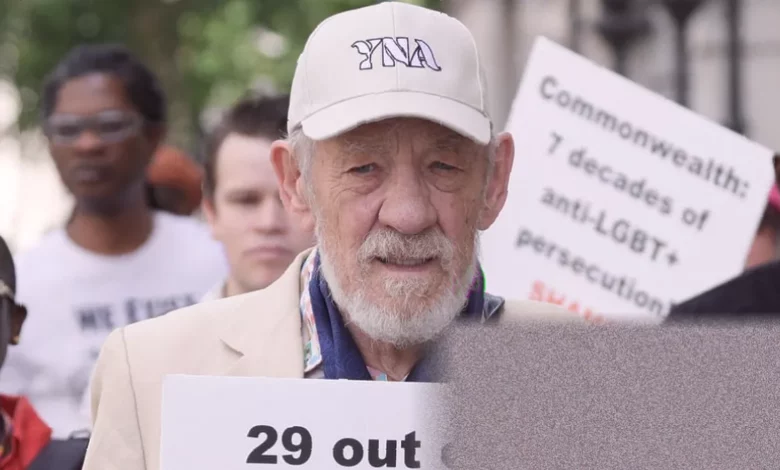
Sir Ian McKellen has marched through central London against the criminalisation of LGBTQ+ people in Commonwealth nations, describing the situation as “appalling”. The actor and long-time activist joined protesters on Saturday for the “Commonwealth Walk of Shame”, an event organised by the Peter Tatchell Foundation and the Out and Proud African LGBTI Network (OPAL). The demonstration highlighted that 29 of the Commonwealth’s 56 member states still outlaw consensual same-sex intimacy — meaning more than half of all Commonwealth countries retain criminal penalties for homosexual acts.
McKellen’s call for justice
Addressing the crowd before the march, McKellen, who co-founded Stonewall UK in 1988 and came out the same year in response to Section 28, said the demonstration was “not about hatred” but about “a love of justice, a love of equality”. He told PA Media: “When Britain had an empire, it introduced into countries far away from here the laws that we had in this country, including the laws against gay people.” He noted that those laws have since been repealed in the UK, where “gay people live freely and openly”, but remain “stuck in the remnants of the British empire now known as the Commonwealth”. Half of the Commonwealth, he said, “stick with those old laws”.
The march began outside the Nigerian high commission and proceeded to the diplomatic missions of Uganda, Papua New Guinea, Trinidad and Tobago, Ghana, Jamaica, Bangladesh and Sri Lanka — all countries where same-sex relationships are criminalised.
The colonial roots of criminalisation
The legal framework behind these prohibitions is a direct legacy of British colonial rule. British administrators imposed laws such as Section 377 of the Indian Penal Code, enacted in 1860, which criminalised male-male sexual relations as “unnatural offences”. These statutes were exported across the empire and, after independence, were often retained in postcolonial criminal codes. In many cases the laws did not reflect indigenous cultural values; a key rationale cited by historians was the desire to “protect white soldiers and settlers from being ‘corrupted’ by indigenous peoples”. Research shows that British colonies were 22 times more likely than other countries to have laws criminalising homosexual conduct.
The continuing impact of this inheritance is severe. Penalties vary widely: Jamaica imposes up to ten years’ imprisonment with hard labour; Kenya up to 14 years; Malaysia up to 20 years plus flogging. In nations including Bangladesh, Barbados, Guyana, Pakistan, Sierra Leone, Tanzania and Uganda, a conviction can carry life imprisonment. In Brunei and twelve northern Nigerian states that apply Shari’a law, male homosexuality can be punished by death. Uganda’s Anti-Homosexuality Act 2023 prescribes the death penalty for “aggravated homosexuality”, which includes acts such as transmitting HIV through same-sex relations, rape and serial offending. The Ugandan Constitutional Court upheld that law in April 2024, ruling it had been legally passed and did not violate the constitution. In July 2022, three men were sentenced to death by stoning in Bauchi state, Nigeria, for homosexual acts.
Those laws, the organisers note, expose millions of LGBTQ+ Commonwealth citizens to arrest, imprisonment, mob violence and discrimination in employment, housing, education and healthcare.
Hopes for change and the silence of the Commonwealth
McKellen said he hoped the march, though not a “huge” event, would ensure “word will get back” to people living in fear. “This is a heartfelt demonstration and I hope word will get back to people who are some of them living in hiding because they’re frightened of the laws of the land and treatment by fellow citizens,” he said. “It’s an appalling situation, and any little bit that we can do to show support I think will be appreciated.”
The actor also pointed to a broader institutional failure. The Commonwealth Charter pledges equality, yet LGBTQ+ rights have historically been excluded from the agenda of Commonwealth Heads of Government Meetings (CHOGM). For more than 30 years, Peter Tatchell has lobbied for these issues to be discussed at CHOGM with limited success. “Perhaps they could show a little bit more interest in actually what the Commonwealth does and what it doesn’t do,” McKellen added. “One thing it doesn’t do is ever discuss this problem. It’s never on the agenda, and perhaps events like this will just nudge politicians into talking about something which is of such concern.”
The UK government has acknowledged its role in introducing homophobic colonial-era legislation. In 2018, then-Prime Minister Theresa May expressed regret for Britain’s legacy of anti-gay laws and offered support for legislative reforms. King Charles III, as Head of the Commonwealth, has been criticised by activists for not publicly speaking out on LGBTQ+ rights, though he dedicated Britain’s first national memorial to LGBTQ+ troops, marking the end of the military’s ban on homosexuality.
Demonstrators held signs calling on the King to “apologise for previous monarchs” and highlighting “75 years” of homophobic persecution. McKellen told the crowd that much of the anti-LGBTQ+ hatred seen across Africa and Asia was “exported there” by “cruel” colonial laws. The march concluded after visiting the listed high commissions, with organisers vowing to keep the pressure on Commonwealth leaders to fulfil the organisation’s own promises of equality.