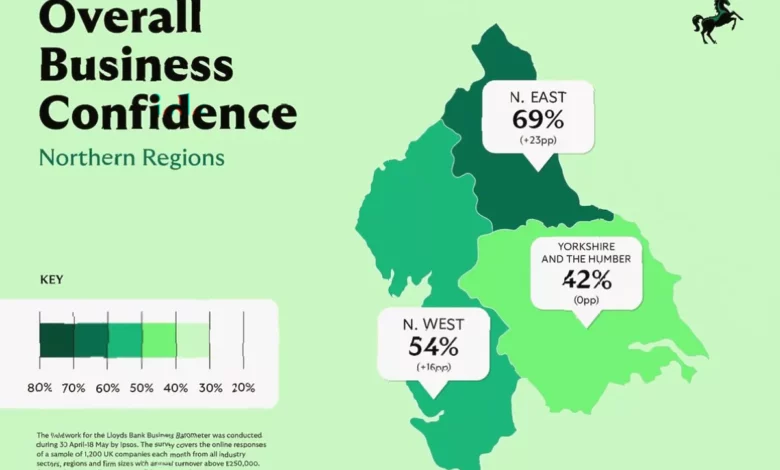
More than half of businesses in the North West are planning to expand their workforce over the next year, according to the latest Lloyds Business Barometer, as the region’s firms head into the summer with markedly improved confidence. The bank’s survey recorded a 16-point jump in regional confidence during May to 54%, driven by stronger customer demand and a brighter economic outlook.
North West confidence climbs
The barometer, which measures sentiment among businesses, found that North West firms were notably more optimistic about their own trading prospects, with the sub-index rising 10 points to 67%. Lloyds attributed the uplift to improved customer demand. Confidence in the wider economy rose even more sharply, by 23 points, to 42%. The hiring intention was particularly striking: 52% of companies in the region said they hoped to increase staff levels over the next 12 months, an 18-point increase on the previous month. The region’s average confidence over the past year stood at 48%, with a high of 58% recorded in February and a low of 27% in September.
Chris Whittle, Lloyds’ area director for the North West, said: “Businesses are heading into the summer with increased confidence during what is expected to be a busy time of year with the ambition to hire and help create new job opportunities for people across the North West.”
The bank’s survey also asked firms about their investment priorities for the next six months. Top of the list were introducing new technology, such as artificial intelligence or automation; investing in their teams through training; and entering new markets. This focus on technology adoption mirrors a national trend: the British Chambers of Commerce estimates that 54% of UK firms are now actively using AI in 2026, up from 35% a year earlier, though adoption remains uneven with smaller businesses and consumer-facing sectors lagging behind. The vast majority of SMEs — 95% — report that AI has had no impact on their workforce size over the past year, and the technology is currently used more to support employees than replace them. However, attention is increasingly turning to “agentic AI” capable of performing multi-step tasks, with many firms moving from prototypes to live workflows.
National picture mixed
Across the UK, business confidence rose by three points to 47% in May, Lloyds said. The increase was felt in seven of the UK’s nations and regions, with the North East and the West Midlands reporting the highest levels. Confidence was static in Yorkshire and the Humber, and fell in Wales, the South West, London and the South East. Nationally, 66% of businesses expected stronger output over the year ahead, while 8% predicted weaker activity, citing ongoing economic uncertainty and cost pressures.
Amanda Murphy, chief executive of Lloyds Business and Commercial Banking, said: “Business confidence edged up modestly in May, suggesting firms are beginning to steady after April’s decline. This month, confidence levels from businesses in the North East particularly stands out. It’s also reassuring to see that increased confidence from the construction sector has brought them more in line with their retail, services and manufacturing counterparts.”
The Lloyds headline sits alongside other indicators painting a more complex picture. The S&P Global Flash UK PMI Composite Output Index fell to 48.5 in May, signalling the first contraction in private sector output since April 2025, driven largely by a sharp downturn in consumer‑facing services. Sentiment among those businesses dropped to its lowest since February 2025, with profits falling sharply and firms scaling back investment and headcount. In contrast, the manufacturing sector showed resilience: its PMI held steady at 53.7, matching the highest reading since May 2022, with production growth accelerating. Manufacturers nonetheless face headwinds from rising input costs, material price inflation, supply chain disruption and labour shortages, and 74% report a desire to scale up domestic production if feasible.
Consumer confidence in the UK edged up slightly to −23 in May from −25, defying market expectations, but high prices remain a persistent worry. More than 80% of consumers expect food and energy costs to rise further. The ongoing conflict in the Middle East continues to weigh on business sentiment, and Lloyds Bank’s own forecast reflects what it describes as potential “stagflationary consequences” for the global and UK economies, with UK GDP growth revised to 0.5% for 2026. EY has similarly slashed its UK growth forecast to 0.8%, citing disrupted energy supplies. On the ground, rising energy prices are pushing inflation higher and complicating expectations for interest rate cuts, while input cost inflation remains steep because of fuel surcharges, raw material prices and wage pressures. Labour costs and turnover are now the dominant pressures for nearly three‑quarters of UK companies.
Regional investment strategies take shape
Despite the headwinds, Lloyds pointed to distinctive growth drivers in different parts of the country. The North East, which recorded the highest confidence in May, is positioning itself as a clean‑energy hub. Plans aim to grow the region’s renewables workforce to 50,000 by 2035 and attract £3bn in private investment, anchored by major projects such as the Dogger Bank wind farms. The Port of Tyne’s £150m Tyne Clean Energy Park proposal alone is expected to create 12,000 jobs.
In the West Midlands, a major initiative called Project MADE targets turning the region into a global advanced manufacturing supercluster by 2035, aiming for £44bn in annual output and 50,000 new jobs, underpinned by 15,000 workers trained in AI and automation skills. The sector already contributes £10.4bn to the regional economy and supports 11.3% of local jobs. Capital investment in the West Midlands rose by 1.4% in the year to the first quarter of 2026, while research‑and‑development budgets saw a sharper uplift of 2.5%.
Scotland’s tourism and hospitality sector was also singled out as a driver of regional growth. Meanwhile, retail nationally is struggling: price growth slowed to 28% in May, its weakest pace in over a year, and retail sentiment remains negative, with businesses expecting further deterioration and weaker hiring and investment plans. On the investment front, UK business investment rose by 0.7% in the first quarter of 2026, though it remains 1.8% below the level seen in the same quarter of 2025. Small and medium‑sized enterprises are cutting borrowing, while larger firms are increasing longer‑term debt, pointing to divergent resilience strategies depending on company size.