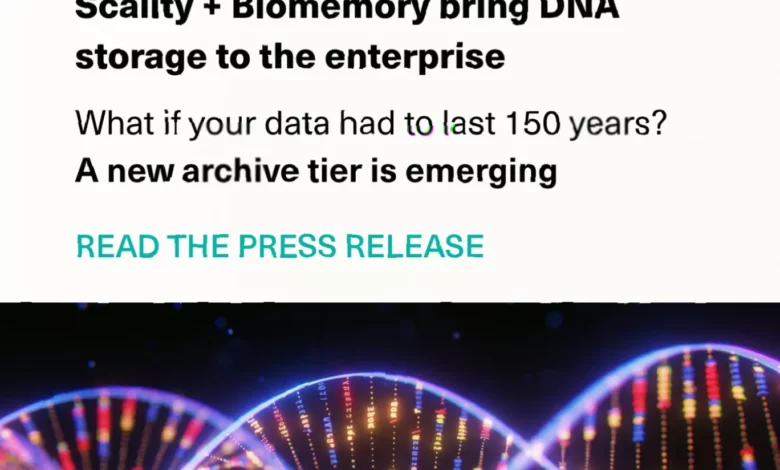
Scality, the data infrastructure software company, has announced a strategic partnership with Biomemory, a French pioneer in industrial-grade DNA-based data storage, to bring the technology into mainstream enterprise environments as a viable cold archive tier. The collaboration will see the two companies integrate DNA storage into Scality’s object storage platform, positioning it alongside existing flash, disk and tape infrastructure rather than replacing them.
DNA storage: extreme longevity and minimal operational demands
DNA data storage is transitioning from a laboratory curiosity to a commercial archival solution optimised for what the industry calls “keep forever, read rarely” scenarios. The core value proposition is extreme longevity combined with near-zero operational demands. Under the right conditions, DNA can remain stable for thousands of years, and Biomemory’s solutions are engineered to guarantee data retention and readability for up to 150 years. The storage medium requires near-zero media refresh and consumes zero power at rest, offering a dramatically reduced carbon footprint compared with traditional archival technologies such as magnetic tape or hard disk drives.
The density of DNA as a storage medium is immense: an estimated 215 million gigabytes of data can be stored in a single gram of synthesised DNA fragments. Biomemory uses synthetic biology to produce bio-sourced, bio-compatible DNA that remains stable at ambient temperatures with no energy input. The technology is built for data that must endure over multi-decade timeframes, where loss, corruption or unreadability could carry severe financial, legal, operational or societal consequences. Key applications include national archives, scientific and genomic data repositories, media and entertainment preservation, regulated financial and healthcare records, and sovereign or defense workloads.
Biomemory was founded in 2021, drawing on extensive research from Sorbonne University and CNRS French national labs. In March 2026, it acquired the assets of Catalog Technologies, a US-based pioneer in DNA data storage and computing. That acquisition integrates enzymatic bio-secure DNA block assembly with scalable high-speed printing, high-throughput reading, and a low error rate. It also brought a significant patent portfolio and established a flagship office in Boston, Massachusetts, which serves as a US research and development and production hub. Biomemory intends to launch its first commercial solutions leveraging the Catalog acquisition in the second half of 2026, and plans to build and operate its own data centres for customer use as a service by 2027, a timeline accelerated by the acquisition.
Integration and strategic logic
The partnership brings together Scality’s software-defined S3 object storage platform, built to span and optimise across multiple storage media types, with Biomemory’s data centre-oriented DNA storage systems, which are designed with enterprise-grade metrics and a modular architecture. The collaboration will focus on integrating DNA storage as a new, ultra-secure cold archive tier within Scality-managed environments, including Scality ADI (Autonomous Data Infrastructure), a platform launched in May 2026 that combines a distributed object foundation with autonomous operational capabilities, software-defined media flexibility, built-in cyber resilience, and extreme performance at multi-petabyte to exabyte scale.
The strategic logic of the partnership is to extend existing capabilities in long-term data archive policy management, intelligent tiering, and secure, cyber-resilient chain of custody. Scality will serve as a massive-scale control plane around Biomemory’s DNA storage as the technology matures, enhancing the company’s CORE5 cyber-resilience framework — a five-layer defence model that protects critical data from ransomware, malicious access, and infrastructure failures. Scality’s platforms, including RING and ARTESCA (which includes CORE5 capabilities), are already deployed in the world’s most demanding enterprise, government and service-provider environments.
Jerome Lecat, CEO of Scality and a member of Biomemory’s board of directors, said: “The future of data storage is not a single medium; it is a spectrum of storage qualities, each optimised for the demands of the data it holds. DNA storage represents the logical culmination of that spectrum: a cold archive tier with density, secure immutability, and longevity that no conventional medium can approach. Our partnership with Biomemory is a strategic investment in owning that future.”
Erfan Arwani, CEO of Biomemory, added: “Biomemory is building DNA storage with enterprise scale and enterprise expectations. Not as a laboratory curiosity, but as a modular, data centre-ready archival system. To realise that vision, we work with software partners who understand the full stack: how data moves, how policies are enforced, how resilience is maintained across tiers, and how enterprises actually manage the lifecycle of their most valuable assets. Scality is the ideal partner for that challenge.”
The integration roadmap will be developed jointly by both companies in the coming months. The recent acquisition of assets from DNA pioneer Catalog Technologies strengthens Biomemory’s foundation and accelerates its market readiness.