Ex-Isar Aerospace and Volocopter chiefs net €5.7m to tackle enterprise AI delivery issues

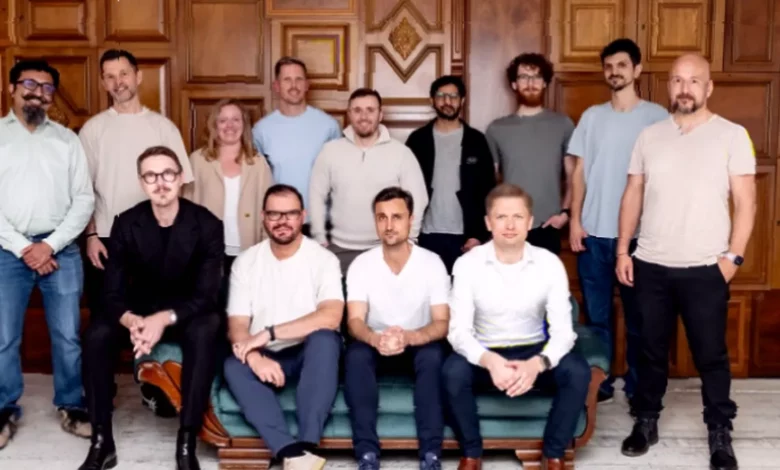
INXM, a Berlin-based startup founded in 2025, has secured €5.7 million in pre-seed funding led by Cherry Ventures, with participation from Redstone, Angel Invest, and Linden Capital, to build what it calls the first AI Process Execution Engine for enterprise operations. The company, headquartered in Schönefeld and currently employing six people, will use the capital to support the commercial rollout of its flagship product, Orchestrator, and deepen development of its core technology platform.
The funding and the investors
The pre-seed round, announced on 3 June 2026, is co-led by Cherry Ventures and Redstone, with additional backing from Angel Invest, Linden Capital, and several business angels. According to Cherry Ventures Founding Partner Filip Dames, “Enterprise AI is stuck in a paradox: the more ambitious the deployment, the less predictable the outcome. INXM has reframed the problem entirely. It’s not about making AI smarter, but making it executable. Compiled AI is a new architectural paradigm, and INXM is the team to define it.” Redstone Founding Partner Michael Brehm added that founders who have brought rocket engines and air taxis to production readiness “understand that AI workflow challenges almost always trace back not only to the models themselves, but to brittle integration with day-to-day operations.” Angel Invest Founding Partner Jens Lapinski noted that enterprises “need AI that can execute governed, repeatable processes across the systems they already use,” describing INXM as “building the orchestration layer that makes this possible.”
The problem: AI that plans but cannot execute
Enterprises have spent billions on artificial intelligence. Most of that spending, however, has produced dashboards, copilots, and pilot projects rather than reliable, production-grade workflows. The gap between an AI system generating a plan and an enterprise consistently executing that plan in a repeatable, auditable manner is the problem INXM was built to address. The company’s founders argue that enterprise AI projects routinely fail because of years-long implementation cycles, armies of engineers, and systems that introduce more disruption than stability. “We founded INXM because we’ve seen first-hand how enterprise AI projects fail: years of implementation, armies of engineers, and AI systems that break more than they fix,” said Alex Oelling, CEO and co-founder. “We have set out to build AI that finishes the work for you — the system that turns AI from a productivity tool into the operational backbone of European industry.”
Compiled AI: How INXM’s approach differs
At the centre of INXM’s offering is Orchestrator, a platform built around what the company terms “Compiled AI.” This architectural principle marks a clear departure from the agent-based models that dominate much of today’s AI investment. Rather than allowing a large language model (LLM) to make real-time decisions at every step of an operational process, Compiled AI uses LLMs during a design phase to generate deterministic, enterprise-ready code. That code is then executed without further model invocation, ensuring that outcomes remain repeatable, auditable, and compliant with enterprise governance requirements.
According to Matthias Kainer, co-founder and CTO, “At its core, Compiled AI means you use LLMs to generate deterministic, enterprise-ready code. You then run the code to achieve your outcome. This gives you the flexibility of natural language from AI models, but the testability of deterministic code.” The approach trades the runtime flexibility of autonomous AI agents for predictability, auditability, and significantly reduced token consumption and cost. It also lowers security exposure by limiting the model’s access during execution. For enterprises in high-stakes environments, this trade-off is critical: they cannot afford unpredictable outcomes in production.
Orchestrator turns user intent into executable “Plans” that coordinate work across systems, people, and processes. The platform integrates with existing ERP, MES, PLM, and quality management systems rather than replacing them, targeting industrial manufacturers, aerospace companies, and logistics operators who require deterministic, auditable results. INXM aims to automate processes within months rather than years.
The founders and their background
INXM was founded in 2025 by Alex Oelling (CEO), Matthias Kainer (CTO), Jesper Bylund, and Kamil Klüber. Oelling previously served as Chief Digital Officer at both Isar Aerospace and Volocopter, joining Isar Aerospace on 1 January 2023 to oversee future-proof digital solutions and IT architecture. He also initiated VoloIQ, a digital backend for airlines, and founded the property tech digitalisation firm Sensorberg. Kainer worked alongside Oelling at both aerospace companies, building mission control systems, launch orchestration, and cloud-native replacements for legacy operational platforms. Bylund and Klüber bring experience from n8n and Thoughtworks, rounding out a team that understands both the software automation and enterprise integration challenges that industrial operators face.
Competitive landscape and market positioning
INXM enters a market where several well-capitalised players are building adjacent infrastructure. n8n, the Berlin-based workflow automation platform, raised $180 million in a Series C in October 2025 at a $2.5 billion valuation and later received a strategic investment from SAP that pushed its valuation to $5.2 billion, making it one of Germany’s most valuable AI companies. n8n focuses on connecting applications through visual workflow automation; INXM targets deterministic execution with enterprise-grade governance, placing the two in adjacent rather than identical territory.
Parloa, another Berlin-based company, raised $350 million in a Series D in January 2026 at a $3 billion valuation, tripling in value in under eight months. Parloa operates primarily in contact centre automation, not industrial operations. LangChain raised $125 million in a Series B led by IVP at a $1.25 billion valuation in October 2025, bringing its total funding to $260 million across four rounds. LangChain provides foundational developer infrastructure for AI applications and agents, but targets developers building new systems, whereas INXM targets operational teams managing existing ones.
What differentiates INXM is its emphasis on industrial environments and compliance-first, deterministic execution. In sectors where the consequences of unpredictable outcomes are measured in operational risk and not inconvenience, enterprises remain reluctant to hand control to autonomous AI systems. INXM’s approach — using AI to design execution plans that then run deterministically — directly addresses that reluctance, positioning the startup to serve a market that demands reliability over experimentation.