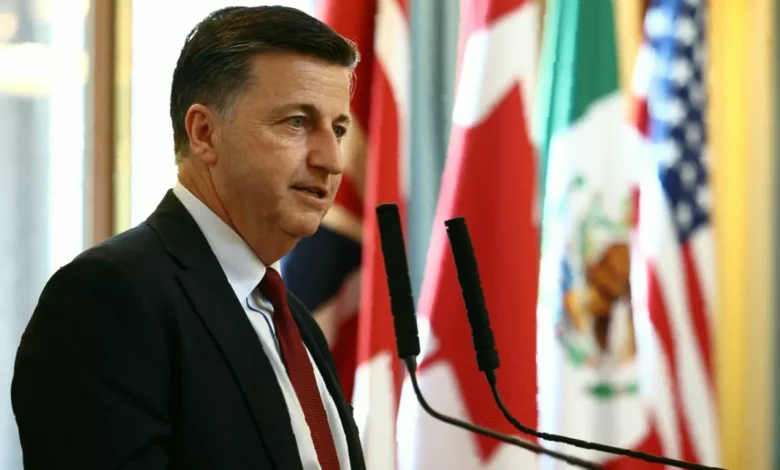
Newly released messages reveal that Douglas Alexander privately welcomed Peter Mandelson’s appointment as the Labour government’s ambassador to the United States, telling the peer it was “good news for you, for the government and for the country” – a stark contrast to the Scottish Secretary’s public assertion that Mandelson “should not have been appointed”. The disclosure has been put before Sir Laurie Magnus, the Prime Minister’s independent adviser on ministers’ interests, in a formal letter from the Scottish National Party demanding an investigation into whether Alexander breached the ministerial code.
Private congratulations
The messages, obtained from a batch of documents released in recent weeks, show that Alexander sent a personal note to Mandelson immediately after the ambassador’s appointment was announced in 2025. Congratulating his longtime political ally, Alexander described the move as beneficial for Mandelson, the government and the country. The correspondence, written while Alexander was a Labour MP awaiting a cabinet post, reveals a relationship that the SNP claims goes far beyond casual acquaintance. According to the documents, Mandelson helped Alexander secure selection as the Labour candidate for Lothian East, advised on the Scottish Labour Party’s election campaign, and set up meetings with his business clients. Alexander reportedly thanked Mandelson for being “influential” in his “whole improbable journey”.
The messages also indicate that Mandelson introduced Alexander to contacts at Global Counsel, the lobbying firm Mandelson founded. An email from Alexander’s time as a trade minister shows him thanking Mandelson for that introduction. Global Counsel, documents reveal, sought work with entities linked to the Russian and Chinese governments, including the Russian state investment firm Rusnano and the state-owned China International Capital Corporation. SNP MSP Alex Kerr has raised national security concerns, stating that Mandelson was “putting Douglas Alexander in a room with unknown individuals”.
Watchdog letter
The SNP’s letter to Sir Laurie Magnus centres on whether Alexander breached the ministerial code by failing to declare the meeting with Global Counsel contacts for approximately eighteen months. The meeting took place in summer 2024, but Alexander only registered it in March 2026 – a delay the SNP calls “appalling judgment” that brings “shame on Scotland”. Sir Laurie, appointed as the Prime Minister’s independent adviser on ministers’ interests in December 2022, is responsible for investigating potential breaches of the code. He has previously conducted inquiries into cases such as Nadhim Zahawi’s tax affairs. The letter explicitly contrasts Alexander’s private welcome of Mandelson’s appointment with his public position last month, when he claimed the peer “should not have been appointed”. The SNP argues this contradiction raises questions about Alexander’s candour and his adherence to the standards expected of a minister.
Contradiction under scrutiny
The gap between Alexander’s public and private statements warrants deeper examination. While the Scottish Secretary now says Mandelson should never have been given the Washington post, his private messages show he saw the appointment as good news for the country. The documents reveal that Alexander was deeply enmeshed in Mandelson’s network – receiving help with his selection as a candidate, advice on the Scottish campaign, and introductions to lobbying clients – yet publicly distanced himself from the peer after Mandelson’s sacking in September 2025. Mandelson was dismissed as US ambassador following revelations about his relationship with convicted sex offender Jeffrey Epstein. Files released by the US Department of Justice indicated that Mandelson’s connection with Epstein extended beyond what he had previously disclosed, with allegations that he may have leaked sensitive government information to Epstein in 2009.
Before taking up the post, Mandelson had failed security vetting in January 2025, but the Foreign Office overruled the recommendation from UK Security Vetting. No records exist of measures taken to mitigate serious security concerns, despite flags raised about his associations with foreign state figures. The same released documents also contain internal government criticism, with messages between Mandelson and senior ministers describing Starmer’s government as “pathetic”, “disappointing” and “beleaguered”.
The contradiction is not limited to Alexander’s position on Mandelson. While publicly aligning with the government, Alexander admitted to Mandelson in private that “there’s v little enthusiasm for Labour” in Scotland – a comment that sits awkwardly with his role as the Cabinet’s voice for Scotland. The Scottish Secretary’s responsibilities include industrial strategy, energy policy, child poverty and constitutional matters, and he represents Scotland on non-devolved issues. Yet the messages show him confiding in a man who, at the time, was a controversial figure with links to foreign state interests and a failed vetting process.
The SNP has called for Mandelson to lose his peerage and repay a £75,000 taxpayer-funded payout he reportedly received after being dismissed as ambassador. Its Westminster leader, Dave Doogan, has accused Alexander of showing “appalling judgment” and bringing “shame on Scotland”. The timing of Alexander’s declaration – March 2026 for a meeting that occurred in summer 2024 – remains a central point of contention. The SNP wants Sir Laurie Magnus to determine whether this delay constitutes a breach of the ministerial code, which requires ministers to be open and transparent about their dealings. The watchdog’s remit is confined to ministers’ conduct during their time in office, meaning Alexander’s actions as a minister since September 2025 are squarely in scope.