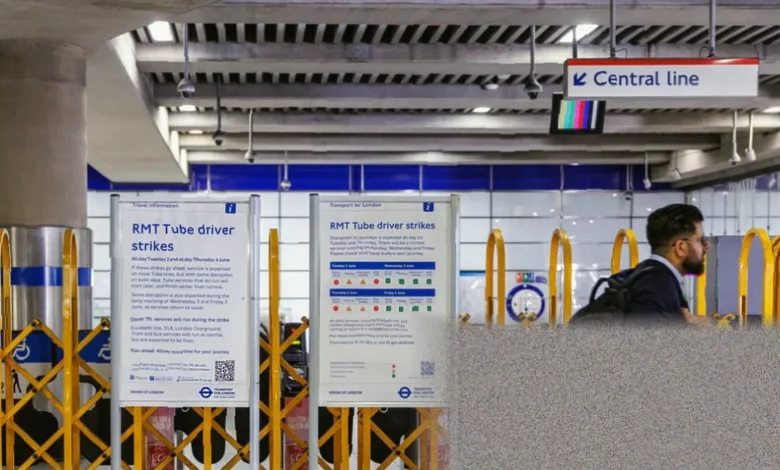
Another London Underground strike is set to go ahead on Thursday, the second 24-hour stoppage this week, as the RMT union confirmed its members will walk out in a dispute over the introduction of a four-day working week. Transport for London (TfL) has urged the union to call off the action, warning passengers to check before they travel and expect little or no service on several key lines.
Thursday’s strike, running from 00:01 to 23:59, follows Tuesday’s stoppage, which was marked by higher-than-expected driver turnout. TfL said 60% of drivers worked on Tuesday, a figure that suggests many RMT members did not take part. As a result, the network stayed largely open. Oyster and contactless card taps fell by only about 10% across the day, while Tube journeys were down 41%. The Jubilee line ran almost 90% of its normally scheduled kilometres. Passenger numbers were significantly higher on buses, the London Overground and the Elizabeth line, TfL said. Services returned to normal on Wednesday morning with no residual impact.
On Thursday, no service is expected on the Circle line, the Piccadilly line (including to Heathrow Airport), the Metropolitan line between Baker Street and Aldgate, and the Central line between White City and Liverpool Street. Other Tube lines will start later and finish earlier with less frequent services than usual. The Elizabeth line, London Overground, national rail and DLR services will run as normal, but are expected to be significantly busier. Buses will operate but are likely to be crowded and slowed by increased road congestion. TfL advised passengers to allow extra time for journeys and to complete travel before 9pm.
The dispute over the four-day week
At the heart of the conflict is TfL’s proposal to introduce a voluntary four-day working week for Tube drivers, with no reduction in pay. TfL said the plan is intended to improve work-life balance and service reliability. The four-day week is currently being trialled on the Bakerloo line. Drivers who do not wish to adopt the new pattern can remain on a five-day week, TfL has stressed.
The RMT union opposes the proposal, arguing that it effectively compresses five days of work into four longer shifts. The union has raised serious concerns about increased fatigue, reduced flexibility, longer shift lengths and the potential impact on safety in what it describes as a “safety-critical role”. The RMT has accused TfL of trying to force through working changes without meaningful negotiation, a claim TfL denies. The RMT has also instructed its members not to use company-issued electronic devices, including iPads, since March 21 this year.
The rival Aslef union, which represents just over half of Tube drivers, has welcomed and accepted the four-day week proposals. Aslef said the voluntary change would give drivers an extra 35 days off per year. One Aslef spokesperson described the RMT-led strikes as unusual, saying it was “the first strike in the history of the trade union movement designed to stop people having a shorter working week and more time off”.
Negotiations between the RMT and TfL at the Advisory, Conciliation and Arbitration Service (Acas) ended without resolution on Monday. No further talks have taken place since. TfL’s chief operating officer, Claire Mann, said the proposals are designed to improve work-life balance and service reliability. A TfL spokesperson said: “We continue to urge the RMT to work with us to resolve their questions on the proposed four-day week.”
The RMT declined to comment. It has not scheduled any further strikes on the Underground. Talks between the union and TfL are expected next week.