Policing risks being driven back to the 1960s if baseless claims that officers are biased against white people are allowed to take hold, the leader of Britain’s black officers has warned. Ch Insp Andy George, president of the National Black Police Association, said bogus allegations from politicians such as Nigel Farage and far-right activists that forces operate “two-tier policing” could set back decades of work to tackle systemic, longstanding prejudice against black people. “There is a danger of policing going back to a time long before Stephen Lawrence’s murder, to the 1960s and 1970s, because of the attacks from the far right which have been growing over the past few years, and which are becoming more mainstream,” he told the Guardian.
George’s warning comes amid a fierce national debate triggered by the murder of 18-year-old university student Henry Nowak in Southampton last December. Nowak was stabbed five times by Vickrum Digwa, who falsely claimed he had been the victim of a racist attack. Officers arriving at the scene handcuffed the teenager and placed him under arrest, despite him repeatedly telling them he had been stabbed and could not breathe. Bodycam footage captured Nowak saying “I can’t breathe” and that he had been stabbed nine times. He died shortly after being handcuffed. Hampshire’s chief constable, Alexis Boon, has apologised for the way Nowak was arrested and handcuffed, describing the incident as an “absolute tragedy” and a “very difficult watch”. The officers involved are “distraught” and are not currently on frontline duties, being treated as witnesses by the Independent Office for Police Conduct, which is investigating the case.
Digwa was convicted of murder on 28 May 2026 and sentenced to life imprisonment with a minimum term of 21 years. His mother, Kiran Kaur, was convicted of assisting an offender by hiding the murder weapon. The judge rejected Digwa’s accusations that Nowak had physically or racially abused him, stating he had brought shame upon his family, community and religion. The judge noted that Digwa’s actions had “stirred up racial tension in Southampton and across the country which have made many Sikhs worried about their own safety.”
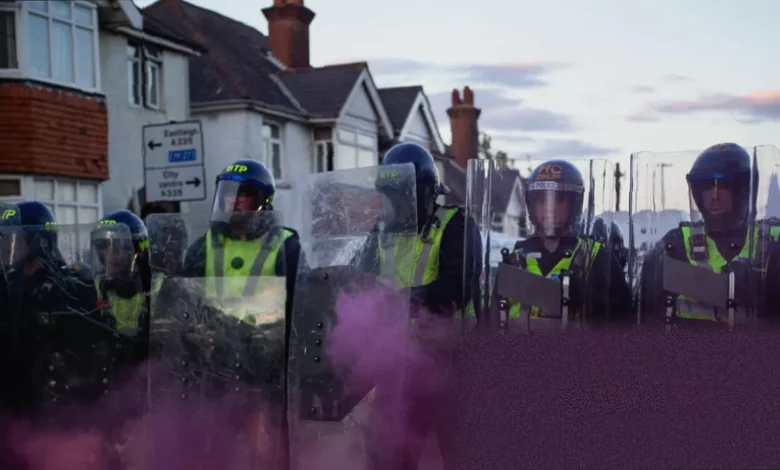
In the wake of the sentencing and the release of the bodycam footage, protests erupted in Southampton. Far-right activist Tommy Robinson, whose real name is Stephen Yaxley-Lennon, and campaigner Laurence Fox were among those who addressed crowds. Robinson claimed Nowak was “murdered by racist police policy’s that target white people” and that “white lives matter too”. Elon Musk shared a post by Robinson on X. The protests saw clashes between demonstrators and police, with missiles including bottles, bricks, and wheelie bins thrown. Eleven police officers and a police dog were injured. Two people were initially arrested for assaulting police and possession of a weapon.
Police chiefs have ordered a nationwide increase in intelligence gathering about potential violence believed to be linked to far-right protests, after the clashes in Southampton. One senior police source told the Guardian that politicians including Farage, Robinson and “some Conservatives” appeared to be trying “to stoke up tensions for political gain” and were “reckless about whether their comments would lead to trouble on the streets”.
Political exploitation of a tragedy
Nigel Farage, the leader of Reform UK, has seized on the Nowak case to claim the UK is “living under two-tier policing”, arguing that “the rights and privileges of white people matter less than those of ethnic minorities”. He called for a response of “pure cold rage” to the incident and claimed an accusation of a racial slur was treated more seriously than an act of murder. Reform UK has said it would pass an “equal treatment bill” to ban police race action plans and end diversity, equity and inclusion practices.
But his intervention has been strongly condemned across the political spectrum. Prime Minister Keir Starmer called Farage’s comments “unforgivable”, saying: “A grieving family have asked us not to respond in the way that the leader of Reform has responded … His response has been to appeal for rage – rage. That’s his response to a father who has lost his son and asked for that not to happen. Exploiting this tragedy to create grievance and division would be wrong in any circumstances, but to do it when the family are expressly saying please don’t is unforgivable. It shows exactly who he is.”
Nowak’s father, Mark, had condemned the “inhumane and degrading” treatment of his son by police. But he added: “We do not want his death to be used to create further division, hatred or tension. We want his story to help make our streets safer for everyone.”
Conservative leader Kemi Badenoch also criticised Farage for “grandstanding” and “reinforcing the difference”, stating, “we are descending into tribalism”. She described Nowak’s death as a “seminal moment for Britain” and warned against divisive rhetoric. Home Secretary Shabana Mahmood rejected the notion that police have different standards for different communities and urged lawmakers not to “allow this murder to turn communities against one another”. In the House of Lords, Doreen Lawrence, who fought police for justice after they failed her murdered son Stephen in 1993, said: “My condolences goes out to Henry Nowak’s family. I think what’s happened with him should never have happened. And the police should be at fault for what happened on that night.”
The argument that false bias claims could undermine anti-racism efforts
Ch Insp Andy George’s central argument is that the false narrative of anti-white bias poses a direct threat to the progress made since the Stephen Lawrence case. The Macpherson Report, published in 1999 after the botched investigation into Stephen Lawrence’s murder, made more than 70 recommendations for reform and found the original police investigation was “marred by a combination of professional incompetence, institutional racism, and a failure of leadership by senior officers”. The National Black Police Association, founded in 1972, has long campaigned for justice and fairness in law enforcement and better relations between police and minority communities. George fears that the current wave of accusations, amplified by politicians and far-right activists, could reverse that progress.
Sir Andy Cooke, who stood down in April as chief inspector of constabulary, told the Guardian he found no evidence of anti-white bias during his five years scrutinising all forces in England and Wales. “Throughout my five years at the inspectorate, I found no evidence at all to support any claim there was an anti-white bias in operational policing,” he said. “At a time when there is disquiet in some communities, this is no time to play politics with community tensions, particularly off the back of such a distressing incident that caused so much pain to the family of Henry Nowak. This should be a period of time where politicians respect the family’s wishes and do not try to exploit such a tragic and painful situation to boost their political fortunes.”
Hampshire’s chief constable Alexis Boon also rejected claims of anti-white bias. “I don’t accept the term of two-tier policing, I don’t recognise it,” he said. He denied that policing is racist, adding: “I do not think policing is racist. There are racist individuals within policing. Of course there are, and there have always been. And we will tackle that and deal with it.” He said some of the criticism directed at Hampshire Constabulary has been “unfair”.
At the same time, government and police are discussing a review of police promises on tackling racial bias against black people, with ministers convinced some of the wording is clumsy and open to attack. The National Police Chiefs’ Council is reviewing anti-racism guidance for officers, which some have blamed for the actions taken in Nowak’s arrest. Reform UK has also called for an end to “police race action plans”.
The fallout has also touched individual officers. Christi Hill, a former police constable of 12 years, was forced to flee to a safe space after she was falsely accused online of being involved in the arrest of Nowak. She criticised social media and AI platforms, including Elon Musk’s Grok, for spreading the false claim, saying she had left the police more than a year before the murder.
In the Portswood area of Southampton, where anti-police protesters clashed with officers, politicians and residents criticised the violence. Satvir Khan, the MP for Southampton Test and the first female Sikh to become a UK government minister, said she needed a security guard when she visited the area because she had received death threats. Community leaders said there had been an increase in hate aimed at Sikh people, with some changing their routines to avoid being targeted and extra police patrols around Sikh buildings.