Chancellor Rachel Reeves’s plan to exempt certain pensioners from income tax from 2027 will benefit only a tiny fraction of Britain’s retirees, according to new analysis from pension specialists LCP. The research, published today, calculates that fewer than one million people – roughly five per cent of the 13.2 million individuals currently drawing a state pension – will qualify for the relief announced in the Budget.
The vast majority of pensioners are locked out of the concession, often because of the way the policy is designed. Anyone receiving the old state pension – the system that applied to people who reached state pension age before April 2016 – is automatically excluded. That group numbers 8.2 million claimants, of whom 7.7 million are on the basic rate of just £9,614 a year, far below the frozen personal allowance of £12,570. A further 6.5 million old-system pensioners also receive additional state pension payments – known as “increments” – and those increments disqualify them, even if their total income is identical to someone on the new state pension who would be protected.
Among the five million pensioners on the new state pension, introduced in 2016, more than four in five are ineligible for various reasons. Around 290,000 live outside the United Kingdom and do not qualify. Roughly one million receive “protected payments” on top of their standard entitlement, which bars them from the exemption. A further 1.1 million have pension rates so low that they will not breach the tax threshold within three years – though the freeze on allowances means that could change. And approximately 1.8 million have other taxable income, such as private pensions, savings interest or investment returns, which also excludes them.
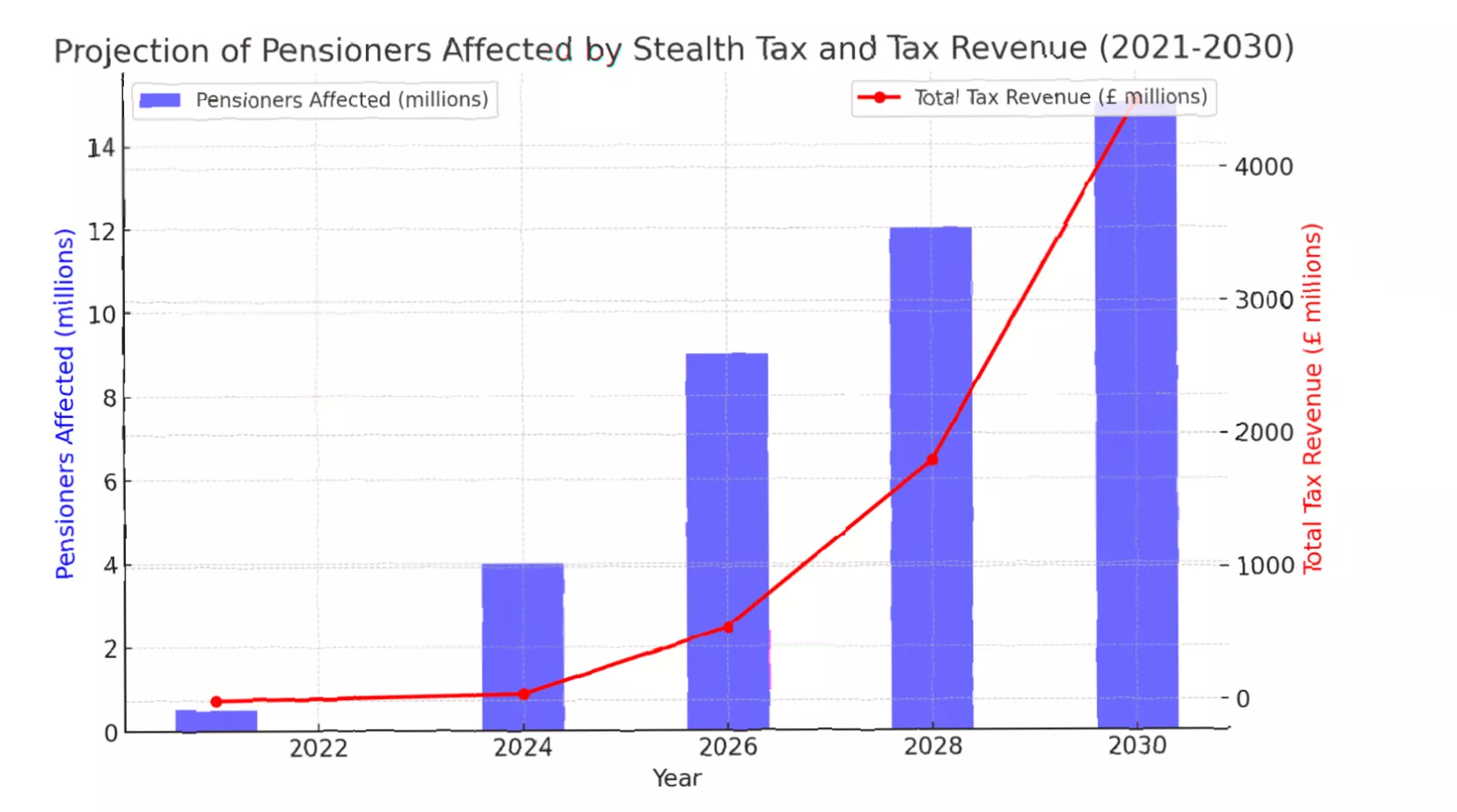
The result is that the exemption applies only to pensioners whose sole income is the basic or new state pension without any increments. HMRC’s director of individuals policy, Cerys McDonald, stated in January 2026 that between 800,000 and one million pensioners already fall into that category. The Institute for Fiscal Studies has warned that by 2027–28, every retiree receiving the full new state pension would be a taxpayer without an exemption, because the full new pension – set at £12,547.60 for 2026–27 – is already just £22.40 below the frozen personal allowance. The triple lock ensures that the state pension will continue to rise each year, while tax thresholds remain frozen until at least 2031, guaranteeing that the two policies will collide repeatedly.
The Government has described the proposed exemption as a way to “ease the administrative burden for pensioners whose sole income is the basic or new state pension without any increments”. HMRC is developing a mechanism to protect those individuals, with new arrangements expected to be operational from April 2027. Fresh primary legislation will be required. But the scheme also creates punishing “cliff edges”, LCP’s analysis shows. Someone with just £1 of additional income loses the entire exemption. That means they must pay tax not only on that pound but also on their state pension – an estimated £88 in 2027–28, rising to £220 by 2029–30. Cashing out a small pension pot could trigger the same disqualification, costing hundreds of pounds in extra tax.
The policy also introduces glaring unfairness between pension systems. A retiree on the old state pension with the same total income as someone on the new state pension will face a tax bill, while the new-system counterpart will have their liability cancelled entirely. Steve Webb, a former pensions minister under the coalition Government and now a partner at LCP, said the approach is “fundamentally problematic”. He added: “Two separate policies – triple lock uprating of the state pension and freezing of tax thresholds – will collide next year. This is politically embarrassing for the Government, but the proposed solution is deeply flawed. It discriminates against those on the old state pension system, even if they have the same income as someone on the new system, and creates unwelcome ‘cliff edges’ for those who have even a pound of other income. It is also clearly a temporary sticking plaster solution for a problem that will have to be addressed at some point.”
Alasdair Mayes, Partner and Head of Pensions Tax at LCP, described the plan as “another example of a seemingly well-intentioned policy announcement adding complexity and unfairness in the tax system”. He said the priority should be “a simple and transparent tax system”. Webb also warned that the scheme risks penalising people who have saved modest amounts in private pensions, while the IFS has noted that frozen thresholds act as a “stealth tax” on pensioners, returning a growing share of state pension increases to the Treasury. Meanwhile, broader changes on the horizon – including the extension of inheritance tax to pensions from April 2027 and new national insurance charges on salary-sacrifice pension contributions from 2029 – add further layers of complexity for retirees and their families.