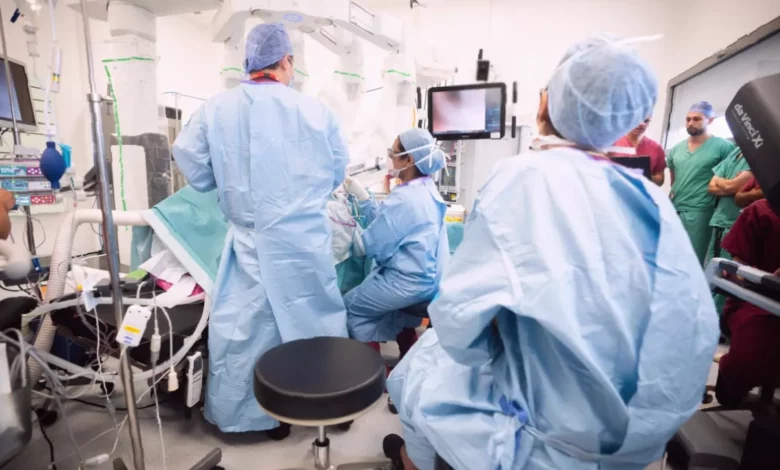
Surgeons performing complex procedures could soon have an AI-driven “extra helping arm” at their side, following the first use of a portable colour-coding system in a UK operating theatre. Consultant surgeon Mr Kapil Sahnan, of St Mark’s National Bowel Hospital, described the tool as a “helping arm” that runs in real time alongside surgery, identifying hidden structures and preventing errors to make operations safer.
The system, called Eureka, is a portable artificial intelligence tool that colour-codes different parts of the human body during live surgical operations. Developed by surgeons in Japan, the AI was trained using thousands of videos of surgical procedures, allowing it to recognise anatomical structures that can be difficult for the human eye to distinguish. On a screen above the patient, connective tissue appears highlighted in turquoise, nerves in green, and other tissues receive distinct colours, giving the surgeon a clear visual map of what lies beneath the surface.
‘Google Maps for surgery’ – how the Eureka system prevents errors
The Eureka system functions as a real-time navigation aid, providing visual cues that help surgeons protect or dissect specific tissues. Mr Sahnan likened it to having a “Google Maps or Waze for surgery”, a layer of AI-driven oversight that flags hidden structures and potential risks mid-procedure. By offering this extra layer of information, the technology is designed to prevent errors that might otherwise go unnoticed — for example, where a nerve or blood vessel is obscured by surrounding tissue. The aim is to enhance both precision and efficiency, making each operation safer without slowing it down.
The tool was used for the first time in the UK on Thursday, 5 June 2026, at St Mark’s, the National Bowel Hospital, which is part of the London North West University Healthcare NHS Trust. The procedure was a bowel resection performed on a patient in her 60s, whose name has not been released. It also marked the first time Eureka had been deployed in surgery anywhere outside Japan. Mr Sahnan stressed that being able to identify hidden structures during the operation “makes everything a lot more safe”.
Broader hope and the road ahead for AI in UK surgery
Mr Sahnan expressed hope that the technology could be widely rolled out within the next couple of years to make surgery safer for everyone. He said work is underway to “genuinely prove that this is going to be advantageous and, more importantly, how we can start rolling it out.” The Eureka system is part of a wider push to integrate artificial intelligence into surgical practice across the NHS. AI-driven robotic-assisted surgeries, such as those using the da Vinci Surgical System, already offer enhanced accuracy and reduced tremors, while companies like Medtronic are investing heavily in AI and robotics for surgery in the UK, establishing hubs in London. AI also holds promise for surgical training through automated performance assessment, adaptive learning platforms and virtual or augmented reality simulations.
Yet the translation of AI into routine UK practice is limited by several significant barriers. Infrastructure varies widely between hospitals, with inconsistent Wi-Fi and mobile data connectivity hampering deployment. Training for AI-assisted surgery is often ad hoc and inequitable, with no consistent national standard for competence. The Medicines and Healthcare Products Regulatory Agency (MHRA) oversees the approval of AI-enabled medical devices under the UK Medical Devices Regulations 2002, and devices are classified by risk — higher-risk tools require more rigorous assessment. While the European Union has introduced a comprehensive AI Act, the UK is adapting existing legislation and issuing guidance instead. Data quality remains a challenge, as high-quality, consistent datasets are needed to train AI models for intricate surgical manoeuvres. Ethical and legal concerns — including patient privacy, data security, algorithmic bias, liability in errors, and informed consent — demand careful consideration, as do costs and the need for surgeons to understand how AI generates its recommendations in order to trust and use the tools effectively.
Physician perspectives reflect both optimism and caution. Many UK doctors are hopeful that AI will reduce administrative burdens and save time, yet concerns persist over the risk of error, liability, de-skilling, model drift, bias and a lack of explainability. A significant majority say they need training in clinical AI tools, but access to such training remains limited. While the use of AI in clinical practice is still relatively low for some areas, generative AI use is increasing. The NHS AI Lab has funded machine learning initiatives, and various trusts are piloting AI technologies, but the technology’s integration into everyday surgery depends on overcoming these entrenched challenges. The Eureka system’s debut at St Mark’s marks a concrete step forward — but the infrastructure, regulation and workforce development needed to make it commonplace are still being built.