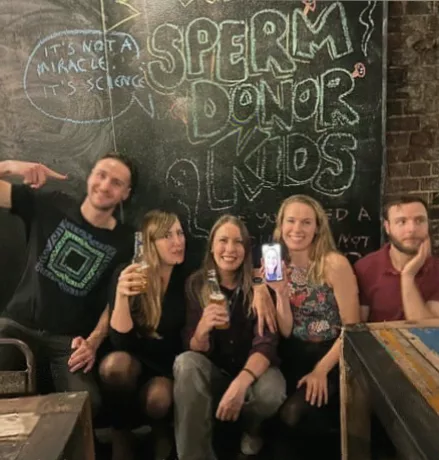
In December 2016, spurred by a Christmas offer from the DNA testing service 23andMe, a young woman sent off a saliva sample hoping to quietly solve a family mystery. The result, which arrived three years later, was a revelation she never expected: a match with a previously unknown half-sister. That single click dismantled the foundation of her identity and exposed a secret her parents had guarded for decades—she and her siblings were conceived using a sperm donor.
The discovery underscores a modern reality for thousands of families. The proliferation of direct-to-consumer genetic testing has rendered old promises of donor anonymity virtually obsolete, forcing a painful reckoning with the past for a generation conceived under a veil of secrecy.
A Family Built on Secrets
The author’s journey towards this revelation was preceded by smaller, unsettling discoveries. As a child, she mistakenly believed a picture of Elvis Presley in her grandmother’s house was a portrait of her father. Years later, she learned that this grandmother was not a blood relation; her father had been adopted, a subject the family did not discuss. This history of curated family lore and quiet omissions fueled her curiosity, a trait she honed in her career as an investigative documentary maker and ghostwriter.
Her parents had pursued fertility treatment in the late 1980s and early 1990s after receiving what her mother described as a “double whammy of bad news”: blocked fallopian tubes and the discovery that her father’s sperm was not viable. The clinic at Nottingham’s Queen’s Medical Centre offered a sperm donor. “They encouraged us not to tell anyone,” her mother said. It was an instruction reflective of its time, when donor conception was often managed with discretion.
This approach had deep roots. Artificial Insemination by Donor was available from the 1940s but was largely unregulated. The landscape only began to change after the groundbreaking birth of the world’s first IVF baby, Louise Brown, in Oldham in 1978, which paved the way for broader assisted reproduction. The subsequent Warnock Report in 1984 led to the Human Fertilisation and Embryology Act 1990, establishing the Human Fertilisation and Embryology Authority (HFEA) as regulator. Crucially, the HFEA’s record-keeping only began in August 1991, two months after the author was born.
The DNA Match That Changed Everything
For years, the author’s 23andMe results showed nothing remarkable—95% British and Irish ancestry, no close relatives. Then, in early 2020, a new match appeared: a woman named Lucy, listed as a half-sister with 27.9% shared DNA. Lucy’s profile stated she was an IVF child, “made” at Nottingham Queen’s Medical Centre, and was looking for her biological father.
Confronted with the match, the author’s mother initially suggested it could be a relative from her adopted father’s side. But subsequent messages from Lucy were definitive: her father was a sperm donor, described as a young medical student, 6ft 3, with green eyes. The author’s mother then delivered the truth in a locked living room, with her father sobbing into his hand. The clinic had chosen the donor; they had never been given details. “We never thought you’d find out,” her mother said. “How were we to know that DNA websites would exist one day?”
The author discovered she was one of triplets, all conceived using the same donor. Her older brother, Tim, was born earlier. The family agreed to keep the revelation from the other siblings, a secret she carried for 1,401 days. “I felt like my life had been trespassed on,” she said.
The Donor Steps Out of Anonymity
The story took another turn when Lucy and her non-identical twin sister, Libby, made contact. Nine months after the author met her new half-sisters, they messaged with stunning news: their sperm donor had joined the same DNA website. He used the pseudonym “Rodney”, taken from the lyrics of The Stranglers’ 1979 song ‘Duchess’. He had been a PhD student at the University of Nottingham when he donated.
Rodney’s emergence was statistically unusual but increasingly common. When he donated in the late 1980s and early 1990s, anonymity was the standard. The law changed on 1 April 2005, removing anonymity for future donations and allowing donor-conceived people to access their donor’s identity at 18. For pre-2005 donations, like Rodney’s, identification relies on the donor voluntarily re-registering with the HFEA or, as happened here, joining a commercial DNA database.
In video calls and emails, Rodney was open. He explained his motivation was a mix of altruism and payment—£10 per donation, which was “a lot then”. He donated two to three times a week for four or five years, sometimes needing to rush his sample to the lab by taxi or bus. “If the bus broke down we’d have to leg it,” he told her. He was part of a group of regular donors who called themselves “Frank’s Wank Bank”.
He also revealed a key detail: his donations began in the month the author’s older brother Tim was born, meaning Tim had a different biological father. The author felt a wave of sadness at this further fracturing of their shared biological narrative.
Coming Full Circle: Becoming a Donor
The personal upheaval, compounded by losing her job and a breakup during the Covid-19 pandemic, led the author to a profound decision: she would donate her own eggs. Partly, she saw it as a “fertility MOT” as she approached 30 with an endometriosis diagnosis. It was also a form of closure, inspired by Rodney’s act. “If I was just washing my eggs down the toilet every month, someone else might as well be using them,” she reasoned.
The process brought the legal and ethical complexities of donation into sharp focus. To donate, she needed a full family medical history from both biological parents, forcing her to contact Rodney for information—a move that felt like a betrayal of her dad. She was paid £750 in expenses and was matched with a single woman in her 40s. Under UK anonymity laws, that was all she was told.
Her mother was faced with a double shock: first, that the anonymous donor was now known, and second, that her daughter was donating her first biological grandchild to a stranger.
Revealing the Truth and the New Normal
In December 2022, the author finally told her siblings. Their reaction was muted—”murmers of surprise” rather than the expected trauma. Tim immediately asked if they all shared the same donor, and was told he likely had a different one. To reinforce their bond, the author gave them coasters made with childhood photos. Tim later insisted they tell their parents they knew, arguing, “It’s best not to have any more secrets.”
The author’s own donation later yielded a result. After applying to the HFEA in 2024 and facing long delays, she contacted the clinic directly. They confirmed that in 2022, her recipient had given birth to a baby girl. “Somewhere out there is a toddler, biologically related to me, but not mine,” she wrote, describing a feeling “between bittersweet and bereft.”
Her story is a single thread in a vast and changing tapestry. Over 70,000 donor-conceived children have been born in the UK since 1991, with numbers more than tripling in the past 13 years, driven by single patients and female same-sex couples seeking treatment. Organisations like the Donor Conception Network now exist to support families navigating these waters, a stark contrast to the era of absolute secrecy her parents inhabited.
The legacy of that era is now colliding with technology. As the Warnock Report that shaped the original law could not have foreseen, direct-to-consumer DNA tests are systematically unpicking old assurances of anonymity. For this family, and countless others, the genetic truth is no longer a sealed record in a clinic file, but a notification that can arrive at any time, with the power to redefine a lifetime of relationships.