A midwife has admitted that an ambulance should have been summoned 90 minutes before the birth of a baby girl who died days after a high-risk home delivery, a coroner’s court has heard.
Sasha Field, the midwife present, stated in a written account that emergency services should have been called when she detected the baby’s heart rate slowing after a contraction. Her statement, read at Barnet Coroner’s Court, aligned with a report by the Healthcare Safety Investigation Branch. In reality, an ambulance was not called by the midwives until 10.37pm on 26 October 2022—two minutes after Poppy Hope Lomas was born and showing no signs of life.
The infant was delivered at her family’s home in Enfield, north London, and died seven days later. Her mother, Gemma Lomas, had previously given birth to her first daughter via caesarean section in 2018.
Mother’s account of being encouraged towards home birth
Gemma Lomas told the inquest she was actively encouraged to attempt a vaginal birth after caesarean (VBAC) at home by Alice Boardman, the head midwife of Edgware Midwives. This was the designated home birth team for Barnet Hospital, which is part of the Royal Free London NHS Foundation Trust. Ms Lomas said she was not made aware of the risks involved and claimed that her complaints of pain from her previous C-section scar were dismissed by the midwives.
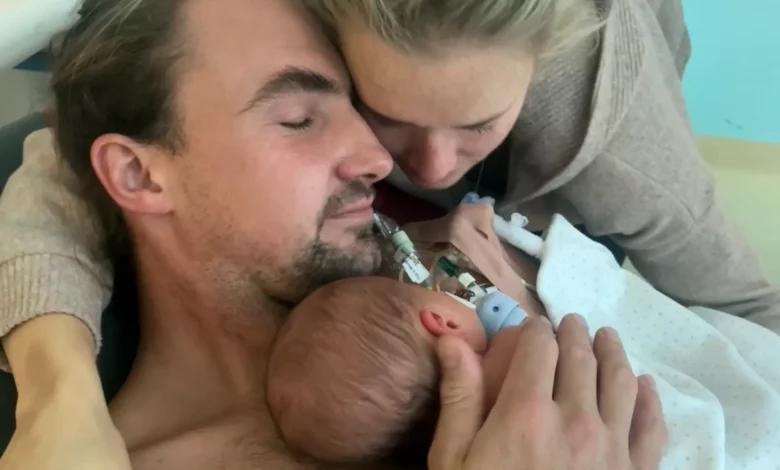
She described the moment after the birth, saying: “Poppy was blue and floppy. There was blood coming out of her mouth and her head fell back. That’s a horrific memory that sticks in my mind, being handed my dead baby.” She also alleged midwives were slow to respond once it was clear her daughter was in distress.
Poppy was transferred to University College Hospital, London, for neonatal care. In a statement, Ms Lomas said the treating consultant neonatologist, Dr Giles Kendall, described Poppy’s brain scan as “one of the worst that he’d seen in his career” and stated the baby had been “starved of oxygen for a long time.” Ms Lomas questioned how this could have occurred if the baby’s heart rate was being properly monitored.
The critical risks of a home VBAC
The case has cast a stark light on the specific dangers of attempting a VBAC outside of a hospital. Guidance from the Royal College of Obstetricians and Gynaecologists is clear: VBACs should be conducted in a “suitably staffed and equipped delivery suite” with “resources available for immediate caesarean delivery.”
The college notes that the risk of a uterine rupture during a VBAC is approximately 0.5%, or 1 in 200, a risk that can increase if labour is induced. Furthermore, about 25% of women attempting a VBAC will require an emergency caesarean section. A primary danger of complications like uterine rupture is that the baby can be starved of oxygen, potentially leading to brain damage or death—scenarios that require immediate surgical intervention only available in a hospital.
Barnet Hospital itself has a consultant-led labour ward for such emergencies. Its midwife-led Barnet Birth Centre is on site, enabling swift transfer. The Edgware Birth Centre, a standalone midwife-led unit staffed by the same NHS Trust, supports only lower-risk births, with higher-risk patients transferred to hospital. The protocols underscore that a planned home VBAC, without immediate access to surgical theatres and advanced resuscitation, falls outside national safety guidance.
Coroner’s concerns over ‘high-risk’ home delivery
Senior Coroner Andrew Walker directly addressed midwife Sasha Field during the hearing, suggesting Gemma Lomas should never have been in the position of delivering a high-risk baby at home. “There is an argument you shouldn’t have been put in a position to deliver a high-risk birth without the necessary equipment available at hospital,” he said, while acknowledging she did her best in the circumstances.
The inquest was adjourned until Wednesday, when evidence is expected from Dr Giles Kendall, the consultant neonatologist who treated Poppy. Dr Kendall is the clinical lead for neonatal medicine at UCLH and a specialist in perinatal brain injury, having completed a PhD on hypoxia-ischemia and inflammation.