Public satisfaction with the National Health Service has risen for the first time in seven years, offering a glimmer of hope for a beleaguered institution. New research from The King’s Fund and Nuffield Trust shows that across England, Scotland, and Wales, satisfaction increased from an all-time low of 21% in 2024 to 26% last year, while dissatisfaction saw the biggest drop since 1998, falling to 51%. This fragile uptick forms the backdrop to Health Secretary Wes Streeting’s bullish claim that, after years of Tory neglect, the NHS is finally “on the road to recovery.”
Streeting’s Prescription: A Litany of Improvement
In a recent address to health service leaders, the Health Secretary presented a dossier of progress from Labour’s first 20 months in power. He claimed the NHS backlog has been reduced by 374,000 since July 2024, that last winter saw the best A&E waiting times in four years, and that ambulance response times for the most critical calls are the best for five years. He also announced the delivery of 2,000 extra GPs, surpassing a promised 1,000.
Digging into the data reveals a more nuanced picture. While the waiting list has shrunk, it still stood at 7.25 million cases in January 2026, with 2.79 million patients waiting over 18 weeks for treatment. On ambulances, the average response time for life-threatening Category 1 calls in January was 8 minutes 8 seconds, meeting a key target. However, for emergency Category 2 calls, the average wait in August 2024 was 27 minutes 25 seconds, still above the 18-minute constitutional standard. In A&E, the median wait in December 2025 was 4 hours and 36 minutes, with performance persistently below the target that 95% of patients be seen within four hours.
The Daily Reality: A System on the Brink
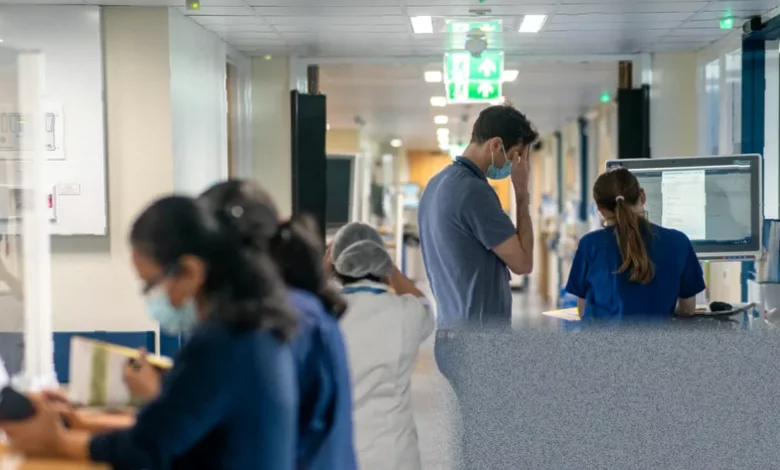
This statistical progress collides daily with an oppressive reality on hospital wards. Last week, Leighton Hospital in Crewe faced intense pressure, with its emergency department full despite winter being over. At one point it was caring for a near-record 170 patients while 110 others who were medically fit for discharge still occupied beds, compounding the crisis. One staff member described it as “the worst few weeks of my career,” citing despair and exhausted colleagues missing breaks.
This exhaustion is systemic. The 2025 NHS Staff Survey recorded intensifying burnout, with over 42% of employees feeling unwell due to work-related stress and nearly a third feeling burnt out. Research from University College London’s Global Business School for Health, based on 850 NHS leaders, concluded that while staff goodwill remains, “people are exhausted” and the system is “running so close to the line operationally” due to relentless demand. Polling by NHS Providers found trust leaders deeply concerned about staff burnout and morale, with more than two-thirds of staff feeling inadequate staffing levels prevent effective care.
The Slow March of Reform
Facing these challenges, Mr Streeting’s tenure has focused on three priorities: hitting waiting time targets, a 10-year plan based on “three big shifts” towards digital, preventive, and community-based care, and a radical restructuring of the NHS itself. On the first, he has committed to restoring the 18-week standard for elective care by 2029, though as of October 2025 only 62% of patients were seen within that time, against an interim target of 65% by March 2026.
Insiders report that progress on the “three big shifts” is slow, with plans announced “far outstripping delivery on the ground.” One senior figure confessed they could not yet “hear the sound of the machinery” clanking into gear. The political promise of creating dozens of integrated “neighbourhood health centres” also remains largely unfulfilled.
The High-Stakes Restructure
The most consequential and controversial reform, however, is the planned abolition of NHS England and its merger with the Department of Health and Social Care (DHSC). This move, not in Labour’s manifesto and ruled out by Mr Streeting himself in January 2025, marks the end of a 12-year experiment with an arm’s-length body established under the 2012 Health and Social Care Act.
The government’s rationale is to cut bureaucracy, bring the NHS “back into democratic control,” and save approximately £500 million by halving the combined headcount of the DHSC and NHS England, which exceeds 18,000 staff. The merger will also impact the 42 regional Integrated Care Boards, some of which are already consolidating to improve efficiency.
Critics warn the process is fraught with danger. Stuart Hoddinott of the Institute for Government described the decision as “incredibly hasty,” made with “little consideration of the wide-ranging impacts” and creating “a lot of turmoil.” The Institute for Government has published a report criticising the overall reform strategy as “chaotic and incoherent.” Bill Morgan, a former health adviser to Rishi Sunak, labelled the reorganisation a “total car crash,” noting the legislation to formalise it—not expected until 2027—has not yet been published.
The Public Accounts Committee has expressed concern about the uncertainty this creates for patients and staff, highlighting the lack of a clear plan for how the change will impact key services and targets. The human cost through redundancies is significant, but the greater risk identified by analysts is that staff and organisations, left dispirited and distracted by a “chaotic” restructuring, will be unable to focus on delivering the frontline improvements the public is waiting for. With public optimism about the NHS’s future still low—only 16% believe care will improve in the next five years—the success or failure of this gamble will define the government’s health legacy.