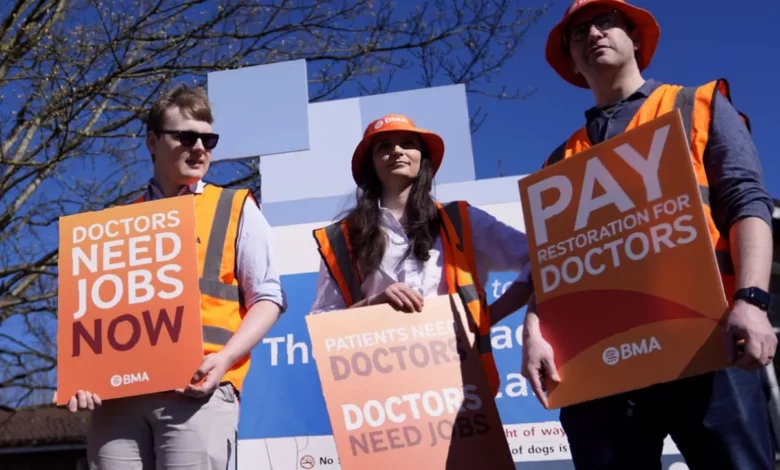
Health Secretary James Murray has insisted that the British Medical Association’s demands for further pay increases for resident doctors are “unrealistic, unaffordable, and unsustainable”, as the union prepares to ballot members for what would be the 16th strike in a dispute stretching back more than three years.
Speaking after a meeting with BMA leaders, Murray pointed to the 33.4 per cent pay rise awarded to resident doctors over the past four years, which he said was the highest anywhere in the public sector. He argued that the government had already delivered significant improvements, including higher starting salaries for new graduates—now substantially above what they were four years ago—and structural reforms designed to deliver more frequent and fairer pay rises as doctors gain competencies.
“The BMA’s demands for further substantial pay increases this year are unrealistic, unaffordable, and unsustainable,” Murray said. He expressed disappointment that the union had not engaged further to strengthen the existing offer, which had remained unchanged since the one put forward by his predecessor.
The Health Secretary also highlighted the wider cost of industrial action, stating that strikes had added hundreds of millions of pounds to NHS finances, diverting money from patient care and hitting other staff. The government maintains that patients do not support further walkouts.
Murray was appointed to the role earlier in May 2026 after Wes Streeting resigned as Health Secretary, citing a loss of confidence in the Prime Minister’s leadership following Labour’s poor performance in recent elections. Streeting’s departure opened the door for Murray, who had said he hoped to begin a “productive relationship” with the BMA. However, initial discussions have failed to produce a breakthrough, with the union accusing the government of the same unwillingness to move that it encountered under Streeting.
The dispute and the BMA’s position
The BMA, which represents around 70,000 resident doctors in England, has rejected the government’s latest pay offer. The union is demanding a significant pay increase to reverse what it says is a 26 per cent erosion of real-terms pay since 2008/09. It is also calling for a major expansion of training places for medical specialties, arguing that a “jobs bottleneck” is blocking career progression and driving doctors out of the NHS.
Jack Fletcher, chair of the BMA’s resident doctors committee, said: “We had hoped that a change in leadership at the Department of Health and Social Care would lead to a change in approach. Sadly, we have run up against the same unwillingness to move we encountered under Mr Streeting.” He described the union’s ask as “straightforward: a credible, meaningful offer comprising concrete new jobs and real progress towards pay restoration.”
The BMA’s resident doctor members have a mandate for industrial action until August 2026. In February this year, 93.4 per cent of those who voted backed further strike action. The union has now announced a four-day strike from Monday, June 15 to Friday, June 19, and has warned of further walkouts in July if no progress is made.
Background to the strikes
The dispute dates back to March 2023, when resident doctors—formerly known as junior doctors—first walked out over pay and conditions. There have been 15 previous rounds of strikes, each causing widespread disruption to NHS services, including the postponement of tens of thousands of diagnostic tests, outpatient appointments and operations. The NHS has consistently said it aims to maintain safe staffing levels for urgent and emergency care during the action.
Industrial action by resident doctors has a long history in the UK. Major strikes occurred in 1975, when doctors opposed a proposed contract they believed would cut pay and fail to address excessive hours, and again in 2016, during a dispute over contracts and working conditions.
The government’s latest offer, made by Wes Streeting before the April 2026 strike, included a 4.9 per cent increase in average basic pay for 2026–27 and the creation of 1,000 additional training places. Streeting had argued at the time that the deal would leave resident doctors 35.2 per cent better off than four years earlier. However, the 1,000 training places were later removed from the offer, with ministers citing the cost of repeated strikes as the reason.
Emma Runswick, deputy chair of the BMA council, has also been involved in negotiations. Separately, the BMA has been in a parallel pay dispute with consultants, who have also balloted for industrial action.
The union’s leadership has warned that unless the government makes a credible move towards pay restoration and provides concrete additional training posts, further strikes will follow. “Our ask is straightforward,” Fletcher reiterated, with the BMA insisting it remains ready to negotiate but will not accept what it considers to be an insufficient offer.