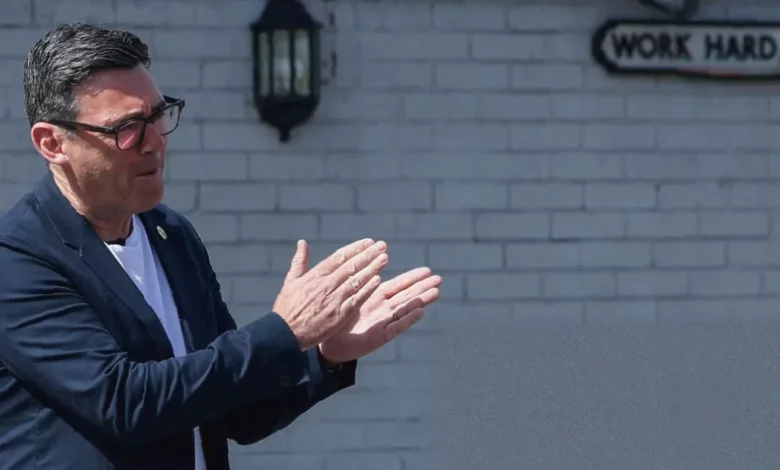
Andy Burnham’s drive to return to parliament is being managed by a campaign operation so small and precarious that one insider describes it as “hand-to-mouth”, reliant almost entirely on volunteers and a handful of sympathetic Labour MPs from the soft left. The Greater Manchester mayor’s inner circle, while deep in political experience, numbers barely a dozen core staff, with no permanent war chest or salaried machine behind it.
The size of the operation stands in contrast to the scale of Burnham’s ambitions. Friends and allies say he has long harboured designs on re-entering the House of Commons, and those plans are now concrete: he has announced he will stand in the Makerfield by-election, a contest triggered by the resignation of the sitting Labour MP, Josh Simons, a longtime ally who is expected to take a senior role in any future Burnham administration. The seat, a “red wall Reform anger” constituency, is seen as a crucial and consequential test.
At the heart of Burnham’s campaign is a tiny team led by Kevin Lee, his chief of staff and “right-hand man” for more than 15 years. Lee has worked with Burnham through his shadow cabinet roles, two mayoral campaigns, and his tenure as mayor. The campaign’s political lead is Anneliese Midgley, an MP and organiser with a trade union background, who is central to the Makerfield operation. Lucy Powell, Labour’s deputy leader and a fellow Manchester MP, has been assisting with the campaign, bringing her experience as Ed Miliband’s 2015 campaign manager. Louise Haigh, the former transport secretary and a prominent member of the Tribune group of left-wing MPs, is also a key ally actively involved. Ed Miliband, a political friend of Burnham, is expected to hold a significant position in any Burnham government.
The volunteers and MPs who are backing Burnham’s push are drawn largely from the soft left of the Labour Party. But the sheer lack of a permanent, paid infrastructure raises a fundamental question: how can a campaign built on such a shoestring support a credible bid for the party leadership and, ultimately, the prime ministership?
Those close to Burnham argue that the answer lies in the depth of his existing network and the long preparation he has undertaken. Burnham has run for the Labour leadership twice — in 2010, when he came fourth, and in 2015, when he finished second. That experience, they say, has allowed him to develop a mature set of ideas tested in a major city. His political philosophy, which he calls “Manchesterism”, emphasises regional growth, public service delivery and reducing geographic inequalities. As mayor, he has pursued policies such as bringing the region’s buses under public control through the “Bee Network”, and he advocates for a “productive state” with a more collaborative relationship between the state and business, including a greater openness to public spending and borrowing, potentially funded by higher taxes on wealth and property. He has also expressed support for electoral reform, arguing for proportional representation in Labour’s manifesto.
Key policy influences include Mathew Lawrence, director of the Common Wealth thinktank, who has shaped Burnham’s ideas on the productive state, and Neal Lawson, director of the centre-left pressure group Compass, who has introduced Burnham to various left-wing voices and believes the mayor has unique electoral appeal. The political economist and the pressure-group director are not formal campaign staffers, but they form part of the informal policy network that Burnham can call on.
The core team is small but overlapping with MPs who have their own offices and networks. In a crisis or a general election campaign, that informal web would need to scale rapidly. The challenge is compounded by the fact that Burnham’s path to parliament has already faced obstacles: he was previously blocked by the Labour National Executive Committee from standing in the Gorton and Denton by-election in January 2026. The Makerfield contest is therefore seen as his only current route back to Westminster.
Readiness for the top job
Burnham’s ultimate aim, according to those who know him, is the premiership itself. Keir Starmer, who currently holds the job, has discovered to his cost the difficulty of governing without a tight-knit team of advisers and a strong network of political allies. Burnham’s allies insist that his ideas are well developed and have been put into practice in Greater Manchester, giving him a platform that a purely Westminster-based candidate would lack. But the question of who is helping him prepare for that fight — and whether the current shoestring operation is enough — remains unresolved.
The mayor’s political circle also includes Angela Rayner, who is herself a potential leadership contender, though reports suggest a “leadership pact” between them, with Rayner potentially taking a top cabinet position in a Burnham government. Other figures, such as Josh Simons, the outgoing Makerfield MP, are expected to step into senior government roles. Burnham has also maintained relationships with former Labour figures such as Tony Blair and Gordon Brown, under whom he served as Secretary of State for Health and Secretary of State for Culture, Media and Sport.
On policy, Burnham has signalled support for immigration changes spearheaded by Shabana Mahmood, though with potential adjustments on indefinite leave to remain. He has been critical of the current government’s fiscal framework and has called for greater fiscal devolution to mayors, a departure from the Westminster dominance he argues must be ended. His vision for government is built on regional empowerment rather than the traditional centralised model.
The Makerfield by-election will test whether a volunteer-run, hand-to-mouth operation can deliver a parliamentary seat. Should it succeed, the next challenge will be far larger: turning a minuscule team into a machine capable of mounting a serious prime ministerial bid.