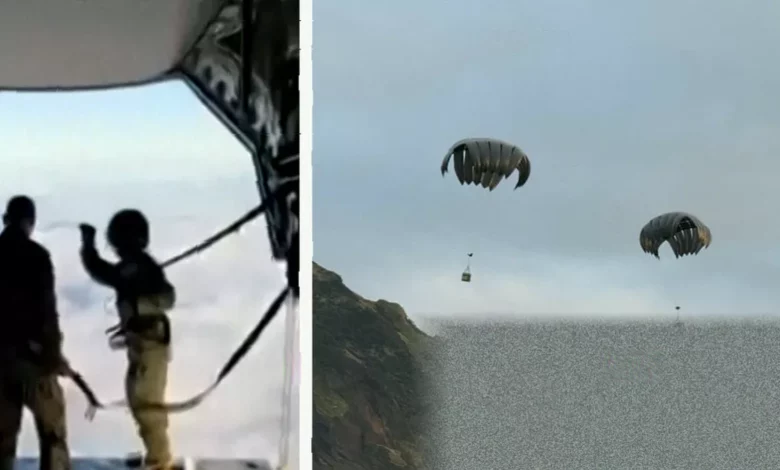
Paratroopers parachuted medical aid to a remote British island after a suspected case of a potentially deadly virus triggered an emergency response spanning 7,000 miles and two continents. Six paratroopers, an RAF consultant and an army nurse from 16 Air Assault Brigade landed on Tristan da Cunha – Britain’s most remote inhabited overseas territory – after an RAF A400M transport aircraft flew from RAF Brize Norton in Oxfordshire to Ascension Island, refuelled in mid-air by an RAF Voyager tanker, and then pressed on to the tiny volcanic speck in the South Atlantic.
The operation was launched after a British national who lives on Tristan da Cunha developed symptoms compatible with hantavirus, a group of viruses primarily carried by rodents that can cause the severe and often fatal Hantavirus Pulmonary Syndrome (HPS). The UK Health Security Agency confirmed on Friday that the individual had disembarked from the cruise ship MV Hondius – which was at the centre of an outbreak of the Andes virus strain, one of the rare strains capable of human-to-human transmission, though such transmission is uncommon. The patient first reported diarrhoea on 28 April, approximately two weeks after leaving the ship, followed by fever. The person is reported to be stable and in isolation, but the island’s oxygen supply was running out.
The mission was executed on Saturday, 9 May 2026. Brigadier Ed Cartwright, commander of 16 Air Assault Brigade, described the gap between the request for help and the arrival of personnel and medical stores on the ground as “7,000 miles and about 56 hours”. He told Sky News: “No airstrip, high winds, very difficult to reach, and over a week for a boat, and the patient, as I understand, was on oxygen, and that oxygen supply was running out – so we had very few options.”
The jump onto a ‘golf course covered in rocks’
Brigadier Cartwright said the soldiers described the descent as a “pretty tasty jump”. Because the island lacks an airstrip and is normally accessible only by boat – a voyage of roughly six days from Cape Town, South Africa – the only feasible option was a parachute insertion. “They would have got out of the aircraft, had to turn straight into wind to avoid being pushed past the island and into the Atlantic, and then had a very difficult descent down through the cloud and on to the drop zone, which was a golf course covered in rocks,” he said. He acknowledged the inherent risks: the winds were “reasonably high” and parachuting always carries danger. The Ministry of Defence confirmed it was the first time the UK military had parachuted medical personnel to provide humanitarian support.
Tristan da Cunha, a group of volcanic islands in the South Atlantic, has a population of just 221 and normally a two-person medical team. The island has long contended with infestations of rats and mice – the typical carriers of hantavirus. The suspected case on Tristan da Cunha is linked to the wider outbreak aboard the MV Hondius, which departed Ushuaia, Argentina, on 1 April 2026 and visited Tristan da Cunha between 14 and 16 April. As of 8 May, eight cases (six confirmed, two probable) had been reported on the ship, including three deaths – a case fatality ratio of 38 per cent. Passengers disembarked at multiple locations, including St Helena and Tenerife, leading to a multi-country spread. The ship arrived in Tenerife on Sunday, 10 May, where passengers began disembarking.
Extraction and official response
Brigadier Cartwright said there was a plan to get the team back. “There are some ships being moved and some further medical support being prepared, so we’ll be able to extract them safely in due course,” he added. British nationals from the MV Hondius are being repatriated to the UK, with plans for isolation and monitoring for 45 days. The Foreign Secretary, Yvette Cooper, said the safety of “all members of the British family” was the top priority, and pledged continued co-operation with international authorities and the Tristan da Cunha administration. The Minister for the Armed Forces, Al Carns, described the deployment as “an extraordinary operation in incredibly challenging circumstances”. Hantavirus infection has no specific treatment, cure or vaccine; early recognition and intensive care improve the chances of recovery. The Andes virus strain – confirmed on the MV Hondius – is one of the few that can, in rare instances, spread from person to person, primarily through inhaling airborne particles from infected rodent urine, droppings or saliva.