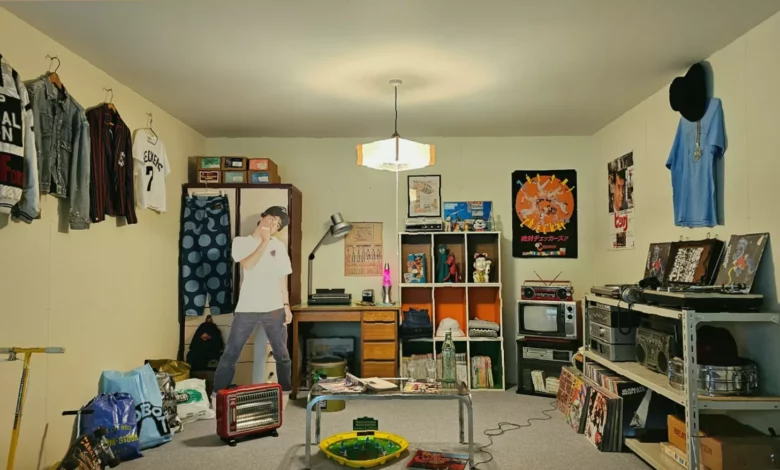
A replica of Tomoaki Nagao’s teenage bedroom – minus the bed – opens the new exhibition at London’s Design Museum, a recreation of the space where the future designer spent his adolescence in 1980s Tokyo. The room, stripped of its mattress but packed with the artefacts that shaped his early tastes, is the starting point for “Nigo: From Japan with Love,” the first major retrospective of the designer’s career outside Japan. Stretching from May 1 to October 4, 2026, the show brings together more than 700 objects, around 600 of which come from Nigo’s personal archive – rare designs, ceramics he made himself, and a life-size glass tea house commissioned specially for the exhibition.
Who is this person?
If you know his work, the exhibition may feel like a pilgrimage. If you do not, the opening room’s intimate setting quickly gives way to a broader question: who is this person, and why does he warrant an entire museum show? The reviewer of the original wire story admitted to walking in never having heard of Nigo, and walking out just as bewildered. “He’s obviously successful, and yet I had never ever heard of him,” the account noted. “Reading up about him prior to the exhibition didn’t really help to understand why he is popular. And frustratingly, the exhibition left me just as bewildered.”
That confusion is worth unpacking, because Nigo – born Tomoaki Nagao on December 23, 1970, in Maebashi, Gunma, Japan – is anything but obscure within the worlds he inhabits. He is the founder of A Bathing Ape (BAPE), the streetwear label that revolutionised the industry in the 1990s with its camouflage patterns, bold graphics and deliberate scarcity. He is also the current artistic director of the luxury fashion house Kenzo, a role he took up in September 2021; his debut collection for Kenzo arrived in January 2022, blending streetwear sensibilities with the house’s heritage. He has served as creative director for Uniqlo’s UT brand, collaborated with Louis Vuitton alongside Virgil Abloh, and partnered with Pharrell Williams to launch Billionaire Boys Club and Ice Cream footwear. He is a DJ and record producer who has released solo albums such as “Ape Sounds” and “I Know Nigo!”, and he is the DJ for the Japanese hip-hop group Teriyaki Boyz, whose work featured on the “Fast and Furious: Tokyo Drift” soundtrack.
His nickname, which means “number two” in Japanese, dates back to his days as an assistant to Hiroshi Fujiwara, the man often called the godfather of Harajuku. Nigo studied fashion editing at Bunka Fashion College in Tokyo, where he met Jun Takahashi, founder of UNDERCOVER, and together they co-founded the boutique NOWHERE in 1993. That same year he launched BAPE, whose name comes from a Japanese idiom about a bathing ape in lukewarm water, used to criticise the complacency of Japan’s youth. The brand became a global phenomenon, adopted by hip-hop artists including The Notorious B.I.G., Kanye West and Pharrell Williams. The Bapesta sneaker, released in 2002, drew comparisons to Nike’s Air Force 1 and became highly collectible – though it also attracted lawsuits from Nike over alleged copying. Nigo sold a majority stake in BAPE to Hong Kong’s I.T Group in 2011 and left the brand entirely in 2013.
The criticisms: aping America, or creating something fresh?
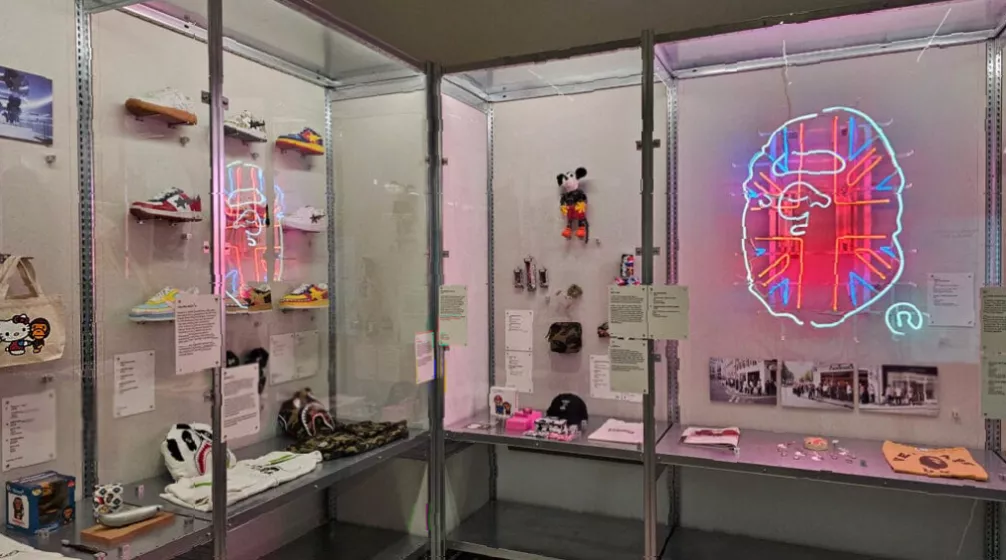
For the uninitiated visitor, the exhibition’s displays can feel less like a celebration of original design and more like a museum of borrowings. The original reviewer observed that a T-shirt featuring an image of an American peanut brand could be a two-pound giveaway or a two-thousand-pound Nigo copy – “it really wasn’t possible to tell the difference.” A denim jacket, the exhibition text explains, was so slavishly copied from the original that the stitches line up. “Is that a creative process?” the reviewer asked.
This goes to the heart of the confusion about Nigo’s appeal. His work is deeply rooted in vintage Americana – the music, movies, workwear and cultural artefacts he absorbed as a teenager in 1980s Japan. That reverence for American culture is a central thread of his career, from the Bapesta’s debt to Nike to the Human Made brand he launched in 2010, which explicitly channels vintage American workwear and Japanese craftsmanship. But the line between homage and imitation is thin. The research briefing notes that Nigo’s early fascination with American culture “deeply influenced his design ethos,” yet the exhibition’s hagiographic descriptions, which the original reviewer said “seemed to have been written by Nigo’s publicist rather than by an objective museum curator,” do little to clarify where that influence ends and original creation begins.
More than one visitor might leave with the impression that the show is less a retrospective and more a marketing exercise. The reviewer called it “a sales tool set up by Nigo’s marketing department to promote Brand Nigo to a new generation of potential customers.” The descriptions are relentlessly laudatory, and the curation offers little critical distance. For those already immersed in Nigo’s world, the exhibition may be a treasure trove of rare designs, ceramics he made himself, and the specially commissioned glass tea house. For those who are not, the experience can feel like walking through a branded showroom.
The purpose of the exhibition
Yet the organisers have a clear goal in mind. The exhibition is designed to trace Nigo’s journey from that teenage bedroom in Tokyo to global influence, exploring the blend of influences that made him – vintage Americana, hip-hop, streetwear and traditional Japanese crafts. The 700 objects include not just fashion but also examples of his art collection: Nigo is an avid collector and early supporter of the artist Kaws, whose painting “Kaws Album” – commissioned by Nigo – sold for $14.8 million in 2019. His art collection sales have totalled $28 million. The show also includes ceramics he made himself, underscoring his hands-on approach and his integration of Japanese craftsmanship.
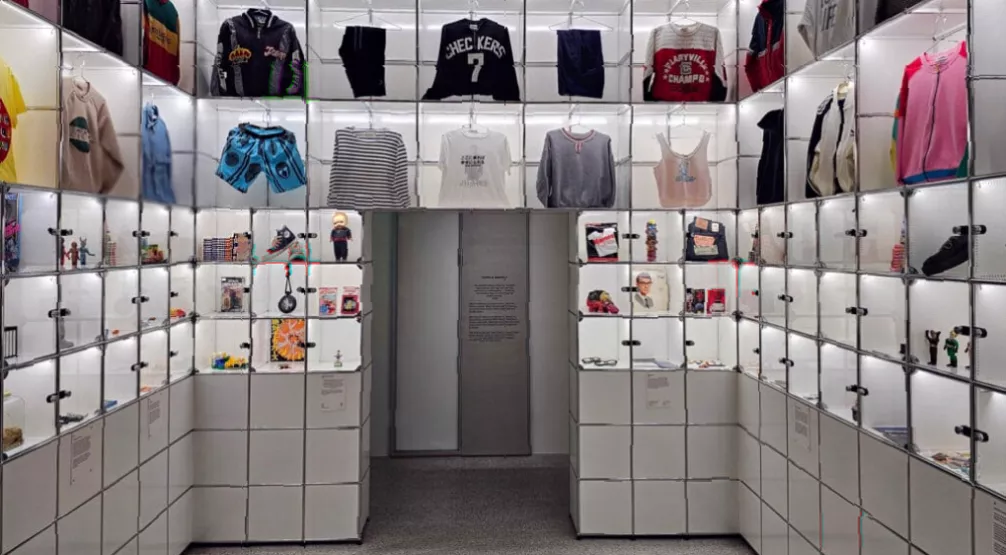
The exhibition’s themes are consistent with the arc of Nigo’s career: bridging streetwear and luxury, pioneering scarcity and hype marketing, and building a personal brand that now spans fashion, music, art and even wine – the Australian winery Penfolds appointed him its Creative Partner for two years in July 2023. Awards have followed: the MTV Asia Awards Style Award in 2005, GQ Japan’s Fashion Designer of the Year in 2020, and the Mainichi Fashion Grand Prix grand prize in 2022 for his work at Kenzo. Estimates of his net worth range from $20 million to $50 million, reflecting the commercial success of his ventures.
Ultimately, “Nigo: From Japan with Love” is a show that demands context. Without it, the unfamiliar visitor is left with a collection of expensive copies and adulatory labels. With it – reading the biography, understanding the history of BAPE, the role of scarcity, the partnerships with Pharrell and Virgil Abloh, the 2020 Louis Vuitton capsule collection, the Teriyaki Boyz soundtrack, the $14.8 million Kaws painting – the exhibition becomes what it intends to be: a portrait of a designer who turned his teenage obsessions into an empire. The replica bedroom at the entrance is not just a nostalgic touch. It is a statement of origin: everything else in the show flows from the objects, records and images that surrounded a boy in Maebashi who wanted to be number two to the godfather of Harajuku.
The exhibition, Nigö: From Japan with Love, is at the Design Museum until 4th October 2026.