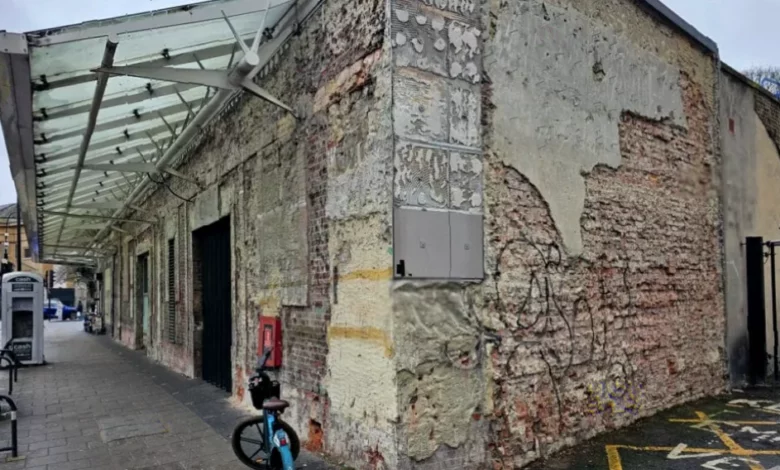
For a fleeting moment, the architectural ghosts of London’s transport past have been resurrected at Oval Tube station. The complete removal of its 1990s exterior cladding for essential repairs has stripped the building back to its brick skeleton, unexpectedly revealing long-buried details from its 1920s incarnation.
Around the entrance, the smaller cream square tiles and distinctive black bands of the interwar design are now visible. These were not merely decorative; they functioned as frames for holding advertising posters, promoting everything from Ovaltine to cigarettes, a common feature of stations from that era. Along the side facing the famous cricket ground, further poster spaces have emerged, some still plastered with old tile cement, hinting at where large commercial posters or even vintage tube maps would have been displayed.
Layers of History Uncovered
This temporary reveal exposes just one chapter in the station’s layered history. Oval first opened as Kennington Oval on 18 December 1890, forming part of the groundbreaking City and South London Railway, the capital’s first deep-level electric tube line. Its original architect, Thomas Phillips Figgis, designed a red brick building crowned by a lead-covered dome and cupola lantern, which housed the lift machinery.
That Victorian vision was transformed in the mid-1920s, during a major project to widen the tunnels. The lifts were replaced with escalators, and the station was rebuilt with a plainer, modernist aesthetic. This redesign, part of a wider London Transport effort involving architects like Charles Holden, also gave the platform tunnels their slightly oval shape, a result of their brick construction. The original dome was removed during this modernisation.
The 1920s facade itself disappeared in the late 1990s, concealed behind a new tiling scheme during a refurbishment that also added the current full-length glazed canopy and introduced cricket-themed motifs to the interior decor, a nod to the nearby Oval ground. This cladding later required reinforcing bolts to be installed around 2010 to ensure its stability.
A Necessary Strip-Down for Safety
According to Transport for London (TfL), the decision to remove all the exterior tiling, render, and reinforcement mesh was driven by safety. Some tiles had become loose, creating a risk they could fall and cause injury or damage. The work involves stripping the building down to its original brick substrate before installing a new, secure facade.
A TfL spokesperson confirmed that the project, which has a ringfenced budget of £500,000, is now underway and is expected to take approximately eight weeks to complete. The contractor will finalise a detailed programme as part of the tender process.
The Station’s Future Face and Enduring Character
When the work concludes, Oval station will sport a new exterior clad in 1200 x 600mm technical stone tiles on a specialist support system. The 1990s glass canopy will also be replaced with a modern interpretation of the original 1920s entrance design.
The station’s unique character, however, extends beyond its facade. Its proximity to the Oval cricket ground, which hosted its first test match in 1880, is celebrated internally with cricket murals, statues, and banners, with tiling updates continuing in a 2007 ticket hall refurbishment. The surrounding area is dense with history and art, from Kennington Park—once a common used for protests—to listed Victorian gas holders and public sculptures like “The Touchstone” by Peter Randall-Page. An octagonal brick ventilation shaft at the station, standing 2.8 metres high, is a remnant of plans for a deep-level air-raid shelter.
For now, the station presents a raw, almost brutalist charm, offering a unique and transient opportunity to witness a century of architectural change etched into its walls. Within weeks, this window onto the 1920s will be sealed once more, preserved only beneath a new, contemporary skin.