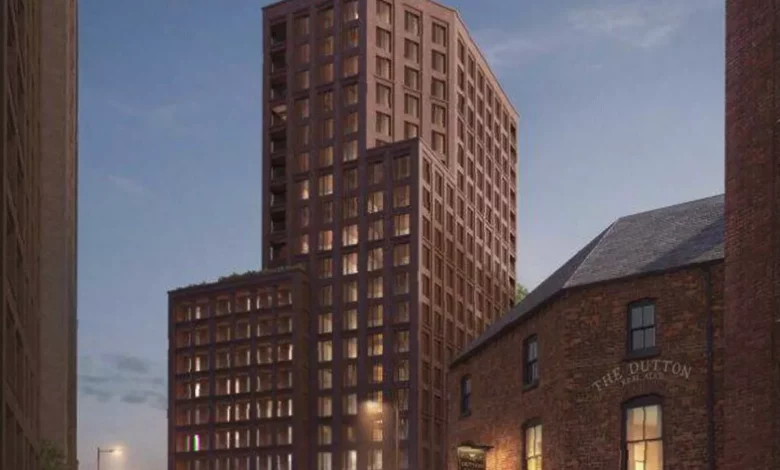
A new housing development could house over 300 residents in the Strangeways area of Manchester, under plans submitted to the city council for a part 20-storey tower block at 24 Dutton Street.
The application, lodged with Manchester City Council, seeks permission to demolish the existing warehouse building on the site – currently operating as a Pure Padel indoor tennis club under a temporary agreement – and replace it with 189 homes. Planning reports estimate the development could accommodate up to 328 new residents and generate approximately £1.9 million in local spending from future occupiers.
The proposed scheme includes a mix of one-bedroom and two-bedroom flats, as well as two-bedroom townhouses. Residents would have access to a private “woodland garden”, resident lounges, a communal roof terrace on the tenth floor and a “productive” roof terrace on the fourteenth floor featuring growing spaces and rainwater harvesting. The development is designed to be car-free, with the exception of some disabled parking along Robert Street.
The site, a short distance from Victoria train station and the wider Manchester city centre, is surrounded by light industrial units and a range of shops. The warehouse building now used by Pure Padel was originally built as a cash and carry in 1947 by the grandfather of Sammy Arora, the club’s owner. Pure Padel has since expanded with other clubs in the UK.
The Strangeways and Cambridge regeneration vision
24 Dutton Street falls within the area covered by the Strangeways and Cambridge Strategic Regeneration Framework (SRF), a joint initiative by Manchester and Salford City Councils to transform a 130-hectare swath of land that straddles the boundary between the two cities. The SRF has been approved by both councils and is now a material consideration for planning decisions.
The framework is a long-term blueprint – expected to take 10 to 20 years – and sets out ambitious targets: up to 7,000 new homes across seven distinct neighbourhoods, with a significant proportion designated as affordable; 1.75 million sq ft of commercial floorspace to support an estimated 4,500 additional jobs; and a new large city-centre park, provisionally called Copper Park. The development approach is designed to support Manchester’s target of becoming a zero-carbon city by 2038, with a “people-first” emphasis on improved transport links and active travel.
The SRF divides the regeneration area into seven neighbourhoods. Dutton Street itself is designated as a residential and mixed-use area on the edge of the city centre. Other major developments already approved within the framework include Brewery Gardens (505 homes) and Waterhouse Gardens (556 homes). In September 2025, Manchester City Council announced an expansion of the city centre boundaries that brought the Great Ducie Street area of Strangeways into the core economic and residential zone.
The regeneration push follows years of effort to clean up the area’s reputation. Operation Vulcan, a police operation targeting illegal trading, has been credited with creating a safer environment for legitimate businesses and is seen as a foundation for the SRF.
The prison’s future
Central to the wider transformation of Strangeways is the question of what to do with HMP Manchester – better known as Strangeways prison – which sits within the SRF area. Manchester City Council has long argued that the prison’s current location acts as a drag on regeneration. In 2022, the council wrote to the government stating that the prison was “coming to the end of its natural lifespan” and was not suitable for the “significant remodelling and expansion” needed to meet modern standards.
The council leader, Coun Bev Craig, described the prison as a “barrier to growth and development which could bring new jobs, much-needed houses and green space.” The SRF document itself explicitly uses the framework as an engagement tool with the Ministry of Justice to discuss the prison’s long-term future. Recent reports have indicated that “promising conversations” are taking place with the government about potentially relocating the prison, most likely outside Greater Manchester.
The prison has a troubled history, including a major riot in 1990, and has recently received damning inspection reports highlighting its “precarious state” and problems with safety, drugs and high staff sickness. Local businesses and residents have also pointed to associated criminal activity and parking issues linked to the prison. Were the site to be vacated, the SRF describes it as a “truly transformational opportunity to create a new city quarter.”