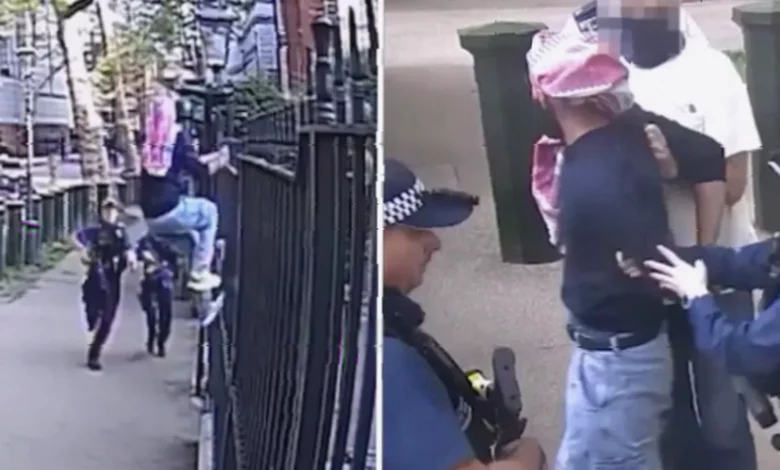
Police bodycam footage captured the moment a failed asylum seeker armed with two knives was tackled by armed officers as he attempted to storm the Israeli embassy in Kensington, west London.
Abdullah Albadri, 34, a Kuwait-born man whose asylum claim had been refused, scaled an eight-foot-high metal fence outside the diplomatic compound on 28 April 2025. He was carrying two serrated knives, each four inches long, and had a handwritten “martyrdom note” on him. Within seconds, diplomatic protection officers pulled him to the ground. During the arrest he told officers: “I wanna make a crime inside there, why are you stopping me?” Body-worn video later captured him saying: “You know it’s just a message, yeah. They need to stop this f****** war on children.”
Motive and Background
The court heard that Albadri had set out from Kilburn in northwest London and walked for about an hour to the embassy, wearing dark sunglasses and a red-and-white headscarf to conceal his identity. CCTV showed him making a salute-like gesture shortly before he tried to climb the fence at around 6pm. His intention, jurors were told, was to “exact revenge” for the killing of children in Gaza.
Albadri, a member of Kuwait’s minority Bedoon community, had arrived in the UK via small boats on two separate occasions: in 2021 and again in April 2025. His asylum claim was refused in April 2025, shortly after his most recent arrival. In court, he claimed he had faced imprisonment and mistreatment in Kuwait for campaigning for human rights. After his arrest, he denied preparing an act of terrorism, insisting the knives were for “personal use” because he was homeless.
The prosecution argued that Albadri had deliberately armed himself, concealed his identity, and attempted to enter a diplomatic site with the intention of using violence to make a political statement. The knives recovered were red-handled, serrated blades, each 10cm long. The martyrdom note found on him was not described in detail in open court but was presented as evidence of his intent.
Conviction
After nearly 14 hours of deliberation, a jury at the Old Bailey found Albadri guilty on 1 May 2026 of preparation of terrorist acts and possession of two bladed articles. He was remanded into custody pending sentencing, the date of which has yet to be fixed.
The verdict came against a backdrop of heightened tension. Just two days earlier, two Jewish men were stabbed in north London in what police described as a suspected terrorist incident, further alarming Britain’s Jewish community. In the month before Albadri’s attack, a pro-Iranian group had claimed online to have targeted the Israeli embassy with drones carrying “dangerous substances”, though police found no hazardous materials. The embassy in London has faced several security alerts in recent times, and security measures remain under continuous review.
Sentencing for the preparation of terrorist acts falls under the Counter-Terrorism and Sentencing Act 2021, which introduced a “serious terrorism sentence” carrying a minimum of 14 years’ custody. For threatening with a bladed article, a mandatory minimum sentence of six months’ imprisonment applies to adults unless exceptional circumstances exist.