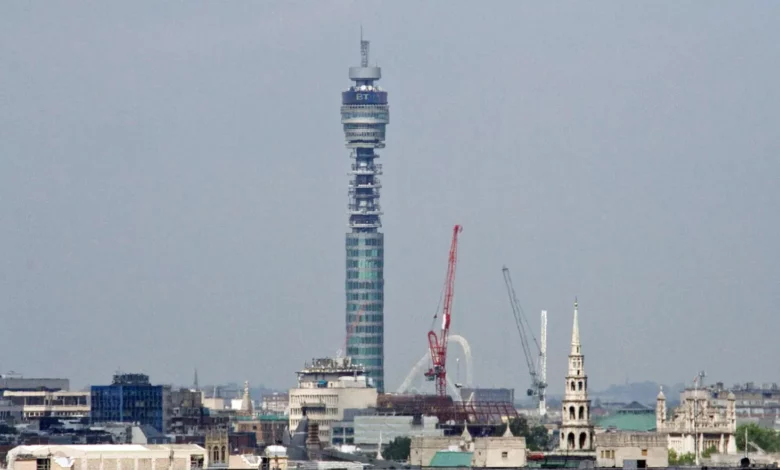
For the first time in nearly half a century, the summit of the BT Tower will be open to the public once again, as the owners of the landmark press ahead with ambitious redevelopment plans.
MCR Hotels, the American group that bought the tower from BT Group for £275 million in February 2024, confirmed that routine public access to the top of the tower and its podium buildings will be part of a “hotel-led, mixed-use scheme”. The promise marks the end of a long period during which the public has been locked out of one of London’s most recognisable structures.
Why public access matters
The tower, originally known as the Post Office Tower, was built between 1961 and 1964 to support microwave aerials for the General Post Office’s microwave network, handling telecommunications traffic across Britain. Designed to function as a secure communication hub during the Cold War, its cylindrical form was intended to withstand a potential nuclear attack. It was the tallest structure in London from its completion in 1964 until 1980, when it was overtaken by the NatWest Tower, now known as Tower 42. It is a Grade II listed building.
That history of secrecy and security is why the public has been kept away for so long. The tower was officially opened to visitors on 19 May 1966, with viewing galleries and a revolving restaurant on the 34th floor operated by Butlin’s. The restaurant made a full revolution every 22 to 23 minutes. But on 31 October 1971, a bomb exploded in the ceiling of the restaurant’s men’s toilets. Although the restaurant briefly reopened, Butlin’s lease expired in 1980, and the tower was permanently closed to the public by the following year, driven by heightened security concerns. For a period, information about the tower was classified under the Official Secrets Act, giving rise to the urban myth that it did not appear on Ordnance Survey maps — although it did appear on maps from 1971 onwards.
With the removal of its microwave aerials in December 2011 — rendered obsolete by fixed and mobile network evolution — the tower’s original telecommunications role faded. But its mystique endured. Now MCR Hotels says the redevelopment will “celebrate the Tower’s heritage, complement Fitzrovia’s historic character, create publicly accessible space, and deliver meaningful placemaking and employment opportunities for the local community”.
The hotel plans take shape
MCR Hotels, founded in 2006 by Tyler Morse, is the third-largest hotel owner in the United States by room count, with a portfolio of around 150 properties worldwide including the TWA Hotel at New York’s JFK Airport and The High Line Hotel in New York City. For the BT Tower, the company has engaged Orms Architects — having previously worked with Heatherwick Studio on the TWA project — to develop proposals.
Beyond the promised public access, emerging plans include a new publicly accessible square, walking routes through the site, retail shops, restaurants, and a rooftop swimming pool. MCR Hotels has emphasised its commitment to preserving the building and telling its story as an iconic hotel. However, the redevelopment is expected to cause disruption due to the tower’s location on busy streets in Fitzrovia, an area undergoing significant regeneration with improved transport links including the nearby Tottenham Court Road Station and the Elizabeth Line.
Discussions have been ongoing with Camden Council’s planning officers and councillors, and a full planning application is expected later this year. BT Group, which sold the tower as part of a broader strategy to simplify operations, reduce costs, and shrink its office footprint, will take several years to vacate the premises because of the complexity involved in removing technical equipment.
Exhibition details
MCR Hotels is showcasing its plans at a public exhibition hosted at University College London on Gower Street. The exhibition will be held in the Jeremy Bentham Room. To find it, enter UCL’s main quadrangle, take the entrance to the right of the portico, turn left along the South Cloisters; the room is up some stairs to your right, adjacent to the UCL Main Library. Wheelchair access is available via the entrance adjacent to the Lower Refectory.
The display will be open on the following dates and times:
Monday 11 May: 5:30pm to 7:30pm
Tuesday 12 May: 5:30pm to 7:30pm
Saturday 16 May: 11:30am to 1:30pm
A separate exhibition marking UCL’s 200th anniversary — with most of the display in the South Cloister and Octagon gallery — can be viewed at the same time.