She remembered the 276 schoolgirls stolen from their dormitories in Chibok, Nigeria, by Boko Haram in 2014. Only a few ever returned. And then, on October 7, 2023, she saw that same terror unfold again — this time at a music festival in Israel, where young people were hunted down and massacred. “I saw that same terror, the murder and the massacre of young people at a music festival,” she said. Her words, spoken publicly, carried the weight of a personal history that now reverberated in east London, where a former synagogue had been set alight in the early hours of a Tuesday morning.
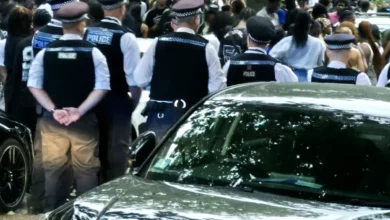
The arson attack on the former East London Central Synagogue on Nelson Street, Tower Hamlets, was reported to police at around 5:16 AM on May 5, 2026. CCTV showed the fire was started deliberately just six minutes earlier. The damage was minor — a set of gates and a lock scorched — and no one was injured. But the symbolism was unmistakable. The building, founded in 1923 and closed since its roof collapsed in 2020, was in the process of being sold to a local Somali Muslim organisation, the Ashaadibi Education and Cultural Centre, which had already placed a deposit on the property with plans to turn it into a community hub for worship and education. Counter Terrorism Policing London (CTP London) took over the investigation because of the nature and location of the incident.
Two arrests have been made: a 45-year-old man and a 52-year-old woman, both held on suspicion of conspiracy to commit arson. They join a growing list of detainees in a series of related inquiries. CTP London has now arrested 33 people across various investigations into recent attacks, with eight charged and one 17-year-old already pleading guilty to arson in connection with the firebombing of Kenton United Synagogue in Harrow on April 19, 2026.
The attack on the former synagogue is not an isolated event. It is part of a disturbing pattern that has left Jewish communities across the UK feeling frightened and questioning whether their own country is safe for them. In the weeks preceding the Nelson Street fire, a 45-year-old man was charged with attempted murder after two Jewish men were stabbed in Golders Green on April 29 — an attack that police declared a terrorist incident. Four ambulances belonging to the Jewish Hatzola charity were torched in Golders Green in March. An attempted arson on a synagogue in Finchley followed in early April. And a memorial wall in Golders Green, dedicated to victims of the Iranian regime and to those killed at the Nova music festival, was also targeted by arsonists.
The Nova music festival massacre — where Hamas militants killed 364 civilians and took 40 hostages at the Supernova Sukkot Gathering near kibbutz Re’im on October 7, 2023 — is the same atrocity the woman in the original quote was recalling. That event, part of a broader assault on Israel, now echoes through the streets of London, where the same terror she described has been visited upon Jewish sites and individuals.
Authorities are investigating whether some of these attacks are linked to Iran or Iranian-backed proxies. A group calling itself Harakat Ashab al-Yamin al-Islamia (HAYI) — The Islamic Movement of the Companions of the Righteous — has claimed responsibility for several recent antisemitic incidents in Britain and other European countries. The government has not confirmed those claims, but the investigation remains active.
The UK government has responded with a significant increase in resources. An additional £25 million has been allocated to boost security patrols, protect synagogues, schools and community centres, and deploy specialist officers. That brings total funding this year to £58 million — described as the largest government investment ever in protecting Jewish communities. Legislation is being fast-tracked to counter state-sponsored actions against the Jewish community and to speed up sentencing for antisemitic offences. The Crime and Policing Bill, which gives police more powers over protests, has received Royal Assent. Britain raised its national terrorism threat level to “severe” from “substantial” on May 2, 2026, following the stabbings in Golders Green.
Prime Minister Keir Starmer has convened meetings with leaders from business, civil society, health, culture, higher education and policing, calling antisemitism “a crisis for all of us.” He has made clear that chants such as “globalize the intifada” are a call for violence against Jewish communities and will be prosecuted. Hate crime prosecutions are being fast-tracked.
The emotional toll is profound. The Community Security Trust recorded 3,700 instances of antisemitic hate in 2025, a four percent rise from the previous year. In 2023, following the October 7 attacks, the CST logged 4,298 cases. Online antisemitism also rose sharply, with 1,541 instances reported in 2025. Jewish communities are not only frightened but also facing rising security costs that threaten to force artists and organisations out of public life.
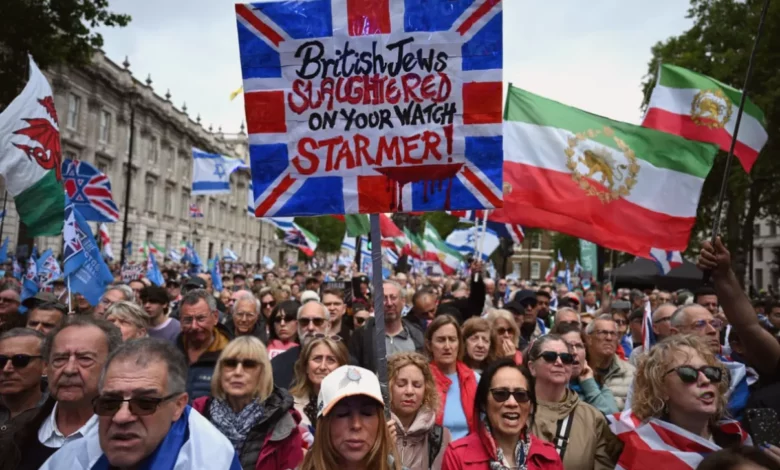
On Sunday, May 10, 2026, a rally organised by numerous Jewish groups gathered opposite Downing Street under the banner “Standing Strong: Extinguish Antisemitism.” Organisers hoped for a “million mensch march.” Prime Minister Starmer considered attending; Conservative leader Kemi Badenoch was expected to speak. The invitation of Nigel Farage sparked controversy.
The woman who spoke of Chibok and the Nova massacre expressed a fear that now feels immediate in London. She saw the same terror then. Now it has arrived at a disused synagogue in Tower Hamlets, at a memorial wall in Golders Green, at the scene of a stabbing, at the smouldering wreck of a charity ambulance. The question she and so many others are asking is not whether the attackers will be caught, but whether the country they call home will ever feel safe again.