Fewer than one in every hundred mobile phone thefts reported to police in the UK results in a criminal charge, according to damning data that lays bare the scale of an epidemic leaving victims without justice.
An analysis of figures from 17 police forces, obtained via Freedom of Information requests, reveals the stark reality. The Metropolitan Police, the country’s largest force, charged suspects in just 0.3% of the 86,000 phone thefts reported to it in 2024-25. Across forces, nearly nine in ten cases were closed without a suspect ever being identified, with the Met closing a staggering 95% of its investigations.
Why charges are so vanishingly rare
The explanation for these microscopic charge rates is multifaceted, involving sophisticated criminal enterprises, overwhelmed police resources, and a booming international market for stolen devices. Phone theft is no longer a casual crime of opportunity but a highly lucrative enterprise for organised networks. The Metropolitan Police estimates it is a £50 million per year industry for gangs in London alone.
These networks operate with efficiency. Street-level thieves, often on bikes or e-scooters, can be paid up to £300 per stolen handset. The devices are then funneled through handlers to international smuggling operations. One such network, disrupted by the Met’s Operation Echosteep, is suspected of smuggling up to 40,000 stolen UK phones to China in a single year, potentially accounting for 40% of London’s thefts. In markets like China, stolen Apple handsets can fetch up to $5,000.
This international pipeline makes tracing and recovering phones immensely difficult. Furthermore, police data shows the challenge begins at the investigation stage. In recent years, the Met screened only around half of all reported phone thefts for further investigation, meaning thousands of cases were effectively closed upon reporting.
Victims have criticised this response, with some feeling their cases were “closed before they were even opened.” The scale is undeniable; with over 116,000 phones stolen in London in 2024 and an estimated 83,900 stolen nationally, the volume of cases is overwhelming police capacity. The result, as one victim described, is a feeling that “too many offenders remain at liberty and most victims aren’t getting the justice they deserve.”
Police action and political pressure
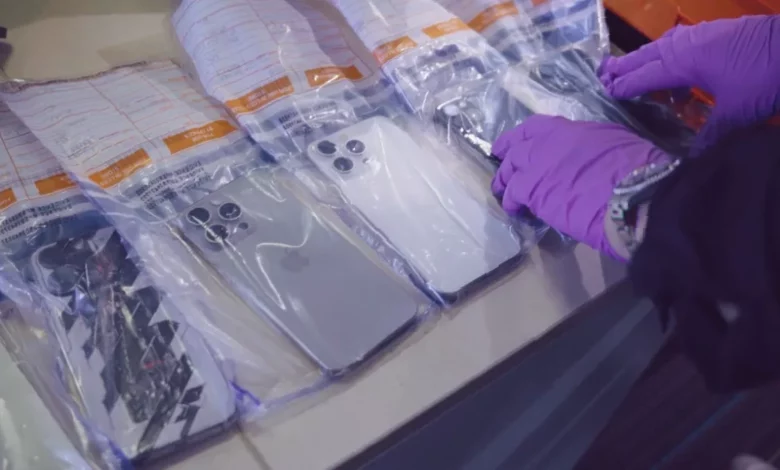
The Metropolitan Police states it is “relentlessly cracking down,” pointing to operations like Reckoning and Echosteep that have led to hundreds of arrests and the recovery of “tens of thousands” of stolen devices. It claims this work resulted in 10,000 fewer phones being stolen in London in 2025 compared to the year before. Nationally, initiatives like Operation Calibre, a coordinated week of action, have been launched.
However, police leadership insists they cannot solve the problem alone. A Met spokesperson emphasised that “manufacturers and tech companies must do more to stop criminals being able to reset, reuse or resell stolen phones.” The force has also called for the courts to prevent repeat offenders from being bailed to reoffend.
The issue was thrust into the political spotlight following the theft of a government phone from Morgan McSweeney, Sir Keir Starmer’s chief of staff, in October 2025. The phone, snatched by a man on an electric bike in Westminster, reportedly contained messages relevant to Lord Peter Mandelson. The Met initially closed the case after a call handler incorrectly recorded the location, later admitting they were “too busy” to investigate. Following media inquiries, the force has now reopened the investigation to reassess the evidence.
Prime Minister Starmer has dismissed as “a little bit far-fetched” any suggestion the theft was linked to subsequent requests for correspondence about Lord Mandelson. He has confirmed the theft was reported, pointing to a released 999 transcript where McSweeney identified the device as a “government phone.”
The Liberal Democrats, however, have seized on the data. The party’s home affairs spokesperson, Max Wilkinson, said: “People could be forgiven for concluding phone theft has been effectively decriminalised… Criminal gangs are feeling emboldened to strike in broad daylight, safe in the knowledge they have a less than 1 per cent chance of ever being caught.”
The search for solutions
Proposed solutions focus on disrupting the criminal business model. The Liberal Democrats are calling for a dedicated unit within the National Crime Agency—the UK’s lead agency against organised crime—to track professional gangs, and for regulations forcing providers to immediately disable stolen phones.
This aligns with pressure on manufacturers. The government has convened summits with tech firms, and the Metropolitan Police Commissioner has given manufacturers a deadline to act or face legal compulsion to make stolen devices “unusable bricks.” Technical measures like stronger Activation Lock and making IMEI numbers visible on lock screens are being urged.
Legislatively, the government’s proposed Crime and Policing Bill includes new powers for police to search premises without a warrant during the “golden hour” after a theft, using GPS data to locate stolen phones swiftly.
For victims, the impact is profound, extending far beyond the financial hit of a £400 device. A phone holds an individual’s entire digital life, leading to risks of financial fraud, identity theft, and significant disruption. As one analysis notes, losing a phone can feel like being “struck blind,” severing access to work, banking, and personal data. Until the chain from street thief to international market is comprehensively broken, the daunting statistics suggest victims will continue to bear that burden with little hope of legal redress.