A major new crime bill moving through the House of Lords will create specific criminal offences for climbing on war memorials and protesting outside the homes of public officials, as the government seeks to bolster protections for both physical monuments and individuals in public life.
Enhanced Protection for Memorials
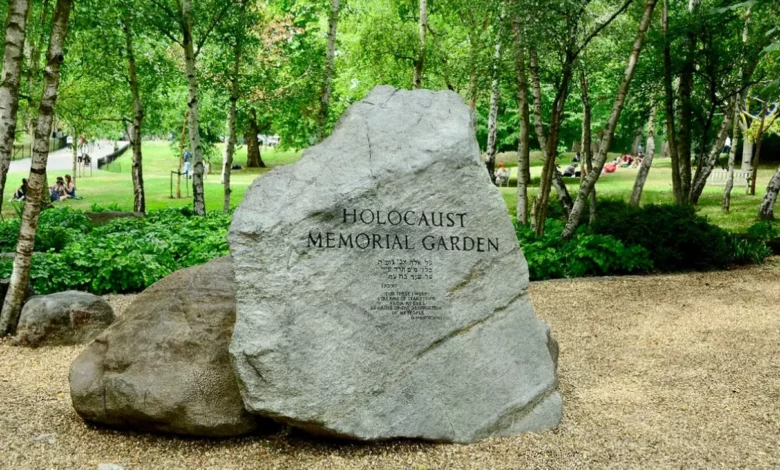
Under the Crime and Policing Bill, climbing on a specified list of memorials without a “good reason” will become a criminal act punishable by up to three months in prison and a £1,000 fine. Peers have agreed to add several new sites to the draft list, including the Holocaust Memorial Garden in London’s Hyde Park and the Monument to the Women of World War II in Whitehall.
The Hyde Park garden, established in 1983 as Britain’s first national memorial to Holocaust victims, features boulders inscribed with a passage from the Book of Lamentations. Its inclusion follows an incident in April 2024 when the Royal Parks authority covered it with a blue tarpaulin during a nearby pro-Palestinian demonstration, fearing potential vandalism and antisemitic attacks. This action was later described as “deeply troubling” by Yad Vashem, the World Holocaust Remembrance Centre in Israel, which argued it addressed symptoms rather than the root cause of antisemitism.
Lord Parkinson of Whitley Bay, the Conservative peer who proposed adding the garden to the Bill, pointed to this covering as evidence of the need for additional protection. “Sadly, that had to be covered in tarpaulin as recently as April 2024,” he said.
Other memorials now set to be covered by the law include The Cenotaph in Whitehall, Birmingham’s Hall of Memory, the Liverpool Cenotaph, The Response in Newcastle, the Portsmouth Naval War Memorial, and the statue of Sir Winston Churchill outside Parliament—the latter recently daubed with phrases including “Free Palestine”.
Addressing concerns about enforcement, Lord Katz, speaking for the Government, sought to reassure peers that the law would target climbing, not ordinary interaction. “The intention of the offence is to capture the act of climbing and I’m confident it will not capture walking on an installation such as the Holocaust Memorial Garden,” he stated, adding that police would use their discretion.
He emphasised that the Bill “intentionally sets out a clear and fixed list of memorials, which provides certainty for the public, policing and the courts,” warning that adding all listed or scheduled monuments would undermine this clarity.
Ban on Protests Outside Private Homes
In a separate but parallel move, the Government has amended the same Bill to ban protests outside the private homes of public office-holders, including MPs, peers, members of the Senedd, and the Mayor of London. Perpetrators could face up to six months in prison.
Lord Katz stated that “harassment and intimidation must never be accepted as a part of a public office-holder’s role.” He distinguished between legitimate political engagement and targeted protest, saying: “It is perfectly legitimate for campaigners during election time to doorknock… Where this crosses the line is when these people choose to protest against the public office-holder at their home.”
Several high-profile official residences are exempt from the ban, including 10, 11 and 12 Downing Street, the Palace of Westminster, the Prime Minister’s country retreat Chequers, and the Foreign Secretary’s Chevening House. The measure is understood to be partly a response to tactics used by animal rights activists in the early 2000s who targeted employees of pharmaceutical corporations.
The Bill, which has undergone significant parliamentary scrutiny and amendment, faces further stages before becoming law. Its progress comes alongside the separate advancement of the Holocaust Memorial Bill, which received Royal Assent in January 2026, paving the way for a national Holocaust Memorial and Learning Centre in Victoria Tower Gardens.