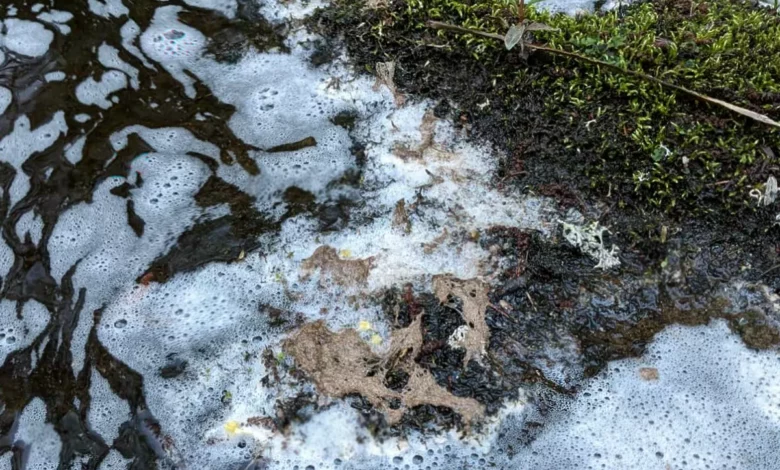
A two-kilometre stretch of the Knockando burn has been destroyed by a chemical spill, in what the director of the Spey Fishery Board described as one of the largest pollution events he has witnessed in 36 years on the river. Duncan Ferguson said the incident, which occurred on the tributary of the River Spey in Moray, had left the waterway “destroyed” and wiped out the salmon population.
Ecological devastation on the Knockando burn
The chemical, believed to be caustic soda, has killed a significant number of fish as well as eels and birds. Caustic soda – sodium hydroxide – is a strong alkaline compound that can drastically increase the pH of water, making it highly toxic to aquatic life. Even small quantities can push pH levels far above the natural range of 6.5–8.5, damaging the gills, skin and digestive systems of fish and invertebrates, leading to mortality and reproductive disruption.
“It’s a tragic event,” Ferguson told the Press Association. “It’s a really bad outcome and it didn’t have to happen.” He stressed that the salmon population on the affected section of the Knockando burn has been “wiped out”, with fly fishers reporting no surviving fish.
The spill comes at a critical time for the River Spey, which is internationally renowned as a prime salmon fishing destination. Recreational angling on the river is a major economic driver: a 2003 study estimated angler expenditure at £11.8 million annually, with salmon and sea trout anglers accounting for £10.8 million of that. When multiplier effects are included, the fisheries contribute £12.6 million each year to household incomes and support 420 full‑time equivalent jobs in the catchment. The capital value of the salmon and sea trout rod fishery alone has been estimated at £56.7 million.
Investigation under way
The Scottish Environment Protection Agency (Sepa) is investigating the incident. A spokesman said: “Sepa are investigating a potential pollution incident in a tributary of the River Spey and are working to identify the source and impacts.” The chemical is thought to be industrially linked, according to Ferguson. The investigation is examining whether negligence in managing the pollutant or an illegal act led to the contamination.
The event comes just ten days after another pollution incident on a Spey tributary, when white paint spilled into the Burn of Carron killed a number of salmon. The repeated incidents have increased pressure for better monitoring and tighter controls on industrial activities around waterways in the region, reigniting questions about the long-term integrity of the river system.
Recovery expected to take years
Ferguson said the salmon population could face a five‑year period of recovery. The Spey Fishery Board has been active in conservation since 2003, promoting a Salmon Conservation Policy, conducting scientific research and running habitat improvement projects through the Spey Catchment Initiative. A voluntary Catch and Release policy has been highly successful, with 98% of salmon and grilse caught on the River Spey released in recent years to spawn. Efforts have also included removing barriers to allow salmon to reach the upper reaches of their natal burns.
Atlantic salmon are widely recognised as being in crisis, with return rates from sea to natal rivers declining sharply over recent decades. The latest incident compounds those pressures. Historical precedents show that caustic soda spills can cause widespread devastation: in 1994, a large quantity of the chemical spilled into the River Ellen in Cumbria, killing thousands of fish including salmon and sea trout along half the river’s length. A 2014 spill in Spain’s Tea River killed thousands of fish over two miles, and in 2004, a release of 460,000 gallons of 50% sodium hydroxide solution into the Arthur Kill waterway in New Jersey caused significant environmental damage, proving toxic to fish and aquatic plants.