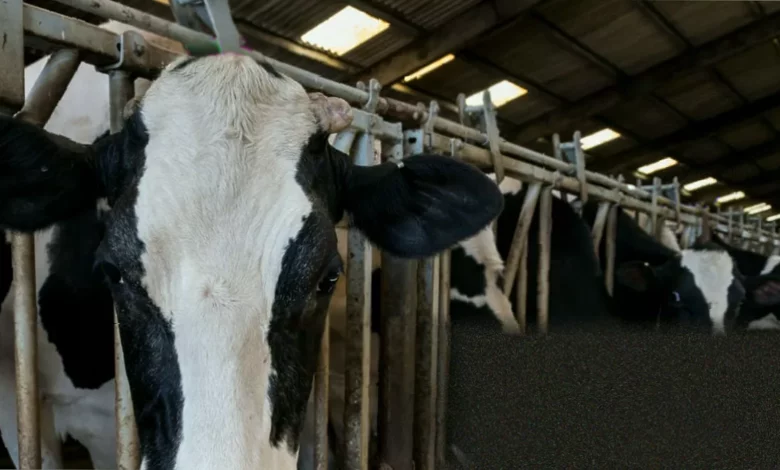
The number of intensive dairy farms in the UK that permanently confine cows indoors has more than doubled over the past decade, according to an investigation by the Bureau of Investigative Journalism (BIJ). Data suggests there are now at least 180 farms where cattle have no access to the outdoors, up from approximately 70 in 2015. In the same period, the number of so-called “mega dairies” — those housing more than 700 cows — has also doubled, with 40 such farms now in operation. The largest of these units contain up to 2,600 cows, more than 16 times the average UK dairy herd of 160 animals.
Despite this rapid expansion, large dairy units in the UK are not required to hold an environmental permit, unlike intensive poultry and pig farms. This regulatory gap means the government does not have a clear picture of how many such farms exist or where they are located. Using public and industry records, satellite images and drone footage, the BIJ identified 42 factory units across the country, with hotspots in Devon, Cornwall, Dorset and Cheshire. Of these, 16 were found to confine at least 1,000 cows, and the largest were in Pembrokeshire, Lancashire and Cheshire — all holding more than 2,000 animals.
Economic pressures driving change
The surge in intensive dairy farming is being driven by severe financial pressures on British farmers. Over recent months, shortages of essentials including fertiliser, fuel and feed have caused costs to shoot up. Fertiliser prices in September 2022 were 139% higher than a year earlier, and the combined volatility of natural gas and crude oil prices has pushed up fuel costs. Geopolitical tensions in the Gulf have exacerbated these issues, with some fertiliser prices rising by as much as 53% and fuel prices doubling in a matter of months.
At the same time, the price farmers receive for their milk has fallen far below the cost of production. Some farmers have been forced to sell milk for as little as 28p a litre, despite it costing about 40p a litre to produce. For decades, dairy farming has suffered from low margins, making farmers particularly vulnerable to market volatility and inflation. Research from 2022 showed that a typical 480g supermarket pack of cheddar selling for around £2.50 would leave the dairy farm with less than a penny in profit. Judith Bryans, chief executive of Dairy UK, the industry association representing processors including Arla, Müller and Saputo, noted that currently more milk is being produced than the market needs, both in the UK and globally, which tends to push prices down until the market balances again.
In this challenging environment, many farmers say they have been left with little choice but to “go big” and adopt more intensive systems to boost productivity. One dairy farmer, who asked to remain anonymous, told the BIJ: “They feel like they’ve got to do it.” Another farmer, who used to run an intensive unit where cows were milked indoors three times a day, said: “The only way to make more money is to produce more milk.” He eventually switched to outdoor grazing because of the stress involved in intensive farming, and has since diversified his business to remain viable. The move towards factory-style dairy production mirrors a wider pattern across the UK livestock sector. In 2017, a BIJ and Guardian investigation revealed the spread of hundreds of poultry and pig megafarms, and a year later the same outlets uncovered US-style intensive beef “feedlots” on UK soil — which the government was also not monitoring.
The economic pressures have been compounded by the power dynamics in the supply chain. Danny Chambers, a Liberal Democrat MP, said: “We have a handful of powerful retailers at the top [and] a number of processors and distributors in the middle exploiting the hundreds of thousands of farmers stuck at the bottom. After the more powerful players take their cut, the farmers get whatever is left.” Chambers is among a group of MPs calling for further legislation to ensure fairer treatment and prices. Tim Lang, professor of food policy at City University, described the situation as “unacceptable yet normal”, adding: “The consuming public would be genuinely shocked to learn the returns on dairy work are so low. Artisanal producers have tried to build alternative models: shorter supply chains, niche markets, high quality, high welfare. But their products are inevitably more costly.”
Some of the intensive dairy units have supplied major industry players such as Arla, Müller and Saputo, which in turn supply UK supermarkets. While farmers struggle, these companies have reported significant profits. Arla Group, which makes Anchor butter and supplies branded milk to Asda, recorded a net profit of €415m in 2025.
Welfare and environmental concerns
The rise of year-round housed systems has alarmed campaigners and some farmers, who draw a direct comparison with battery cages for hens. Patrick Holden, head of the Sustainable Food Trust and an organic dairy farmer, said: “The euphemism of ‘fully housed’ should be replaced by ‘battery dairy cows’. We managed to ban battery eggs; why not battery cows? It is shameful that we subject cows … to these conditions of confinement.”
Others defend the practice. Professor Jude Capper, a livestock expert at Harper Adams University, argued there was no inherently good or bad system. “Although the pastoral image of cattle grazing a sunny, lush pasture is aesthetically appealing, as consumers we often forget that there are just as many days of driving rain, high winds, low temperatures or drought in the UK that can have adverse effects on health and welfare,” she said. Farmers who operate these units maintain that year-round housing allows greater productivity and closer monitoring of cow health, and deny that welfare or environmental standards are compromised. However, the RSPCA has updated its welfare standards for adult cattle, requiring access to pasture for at least 120 days a year for a minimum of four hours a day, where conditions allow, with heifers to go out before first calving. These revised standards came into effect on April 20, 2026.
High milk yields, driven by selective breeding of Holstein-Friesians, can lead to health problems such as lameness and mastitis. Lameness affects a significant proportion of UK dairy cows, and mastitis is a common and painful udder inflammation. Cows in intensive systems may be slaughtered after only three or four lactations because of declining milk production or chronic health issues. The practice of artificially impregnating dairy cows annually and separating calves from their mothers soon after birth also causes psychological distress to both mother and calf, campaigners say.
Environmental concerns have mounted alongside the welfare debate. Data from the Environment Agency shows that between January 2024 and February 2025, officials recorded over 450 pollution incidents connected to dairy and beef farms in England, compared to 123 for poultry and pig farms. In the decade prior, cattle farming was linked to four times more pollution incidents than poultry farms and around six times more than pig farms. A 2020 investigation found that 95% of dairy farms in one English catchment area failed to meet water protection standards, with half polluting rivers at the time of an Environment Agency visit. Cattle farming also accounts for a significant share of the UK’s agricultural greenhouse gas emissions: in 2020, it alone accounted for 46% of the total, yet it remains largely unregulated through the permitting system.
Late last year, the government signalled it would consult on extending its environmental permitting scheme to include dairy farms and intensive beef units. A consultation is expected this summer (2026) as part of the Water White Paper and the Environmental Improvement Plan 2025. Defra has said it will “explore fair and proportionate approaches that seek to maximise environmental benefits and minimise costs and administrative burden for farmers”. Environment Minister Emma Hardy has indicated the government is “looking to develop a proportionate risk-based approach with requirements focused on the most polluting farms”.
The National Farmers’ Union (NFU) has expressed serious concerns about the potential costs. Based on current permitting fees in the pig and poultry sectors, dairy producers might need to spend up to £10,000 to acquire a permit, with an annual renewal cost of approximately £2,000 — a significant burden for farms already struggling to stay profitable. Farming chiefs have said the additional red tape and costs could be detrimental. Hayley Campbell-Gibbons, chief executive of the Royal Association of British Dairy Farmers, said her organisation was “keen to explore an industry-led approach to reducing pollution incidents, alongside understanding how a permitting approach could feasibly operate and be properly resourced in a sector as large and diverse as dairy”. She added: “Nobody would disagree that one pollution incident from farming is one too many; it’s about finding the solution that will have the best environmental outcome.”
Judith Bryans of Dairy UK said the UK had some of the world’s highest animal welfare, food quality and environmental standards, and that rules were in place to ensure a fair and transparent milk trade. “Currently there is more milk being produced than the market needs, both in the UK and globally, while wider economic pressures are also impacting the industry,” she said. Tesco said all its dairy met welfare standards that exceeded government requirements, and that it used transparent pricing structures to ensure farmers received consistent and fair prices. Andrew Opie, director of food and sustainability at the British Retail Consortium, which represents supermarkets, said retailers took their responsibilities to animal welfare seriously and worked rigorously with trusted suppliers to uphold high standards. He also pointed to the role of the Groceries Code Adjudicator, which regulates relationships between the UK’s largest supermarkets and their direct suppliers. From July 1, 2026, responsibility for the adjudicator will transfer from the Department for Business and Trade to Defra, although its statutory role and enforcement powers will not be extended.
New regulations — the Fair Dealing Obligations (Milk) Regulations 2024 — came into force last July, establishing mandatory minimum terms for dairy contracts and creating an Agricultural Supply Chain Adjudicator to enforce them. The regulations aim to improve price transparency and introduce a mandatory 21-day cooling-off period for farmers entering contracts. Despite these measures, the pressures on farmers persist. A fifth of British dairy producers have quit since the Covid pandemic, with warnings that more could follow.
The Department for Environment, Food and Rural Affairs said it had a database of all livestock farms in England and kept a record of all their cattle through its “robust” tracing system. It added that Environment Agency farm inspections are set to double, with funding boosted to reach a record 6,000 a year by 2029, prioritising farms with the highest risk to water quality.