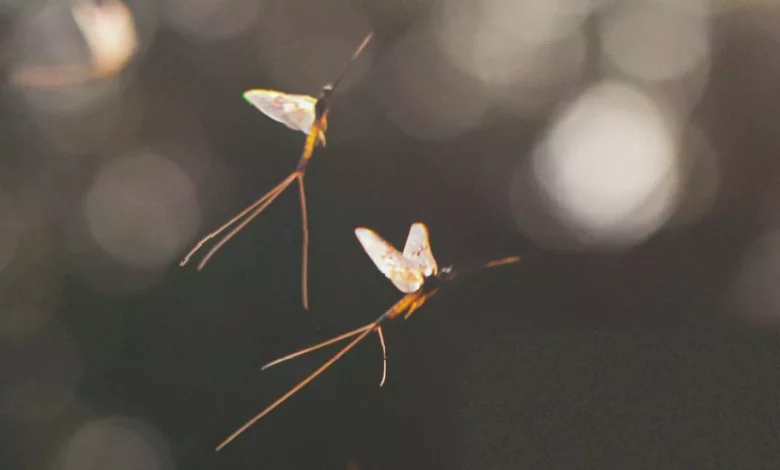
On a spring evening along the banks of the River Thames, male mayflies perform a unique aerial dance to find mates. Thousands of the ancient insects rise in a steep vertical climb, flip over and float back to Earth with wings and tail outstretched in a skydiving posture, dropping slowly through the fading light. This bizarre up-and-down flight pattern, which has likely remained unchanged for hundreds of millions of years, is now understood to be a crucial mating filter.
The behaviour was reconstructed in unprecedented detail by scientists at the University of Oxford, who filmed large swarms of common mayflies in the London borough of Richmond using 3D cameras. Their findings, published in the Journal of Experimental Biology, reveal that male mayflies rely on this distinctive movement to tell males from females. By flying vertically, males rarely travel horizontally above the swarm — the signature flight path of their female counterparts. In further simulations, the researchers found that males would stop pursuing any target that dropped beneath the horizon.
This visual cue is vital because male mayflies have an extraordinarily poor filter. “You can give them a beach ball — which, as far as I’m concerned, looks quite different from a female mayfly — and males will go right up to that much larger object and try to mate with it,” said Samuel Fabian, a research fellow at the University of Oxford who studies insect aerial behaviour. The problem is compounded in low light, when females appear almost identical to males even at close range. By staying below the females, males ensure their reproductive energy is not squandered on other males or inanimate objects.
The science behind the ritual
Mayflies are among the world’s oldest winged insects, emerging roughly 300 million years ago — long before dinosaurs walked the Earth. Their basic body plan has changed little over the epochs, and fossils show a remarkably similar design. Even the Epic of Gilgamesh, one of the earliest known pieces of literature, makes reference to the short-lived mayfly. “They have retained these odd characteristics and we can probably assume that they’ve been doing this [dance] for hundreds of millions of years, and yet we don’t really know why,” Fabian said — until now.
The dance solves a fundamental problem: how to locate a mate in a crowded swarm when time is desperately short. Mayflies undergo incomplete metamorphosis, spending up to 99 per cent of their lives as aquatic nymphs. The adult stage exists solely for reproduction; adults do not feed and possess only vestigial mouthparts. Uniquely among insects, mayflies have two winged adult stages — a transitional subimago, or “dun,” that moults into the sexually mature imago, or “spinner.” Males form swarms above water, and females fly into these swarms to mate in mid-air. After mating, females lay their eggs on the water’s surface or dip into the water to deposit them, after which both males and females typically die. The Dolania americana species holds a record for one of the shortest adult lifespans: females live less than five minutes. For the common mayfly, life as an adult ranges from a few hours to a few days — barely enough time to pass on genes.
Under threat
Despite their ancient lineage, many of Britain’s 51 mayfly species are now in decline — another casualty of what scientists call the “insect apocalypse.” A 2019 global review estimated that 40 per cent of the world’s insects are declining, while another study suggests more than one in ten species could be lost by the end of the century. From 2015 to 2021, the conservation group WildFish carried out a riverfly census of Britain’s chalk streams — some of the cleanest waterways, fed by cool springs from aquifers through chalk, home to species highly sensitive to pollution.
The census found that Britain’s chalk streams had lost 41 per cent of their mayfly species on average compared with 1998. “In many lowland catchments, the spectacular hatches that once defined early summer have diminished dramatically, reflecting decades of mounting pressure on freshwater ecosystems,” said Janina Gray, head of science and policy at WildFish. “Pollution, sediment runoff, reduced river flows and rising water temperatures are all eroding the conditions these insects depend on.” Other research suggests that even modest levels of fine sediment and phosphate pollution in many English rivers may be enough to kill up to 80 per cent of mayfly eggs laid in riverbeds. Fine sediments can suffocate eggs and promote fungal growth, while phosphates inhibit egg development — both pollutants often originating from agricultural runoff and untreated sewage.
Additional threats include neonicotinoid insecticides, which have been found to cause sharp drops in insect numbers in water; rising water temperatures linked to climate change, which can push species to retreat to higher altitudes; habitat loss and degradation from urban sprawl, simplification of farmland, and over-abstraction of water from rivers; and light pollution, which particularly affects night-flying insects. Conservation groups such as Buglife are working to protect invertebrates through research, habitat management, and advocacy. Some conservationists and fishermen are also involved in repopulation programmes, collecting mayfly eggs to increase survival rates.
For now, Fabian encourages Britons to relish the ancient spectacle while they still can. “This behaviour is something that pretty much everyone, at certain times of the year, should be able to see,” he said. “These are quite urban places with lots of traffic, but they’re still hanging on and they’re still doing this dance that they have probably been doing since before Britain was separated from mainland Europe.”