A new social enterprise in Ottawa is training newcomers to retrofit homes for climate action, aiming to tackle what environmental advocates and political leaders describe as two intersecting crises: the urgent need to decarbonise Canada’s housing stock and a severe shortage of skilled workers.
Building a workforce for the climate
Launching in September, Build is a social enterprise established by the Ottawa-based non-profit EnviroCentre, which has been operating for more than 25 years and has partnered with governments and utilities to deliver practical climate solutions to over 18,000 households since 2022. The enterprise’s mission is to train people who typically face barriers entering the construction industry – including women, Indigenous people and newcomers to Canada – in insulation installation, air sealing and other retrofitting skills.
Retrofitting means upgrading a building to improve its energy performance. This can range from minor modifications, such as caulking, to major overhauls of heating and cooling systems. According to the Pembina Institute, Canada needs to retrofit around 600,000 homes each year to meet its goal of net-zero emissions by 2050. The institute notes that 80 per cent of the buildings that will exist in 2050 have already been constructed, making retrofitting of older properties essential even as new building codes reduce emissions from new builds.
The benefits extend well beyond the climate. Melanie Johnston, a director at EnviroCentre responsible for launching Build, said that building envelope upgrades can lead to drastic reductions in greenhouse gas (GHG) emissions. But she also highlighted the non-environmental advantages: household cost savings, improved indoor air quality, and “less visits to emergency rooms for asthma attacks or lost days at school or work.” Research from the Pembina Institute emphasises that deep retrofits can create more affordable, low-carbon, climate-resilient and healthy homes. The economic case is also strong: a wave of deep retrofits could generate over $48 billion annually and create up to 200,000 long-lasting jobs, with every $1 invested yielding $7 in GDP growth, according to industry estimates.
Buildings are among the top-five greenhouse gas emitters in Canada, according to the federal government’s most recent overview of national emissions. The buildings sector accounts for 13 per cent of direct emissions, or 18 per cent when electricity use is included, making it the third-largest emitting sector. The Canadian Climate Institute has warned that “Canada’s climate progress has been modest and is at risk of going in the wrong direction.” Emissions from buildings rose in 2022 due to increased heating demand.
The labour shortage that Build seeks to address is stark. Since 2017, vacancies in skilled trades in the residential construction sector have increased by an average of 11 per cent annually, a trend aggravated by the COVID-19 pandemic, bias against blue‑collar work, and Canada’s ageing population. Statistics Canada projects that more than 245,100 construction workers will retire by 2032, leading to a shortage of more than 61,400 workers. BuildForce Canada estimates a shortfall of 29,000 workers by 2027, with approximately 156,000 workers expected to retire by then. The Canadian Construction Association puts the deficit even higher, estimating a shortage of 85,500 workers over the next decade – a problem that directly affects Canada’s ability to tackle its housing crisis.
The federal government sees immigration as one solution, but immigrants face significant barriers. Many lack Canadian work experience, and the construction industry “is historically mostly male, white people,” Johnston said. “We have heard anecdotally through some of the trainees that the environment is not always welcoming.” That is why Build is also focused on creating a positive and inclusive space. “We’d like to be able to roll out a tool kit for employers to help them remove some of the older toxic behaviours that you might see in the construction environment,” Johnston added.
Build is recruiting newcomers through programmes run by the YMCA-YWCA of the National Capital Region and the Ottawa Community Immigrant Services Organization (OCISO). The YMCA’s Power of Trades programme, funded by Immigration, Refugees and Citizenship Canada and the United Way in Ottawa, provides free pre-employment training including classroom sessions on trades, apprenticeships, labour laws and resume preparation, followed by work placements. Katie Sexton, a vice-president with the YMCA who oversees the programme, said it has an 84 per cent employment rate after completion and has graduated 536 participants in Ottawa alone. OCISO complements this by offering career mentoring, networking and settlement services to help newcomers integrate into the Canadian labour market.
Build also collaborates with Toronto-based social enterprise Building Up, which has been running a 16-week pre-apprenticeship programme since 2016. Building Up pays participants $16.55 per hour, combines eight weeks of classroom training with eight weeks of on-site work, and reports that 90 per cent of graduates move into apprenticeships or full-time employment. It has partnered with Toronto Community Housing to help tenants gain skills in the trades.
Mentees find purpose
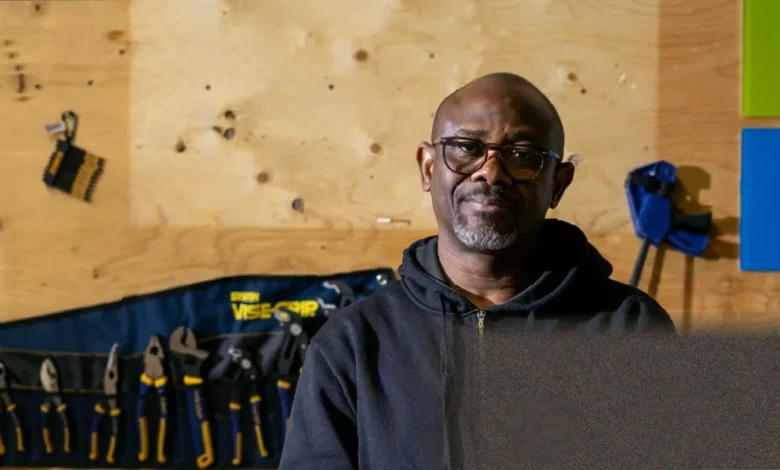
The first two mentees to join Build are John Mava and Allan Kanobana. Mava, who moved to Canada from Nigeria, was looking for work when a construction project started behind his house. Visiting the site, he was struck by how different Canadian construction was from what he knew back home: timber rather than bricks, and a strong environmental focus. “I said it would be great for me to have knowledge about this,” he said. He applied to the YMCA’s Power of Trades programme and through it became one of Build’s first hires.
Kanobana moved to Canada from Rwanda in 2024, hoping to give his children a better education. With a background in occupational health and safety, he also came to Build via the YMCA. “It’s very, very interesting,” he said. “When you look at the building science and the building codes and how building is practised here, it’s very different from where I come from.”
For the past few weeks, Mava and Kanobana have been preparing for Build’s September launch by learning the fundamentals of health and safety, the use of personal protective equipment and other theory, while also getting their warehouse ready for opening. The warehouse will be where they learn practical skills such as insulation and drywall installation, and how to conduct pre- and post-retrofit home assessments. Most of their training is in-house, supplemented by resources shared with Building Up in Toronto.
Build aims to take on two more mentees by the end of the year and to retrofit the homes of hundreds of clients in the Ottawa area, most of whom are already familiar with EnviroCentre through its work in the affordable housing sector.
For Mava, the environmental motivation is central. He recalled a trip to Huntsville, Ontario, to see a house being retrofitted where the owner told him he was doing it for his grandchildren. “He doesn’t want a situation where his kids will ask him: ‘What did you do about it?’” Mava said, referring to the climate crisis. “I don’t want my kids to ask me: ‘John, what did you do about this?’ With this, we’ll be able to reduce the emissions and then the kids will be happy in the future. I’ll be able to say: ‘Yes, this is my own contribution to it.’”