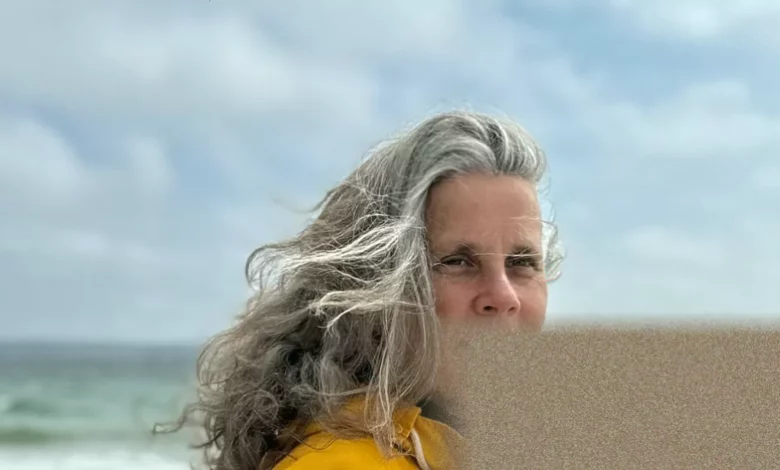
It was during her first winter on the Orkney archipelago that nature writer Victoria Bennett found herself standing on a storm-ravaged beach, howling into the wind. “There’s something very physically releasing about howling,” she says. “It’s quite animalistic and powerful.” With waves crashing against the rocks, she says, “you can really let rip. The sound just disappears.”
A battle with the elements
Until that moment, Bennett had been locked in a battle with her new environment. Having uprooted her life in Cumbria in 2022 at the age of 51, buying a Victorian terrace house with her husband, artist Adam Clarke, and their 14-year-old son, she was beginning to feel “in a fight against the sea, and against the weather”.
As the storm broke, she frantically weighed down the contents of her nascent garden – the first she had ever owned – and felt a little frightened. There is no way to get off Orkney in bad weather, she explains: “We can’t even go to the main town, the barriers get shut, and if you’re walking, you can get blown down the street.” But a few hours later, as she stood on the shore and howled into the wind, the feeling that she was in a battle with the elements evaporated.
An island calling
Bennett’s connection to Orkney began more than a decade ago, when she first visited the remote archipelago of approximately 70 islands and islets, located about 10 miles north of mainland Scotland. On the anniversary of the day her sister drowned in a canoeing accident, she went down to the seashore and cried her heart out into the salty wind. When she returned to England, the islands “whispered” to her, she says, urging her to return and make her home there.
By the time she heeded their call, it was 2022 and she was 51 years old. “I was ready to find my own shape again, and Orkney was where I needed to be to do that,” she says. “I needed to be there, by the sea, in that strange, flat place.” But that first winter, after upending her life, she felt vulnerable and, at times, frustrated.
Cultivating acceptance
For Bennett – whose 2023 nature book, All My Wild Mothers, won the Silver Nautilus Award for Memoirs in 2024 and chronicled the creation of an apothecary garden in Cumbria with her son – the solution was to turn her back yard into an apothecary garden: a reflective space full of traditional medicinal and culinary plants that would nourish her, body and soul. But she soon discovered that this would not be easy on Orkney.
The archipelago has a “hyper-oceanic” climate with little temperature variation between seasons, but is known for its strong winds and salt spray. “When a wind comes from a certain direction off the sea, in 24 hours, the garden gets wiped out,” Bennett says. “That happened twice last year. The salt-burn destroyed everything.” Forced to accept the dominance of the sea over the land, she began to swap plants that could not survive such onslaughts, such as elderberries, for similar but hardier species, such as fuchsia berries. “That’s part of what living here involves: an acceptance that whatever I’m growing is in relationship with the sea, with the elements around me.”
The garden is fertilised with foraged seaweed, and Bennett has learned to look at the plants that flourish on the coastline when she goes swimming in the sea, which she does every day. “Thrift, sea campion, roseroot – the coastline showed me what I could grow, because if it would grow wild there, it would grow in the garden.”
Her small walled garden, which measures 9 square metres, has a central circular spiral bed of medicinal herbal plants, surrounded by a circular path. This is bordered by a micro-woodland of goat willow, elder, wild garlic and bluebells, as well as dwarf fruit trees, roses, wildflowers and larger apothecary plants such as mint, geranium and catmint in sunnier spots. “There is a focus in the borders on colour, pollinators and scent,” she says. She also grows Mediterranean and culinary herbs such as oregano, rosemary, tarragon and marjoram in pots on her patio, and has a half-barrel pond of aquatic plants with marsh marigold and water mint, surrounded by flag iris and goldenrod. “There’s not much room to stand in,” she laughs. “But I find it very peaceful and I love seeing the wildlife that live in it.”
This adaptation of her garden reflects a deeper personal shift. Bennett, now 54, lives with two chronic illnesses: hypermobile Ehlers Danlos syndrome, a connective tissue disorder that causes joint pain and digestive issues, and genetic haemochromatosis, which means her body absorbs excessive iron. Learning that she must stop fighting with the wind and the sea in her garden has taught her a bigger life lesson: that she must treat herself with more compassion and forgiveness, and love her body with all its flaws.
Finding light in the darkness
Orkney’s unique environment amplifies this sense of acceptance. So far north, the islands experience up to 18 hours of light on summer days and an equivalent amount of darkness in winter. Bennett feels there is something magical about the place – “something caught in the expanse of sea and sky, in the contrast of light and dark”. Especially in winter, she says, living there has shown her “the most beautiful light is found in the darkest time”.
Bennett – who holds a BA in English and Creative Studies and an MA in Creative Writing from Lancaster University, and is founder of Wild Women Press and curator of the Wild Woman Web – sees her garden as a mirror for her own journey. “Coming here and growing this garden by the sea has helped me loosen and release into the ebb and flow of life,” she says. Letting go can be necessary, she understands now, and what seems like a loss can, with acceptance, be reframed as an exchange – just as, when the tide goes out, the waves are exchanged for the shore.
“Relinquishing control and allowing my garden to be what it is – without wanting it to be something else – was a really important way of understanding that in myself.”
Adam Clarke has provided illustrations for The Apothecary by the Sea: A Year in an Orkney Garden, which is published on 30 April.