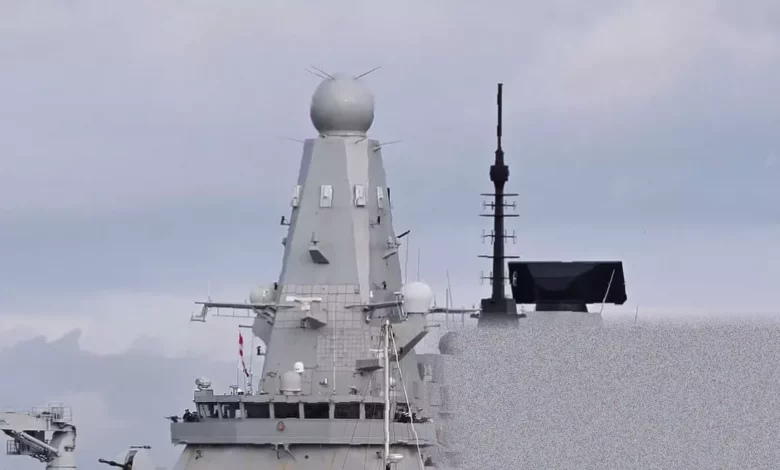
The Royal Navy’s belated dispatch of a destroyer to the Eastern Mediterranean has laid bare the strained reality of British military power, exposing a deep-seated gap between strategic ambition and shrunken capability. More than three weeks after the outbreak of hostilities between the US, Israel, and Iran, the Type 45 destroyer HMS Dragon is only now approaching the coast of Cyprus—a delayed response to a direct attack on a sovereign UK base.
That attack came on 1 March 2026, when hostile drones struck RAF Akrotiri in Cyprus, damaging a hangar used by US spy planes and forcing the evacuation of personnel and local residents. Yet the decision to deploy HMS Dragon was only taken on the fourth day of the conflict, according to Ministry of Defence insiders, and approved by the Chief of the Defence Staff, Sir Richard Knighton, and Defence Secretary John Healey.
A ‘Herculean’ effort to get to sea
Even then, the warship was not ready. HMS Dragon, one of just six destroyers in the fleet, was in dry dock undergoing scheduled repairs. Sources within the MoD described a frantic, “herculean” effort to make it seaworthy, with crews working tirelessly, 22 hours a day, to compress six weeks of work into six days. It finally departed Portsmouth on 10 March, took several days for testing in the Channel, and its arrival date off Cyprus remains unconfirmed.
This delay is emblematic of a broader crisis in readiness, experts argue. “It’s clear one of the military’s big problems is giving the government contingency options,” said Matthew Savill of the Royal United Services Institute (RUSI), pointing to years of spending constraints. The UK’s maritime presence in the Middle East has been “dwindling for a number of years,” he noted. From a post-Cold War fleet of 51 destroyers and frigates, the Royal Navy now has just 13, many of them ageing.
The hollowing out of specialised capabilities is equally stark. For two decades, the UK maintained four minehunters and a mothership in Bahrain, specifically to counter the threat of Iran mining the Gulf and the Strait of Hormuz. Yet the final three vessels were removed in the past year, with two retired. “We had prepared for this eventuality, but when it happened the UK was not there,” a serving naval officer said.
The political choice to stand aside
The slow naval deployment is set against a deliberate political decision to limit the UK’s involvement. As the US built up forces from late January, Britain stood aside. “Keir Starmer had decided this is not our war,” a former senior British military commander said. The Prime Minister has been unequivocal, stating the UK “will not be drawn into the wider war.”
This stance, while politically popular at home, has reportedly caused friction with Washington. US President Donald Trump has privately criticised Starmer for limiting military support, and there has been pressure on London to participate in a possible naval escort mission in the Strait of Hormuz. The only other naval asset potentially en route is the nuclear attack submarine HMS Anson, which left Western Australia over a week ago and is believed to be heading towards the Middle East.
Military figures complain that successive governments have been reluctant to acknowledge what one former senior figure calls the “rhetoric to reality gap”—where the UK projects global power with forces that are stretched perilously thin. “No one in the cabinet or elected Labour has a mind to use hard power,” argued one source familiar with Whitehall, who added that losing niche capabilities like minehunting makes Britain less relevant to its allies.
An overstretched force facing new commitments
The strain is not confined to the Navy. The total size of the full-time UK armed forces stood at approximately 147,300 personnel as of April 2025, below target strength across all services. The Army alone is at a historic low of 71,151 regulars.
Yet new commitments loom. Starmer has pledged that Britain would lead a stabilisation force in Ukraine alongside France if a ceasefire holds. Military planners estimate such a mission, where Russia is considered a moderate threat, could require around 5,000 UK troops. One army figure said sustaining that for over two years, while also maintaining a battle group in Estonia, would become “quite testing.”
Former General Sir Richard Barrons, a member of Labour’s strategic defence review team, argues the lack of readiness is the product of the “armed forces we have ended up with at the end of the post-cold war era – a military right-sized for an era free of threat.”
The funding chasm
While the government has made ambitious spending pledges, a yawning gap exists between promises and funded reality. The UK currently spends 2.4% of GDP on defence, with Labour committed to lifting that to 2.5% by April 2027—a target partly met by cutting the overseas aid budget.
Further commitments are aspirational: an ambition to reach 3% in the next parliament, and a pledge made at last summer’s NATO summit to hit 3.5% by 2035 as part of a broader 5% of GDP spent on national security. However, Chancellor Rachel Reeves has only referred to reaching 3% “for the next parliament,” which could run until 2034.
Crucially, the financial stasis is acute. A detailed 10-year Defence Investment Plan has been on hold since last autumn with no publication date. The MoD believes it needs an additional £28bn over the next four years just to meet existing commitments, which include the £31bn Dreadnought submarine programme, new frigates with Norway, next-generation combat aircraft with Italy and Japan, and AUKUS submarines.
“Could we do that with the budget that we have got? The answer is no,” Sir Richard Knighton conceded in January. A former senior civil servant summarised the Treasury’s position: “Everybody is saying there is no financial headroom.” There is no sign, observers note, of a politically weak Starmer overruling the chancellor.
The Strategic Defence Review published in June 2025 argued that necessary military reforms could be delivered within planned spending increases. But without the delayed investment plan, how this is to be achieved remains unclear. The government’s parallel vision is to make defence an “engine for growth,” aiming to become a major defence industrial power by 2035 and double defence exports.
For critics, the delayed sailing of HMS Dragon is a symptom of a deeper malaise. As one former Whitehall official warned, the world is entering an era of “strong, mad leaders,” with the potential for a China-US confrontation. The argument for greater investment, they suggest, is a last-resort necessity for a medium-sized power—because the world is becoming more dangerous, and rhetoric is no substitute for readiness.