In its inaugural year, a landmark co-investment fund for Northern Ireland has demonstrated significant early traction, deploying £3.1 million of public capital into 13 local companies. The figure, however, tells only part of the story: this investment has unlocked a further £5.4 million from private investors and £1.9 million in additional leveraged funding, bringing the total capital mobilised to over £10 million.
A Partnership Model Designed to Multiply Investment
Co-Fund III, a £39 million equity fund managed by Clarendon Fund Managers on behalf of Invest Northern Ireland, operates on a core principle of partnership. It is a key component of Invest NI’s long-running Access to Finance initiative, which was launched in 2011 to address funding gaps for SMEs. The fund’s remit is to back ambitious small and medium-sized enterprises alongside private investors, business angels, and venture capital firms.
The structure is engineered to stretch public money, ensuring at least half of every investment round is furnished by private capital. While the fund can provide up to 50% of a deal, it typically accounts for around 35%, acting as a catalyst to draw in wider support. Clarendon Fund Managers, which has managed the entire Co-Fund NI portfolio since the first iteration launched in 2012, typically invests between £150,000 and £500,000 into high-growth companies and can commit up to £2.5 million across multiple funding rounds.
In its first 12 months, Co-Fund III completed 16 investments across 13 businesses in target sectors such as health sciences, fintech, and agriculture. Individual cheques ranged from £150,000 to £500,000, with an average initial investment expected to settle around £250,000 over the fund’s decade-long lifespan. Approximately 65 companies are projected to benefit in total.
Building on a Proven Track Record
This third fund follows two earlier Co-Fund NI programmes, also managed by Clarendon. Together, those predecessors invested £51 million across 102 companies through more than 350 investment rounds. That public funding was matched by £113 million from private investors, creating a direct investment pool of £164 million. Those portfolio companies later attracted a further £210 million, lifting the total capital raised during their growth journeys to £374 million.
“The response to Co-Fund III has been very positive,” said Kathryn Hill, Chief Operating Officer at Invest NI. “A combined investment of over £10m in the first year is very encouraging and a strong endorsement of our local companies.” Ms. Hill joined Invest NI in May 2025, having previously held leadership roles in the Department for Communities.
Claudine Owens, a Senior Investment Manager at Clarendon Fund Managers, echoed this sentiment. “We are proud to mark the first anniversary since the launch,” she said, highlighting the quality of local SMEs and their demand for growth funding. Ms. Owens, who has been with Clarendon since November 2018 and has a background in accounting and corporate banking, noted that Clarendon has supported investments in over 100 companies since the Co-Fund series began.
Spotlight on Innovation: Senergy’s Dual Mission
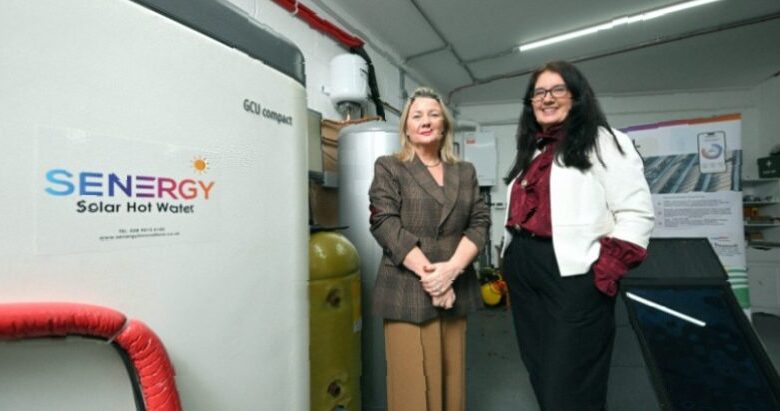
One standout beneficiary is Carryduff-based Senergy Innovations, which secured £500,000 from Co-Fund III as part of a £1.25 million round. Founded in 2013 by Christine Boyle, the company designs, supplies, and installs solar thermal hot water systems for homes and businesses.
Beyond renewable heating, Senergy has developed advanced ‘Sentherm’ conductive polymers engineered for applications in electric vehicles, batteries, and automotive electronics. The material delivers 95% of aluminium’s thermal performance while reducing component weight by 25–45%. According to data from PitchBook, Senergy Innovations has raised a total of $2.27 million from investors including Clarendon Fund Managers and Free Electrons. The Co-Fund III investment has supported team expansion, product development for the automotive sector, and increased sales of its solar solutions.
Addressing the Female Founder Funding Gap
Notably, four of the 13 companies backed in Co-Fund III’s first year are female-founded, representing 31% of the current portfolio. This stands in stark contrast to the broader equity funding landscape in Northern Ireland. While the region produces a high proportion of high-growth female-led businesses—13.3%, nearly double the UK average—all-female founded businesses received only 2% of total equity funding in 2024, a decrease from 4% in 2023.
Invest NI is operating other initiatives to tackle this disparity. Through its Techstart Ventures program, it collaborates with Women in Business NI on a “Female Founders Funding Opportunity,” offering grants of up to £35,000; the application deadline was January 27, 2026. Across Europe, female-founded companies raised approximately 12% of all venture capital in 2024.
Strategic Context and Future Pipeline
The activity of Co-Fund III occurs within a reshaped Invest NI, led since early 2024 by Chief Executive Kieran Donoghue, who has focused on making the organisation more responsive and outward-looking. In May 2025, Invest NI’s Executive Committee—the central decision-making body led by Mr. Donoghue—was strengthened with the appointments of Anne Beggs as Chief Commercial Officer and Kathryn Hill as Chief Operating Officer.
That same month, Dr. Caoimhe Archibald MLA, the Minister for the Economy, launched a new round of Access to Finance funding. This involves a £100 million commitment from Invest NI, which is expected to attract over £150 million in private sector funding, aiming for a total investment pot exceeding £250 million over the next decade. Mr. Donoghue noted that the Access to Finance initiative has bridged a critical gap in private sector funding since its inception in 2011.
This aligns with Invest NI’s current business strategy for 2024-2027, which focuses on supporting productivity, job creation, regional balance, and a transition to a low-carbon economy. As Claudine Owens of Clarendon stated, “Investment in high-growth SMEs across Northern Ireland is key to unlocking further opportunities for the local economy,” a view that underscores the strategic importance of funds like Co-Fund III in the region’s economic architecture.