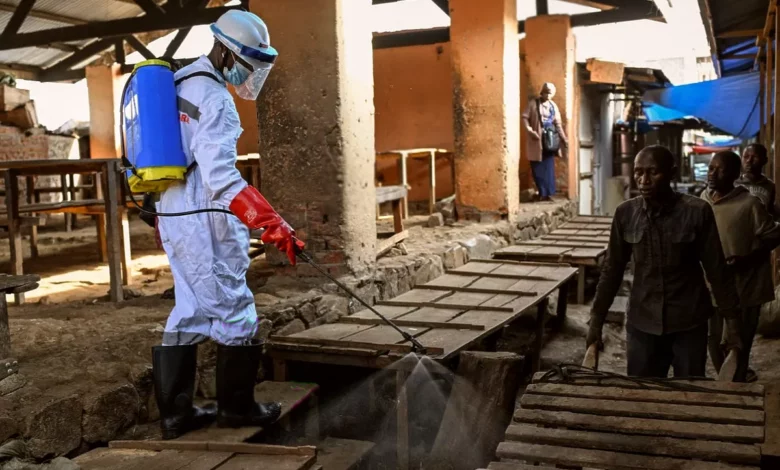
Eighteen suspected Ebola patients have escaped into the community after residents set fire to a treatment centre in the eastern Congolese town of Mongbwalu, the second such attack on a clinic in the region within a week.
Arson and escape in Mongbwalu
On Friday night, assailants torched a tent operated by Doctors Without Borders (MSF) that housed suspected and confirmed cases of the virus. Dr Richard Lokudi, director of Mongbwalu General Reference Hospital, confirmed the attack and the resulting flight of 18 people believed to be sick with Ebola. “We strongly condemn this act, as it caused panic among the staff of the Mongbwalu Referral Hospital and also resulted in the escape of 18 suspected cases into the community,” he said.
The incident came just 24 hours after another treatment centre, in the nearby town of Rwampara, was burned down. That attack occurred when family members were prevented from retrieving the body of a local man suspected to have died of Ebola. Bodies of Ebola victims are highly contagious because the virus remains active after death, and standard infection-control protocols require authorities to manage burials — a measure that frequently sparks protest when families insist on traditional funeral rites.
Deep-seated mistrust fuels resistance
Tensions between health workers and local communities have risen sharply as the outbreak has taken hold. High-security burials were carried out in Bunia, another outbreak town, on Saturday, and authorities in northeastern Congo on Friday banned funeral wakes and gatherings of more than 50 people in an effort to curb transmission. These restrictions clash with deeply held customs around death and mourning, creating a fertile ground for misinformation.
According to health officials, some communities believe the Ebola outbreak is fabricated, while others hold that divine protection renders medical care unnecessary. Such rumours have eroded trust in the response teams. Dr Jean Kaseya, director-general of the Africa Centres for Disease Control and Prevention (Africa CDC), stressed the critical need to build trust with affected communities if containment efforts are to succeed.
The International Federation of Red Cross and Red Crescent Societies (IFRC) announced on Saturday that three of its volunteers had died from the outbreak in Mongbwalu. The agency believes the volunteers contracted the virus on 27 March while conducting dead body management for a humanitarian mission unrelated to Ebola. That date significantly pushes back the estimated timeline of the outbreak, which had previously been linked to the first confirmed death — a health worker with severe bleeding symptoms — in Bunia in late April. The body of that health worker was later transported to Mongbwalu.
Initial tests in Bunia on 30 April came back negative for the more common Zaire strain of Ebola, leading to a delay in identifying the actual pathogen. The current outbreak is caused by the Bundibugyo virus, a rare strain for which there is no approved vaccine or specific treatment. This distinguishes it from the Zaire strain, for which vaccines and therapeutics exist.
Outbreak far larger than official figures suggest
The World Health Organisation (WHO) has elevated the risk level for the Democratic Republic of Congo from “high” to “very high”, though the global risk remains low. WHO Director-General Tedros Adhanom Ghebreyesus confirmed 82 confirmed cases and seven confirmed deaths as of 22 May, but cautioned that the outbreak is believed to be “much larger”. Nearly 750 suspected cases and 177 suspected deaths have now been reported, and officials expect those numbers to rise as surveillance expands.
The outbreak has spread beyond Ituri province into North Kivu and South Kivu, and cases have been confirmed in neighbouring Uganda. The Africa CDC has warned that ten other African countries are at risk — Angola, Burundi, the Central African Republic, the Republic of Congo, Ethiopia, Kenya, Rwanda, South Sudan, Tanzania, and Zambia — and is establishing a continental incident management team to coordinate with the WHO and other partners.
International aid has begun to flow: the UN is deploying emergency personnel, funding, and supplies; the WHO has deployed 22 international staff and released $3.9 million from its contingency fund; the UN Central Emergency Response Fund has released $60 million to accelerate the response in Congo and the region; and the United States has pledged $23 million. The Africa CDC is working to strengthen coordination, surveillance, laboratory systems and community engagement. Yet the repeated attacks on treatment centres and the escape of suspected patients underscore how fragile progress remains when trust is absent.
The three Red Cross volunteers who died on 27 March are believed to be among the first known victims of a virus that was spreading undetected for weeks before the official confirmation.