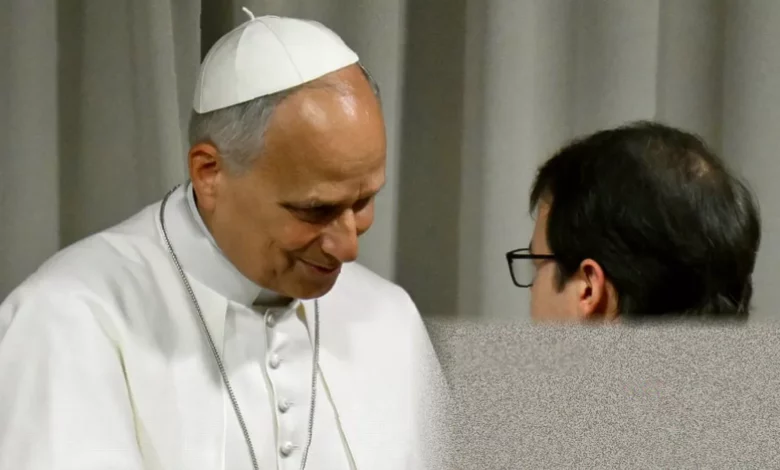
Pope Leo XIV issued a stark warning about the threats of artificial intelligence in his first major papal teaching, yet sat alongside one of the very people driving the AI boom as he released the document. The co-founder of Anthropic, Chris Olah, appeared as a guest speaker at the Vatican ceremony for the encyclical Magnifica Humanitas on May 25, 2026, raising an uncomfortable question: how can the Catholic Church work with a company whose technology may bring about the future the pontiff is warning against?
Vatican’s AI warning: dignity, work and war
In Magnifica Humanitas, Pope Leo XIV delineated the most concerning threats posed by artificial intelligence: replacing workers, accelerating war and exploiting the environment. The encyclical, a document of significant papal authority, warns against a “technocratic paradigm” that views technology as the ultimate standard of progress and advocates for an “integral ecology” linking human dignity, economic justice, cultural identity and care for creation. The Pope expressed concern that AI could lead to “forced inactivity” by displacing workers, undermining human dignity and social stability, and stated that the pursuit of profits cannot justify choices that systematically sacrifice jobs.
On warfare, the encyclical declared it “not permissible to entrust lethal or otherwise irreversible decisions to artificial systems”. The pontiff called for “the most rigorous ethical constraints” to protect “the sanctity of life and to avoid a race to develop such arms”, adding that AI can “lower the threshold for the use of force, shield people from responsibility and foster a culture in which the enemy is reduced to a statistic and the victim to ‘collateral damage’.”
The document also calls for strict state and global regulations on the tech sector, emphasising transparency, accountability and human responsibility. The principle of subsidiarity is invoked, suggesting AI-related decisions should be made at the most local level possible, with communities contributing to oversight.
Anthropic’s role: safety brand or ‘Vatican-washing’?
Anthropic, the most valuable AI startup globally with a valuation of $965bn after a recent $65bn Series H funding round, positions itself as a safety-first alternative to competitors such as OpenAI. The company uses a method called “Constitutional AI” to align behaviour with human values and invests heavily in safety research. Yet its co-founder Chris Olah’s presence at the Vatican has drawn sharp criticism. Paolo Carozza, a law professor at Notre Dame and co-chair of the Meta Oversight Board, said the engagement risks becoming a “feelgood” discourse without critical self-examination for either side. “This is Anthropic’s brand, right? That’s how they’re distinguishing themselves, by aligning themselves with the more safety and responsibility oriented voices. There’s something to be gained by saying, ‘Look, even the pope is willing to talk to us because of [our pro-safety brand]. Google wasn’t on the stage and OpenAI wasn’t on the stage,’” he said.
Pete Furlong, senior manager of policy and research at the Center for Humane Technology, a nonprofit advocating for AI accountability, said that what the Pope writes is “in conflict with what Anthropic says”. He argued that major AI companies are building technology “designed to replace people”, adding: “You can’t have dignity in a world where you’re building technology to replace people.” Furlong noted it is worth taking Anthropic’s efforts at face value for now, while cautioning that increasing financial pressures – such as going public – may bend future stances.
Critics have gone further. Timnit Gebru, founder of the Distributed Artificial Intelligence Research Institute, wrote on LinkedIn that the alliance amounted to “Vatican-washing”. She said the Church should have partnered with “the exploited data workers fighting for their rights, the people whose water is polluted fighting data centers, or the many other victims around the world”. She likened it to featuring tobacco companies discussing tobacco ethics or fossil fuel companies discussing climate change. Anthropic did not offer comment on the matter.
Olah himself acknowledged the tension in his remarks at the ceremony, noting that every frontier AI lab “operates inside a set of incentives and constraints that can sometimes conflict with doing the right thing”. He added: “No matter how sincerely any of us intend to do the right thing – and I believe many of us do – we will always be influenced by those incentives.”
There are areas of alignment. The Church and Anthropic agree on red lines for AI in warfare. When Anthropic’s CEO, Dario Amodei, refused to allow the company’s AI models to be used in fully autonomous weapons and mass surveillance, it led to a bitter feud with the Trump administration. The Pentagon designated Anthropic a “national security supply chain risk”, a move the company is challenging in court, alleging violations of its First Amendment and due process rights. Defense Secretary Pete Hegseth defended the designation, arguing it stemmed from contract negotiations and national security concerns. A judge has temporarily blocked the blacklisting, though the administration may appeal. Meanwhile, the NSA is reportedly continuing to use Anthropic’s AI models due to a shortage of advanced chips needed to run alternatives on classified networks – a contradiction in which the government blacklists Anthropic while depending on its technology.
Anthropic has spent a record $1.6m on lobbying in the first quarter of 2026, beating OpenAI, with much of its advocacy in Washington and state legislatures promoting AI regulation. It has supported legislation such as the GAIN AI Act and the CREATE AI Act.
The environmental cost: data centers versus the Pope’s call for sustainability
Tucked away in one paragraph of the roughly 42,000-word encyclical is a soft critique of the data centers powering the AI boom. “Current AI systems require enormous amounts of energy and water, significantly influencing carbon dioxide emissions, and place heavy demands on natural resources,” Leo wrote. “For this reason, it is essential to develop more sustainable technological solutions that reduce environmental impact and help protect our common home.”
Data centers are foundational to Anthropic’s business, providing the compute power needed to fuel its increasingly powerful AI models. Last year the startup promised to invest $50bn on AI infrastructure, including data centers, in a move that aligns with the Trump administration’s AI Action Plan to maintain American leadership. But that ambition sits in direct tension with the Pope’s call for more sustainable growth.
The environmental footprint is enormous. Global data centers consumed an estimated 415 terawatt-hours of electricity in 2024 – roughly 1.5 percent of global electricity – and that figure is projected to double by 2030. Much of this energy is met by fossil fuels, contributing to carbon emissions. Water consumption is equally alarming: a single large data center can use up to five million gallons of water per day for cooling, exacerbating water scarcity in drought-prone regions. The hardware requires mining of metals such as copper, and data centers generate electronic waste containing toxic substances. Backup generators release significant local pollutants, impacting public health. These energy-guzzling clusters have sparked nationwide backlash in the US from communities worried about industrial emissions and rocketing energy bills.
Anthropic has attempted to address some concerns. The company has committed to covering electricity price increases that consumers face from these facilities and to implementing systems that reduce power usage during peak demand. Critics, however, argue that such measures do little to reconcile the fundamental conflict between the Pope’s vision of an “integral ecology” and the relentless expansion of AI infrastructure. As Furlong put it, the companies are building technology designed to replace people – and those same data centers are now consuming resources at a scale the Pope explicitly warns against.
The labour market implications compound the picture. Anthropic’s own analysis released in March identified coders, customer service representatives and data-entry workers as especially vulnerable to automation. A survey by the nonprofit research centre Epoch AI last month found that 20 percent of full-time workers in the US said AI had taken over parts of their job, while 15 percent said it had created new forms of work – suggesting automation is outpacing new task creation. Dario Amodei himself has warned of an apocalyptic loss of white-collar jobs, predicting that AI could eliminate up to 50 percent of entry-level white-collar jobs within five years, though he has more recently softened his stance, now framing AI as a productivity multiplier rather than a direct replacement. Sam Altman of OpenAI has similarly said the “white-collar jobs apocalypse” is not coming as expected.
That the Vatican would engage with a company whose core business model depends on the very infrastructure the Pope critiques remains a point of contention. Olah’s seat beside the pontiff may have symbolised dialogue, but the substance of that dialogue – and whether it can move beyond a “feelgood” veneer – is still being tested.