Sydneysiders are turning to pedal power in dramatic numbers to escape soaring fuel costs, with the city recording a 25% surge in bike-sharing trips in a single month as petrol prices near record highs.
Data from the City of Sydney shows there were 600,000 bike-sharing trips in March, a sharp increase from February. This behavioural shift is corroborated by the network of automatic counters installed by councils and Transport for NSW, with many recording their highest number of trips since installation six months ago. The trend coincides with a roughly 5% fall in car traffic on major arterial roads like Pennant Hills and Parramatta Roads in March compared to the previous year, according to New South Wales government data.
The fuel price nudge
The direct catalyst is the pain at the bowser. In early April, average unleaded petrol prices in Sydney reached approximately 257.8 cents per litre, with diesel hitting 322.8 cents. This represents an increase of nearly 50% from the previous year, with prices having peaked close to 260 cents per litre. While the Federal Government moved to halve the fuel excise for three months from 1 April—a cut of 26.3 cents per litre that saves households nearly $19 on a 65-litre tank—the underlying global pressures from conflict and supply chains remain.
For many, the calculus of car ownership has been suddenly upended. Australian Automobile Association figures for the last quarter of 2025 show the average household spent about $453 per week on car-running costs, including $214 on loan repayments and $94 on fuel. Against this backdrop, the switch to two wheels is being framed as a long-term financial fix.
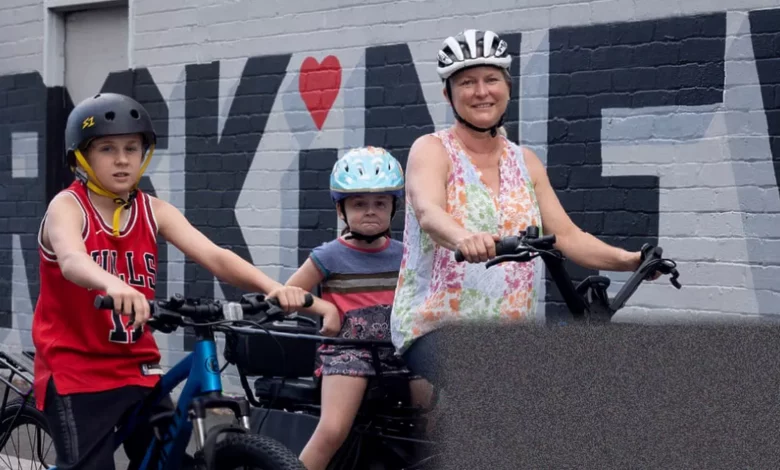
“The initial motivation was more environmental,” says inner-west resident Jacinta Peperkamp, a single mother of two who now relies on a cargo e-bike. “But now it’s definitely a cost-of-living thing.” She notes that before the recent fuel price spike, she wouldn’t have dreamed of longer trips, but now she and her son transit as far as western Sydney using a combination of bikes and trains.
Retailers are witnessing this mindset shift first-hand. David Miller-Heidke, general manager for Australia and New Zealand at 99 Bikes, reports e-bike sales surged by 136% year-on-year in the past week. “Many people who were previously considering an e-bike have now pulled the trigger, viewing it as a long-term cost-of-living fix,” he says. Chris Moore, owner of Sydney bike shop Omafiets, confirms customers are explicitly citing high petrol prices as their reason for purchasing a bicycle or e-bike, with particular interest in family and commuter models that can replace everyday car trips.
A historical parallel: Copenhagen’s oil crisis transformation
This pattern of economic shock catalysing a cycling revolution has a powerful historical precedent. Before the 1970s global oil crisis, Copenhagen’s planners considered removing bike lanes, with only 10% of locals cycling regularly. Denmark’s heavy reliance on imported oil forced a dramatic U-turn, spurred by mass citizen protests demanding better cycling infrastructure.
The result was the fastest expansion of Copenhagen’s bicycle network in its history between 1975 and 1985. Today, approximately 60% of Copenhageners use a bike to commute to work or study—a transformation born from necessity. Sydney’s current circumstances, driven by another oil shock linked to war in the Middle East, present a similar potential inflection point for urban transport.
Infrastructure demand and policy levers
The surge in cycling is being met with, and in turn fuelled by, new infrastructure. Transport for NSW figures show the newly opened Oxford Street cycleway saw almost 100,000 uses in March, while the Bourke Street cycleway in Redfern recorded 134,254 uses—almost triple the count from the same time last year. On a single Wednesday in April, over 4,500 bike trips were recorded along Darlinghurst’s Oxford Street, the highest since it opened.
Longer-term counts are even more striking. In the Sydney CBD, cycling rates almost doubled in March compared to the same time last year (496,516 counts versus 288,907), with adjacent suburbs like Paddington and Eveleigh also seeing massive increases.
Peter McLean, CEO of Bicycle NSW, argues governments should capitalise on this boom by investing heavily in active transport, rather than relying solely on short-term fuel excise cuts which he describes as a “sugar hit.” He points to the success of the Oxford Street cycleway as proof of demand for expanded “greenways.”
“It’s cheaper – even to have a really high-quality expensive e-bike – than it is to maintain a car,” McLean says, noting the compounding costs of insurance, servicing, and registration. “But of course, you do need to be in an area that has really good access to safe infrastructure.”
The NSW Government is investing $50 million in cycling and walking paths across the state, with a focus on Western Sydney and regional areas, and has identified strategic cycleway corridors for development. This aligns with Transport for NSW research indicating 70% of the population is interested in cycling, but many remain “interested but concerned” without safer conditions. There is also reported consideration of new incentives for e-bike and e-scooter riders, such as tax rebates, following the end of the previous Electric Vehicle Rebate Program in 2023.
For residents like Violette Kirton, who is looking to sell her car after buying her first home amid climbing interest rates, the equation is now clear. “The jump in petrol prices really put things into perspective,” she says. “Living and working in the inner west, I’ve started riding my bike more and realised I don’t need a car day to day.”