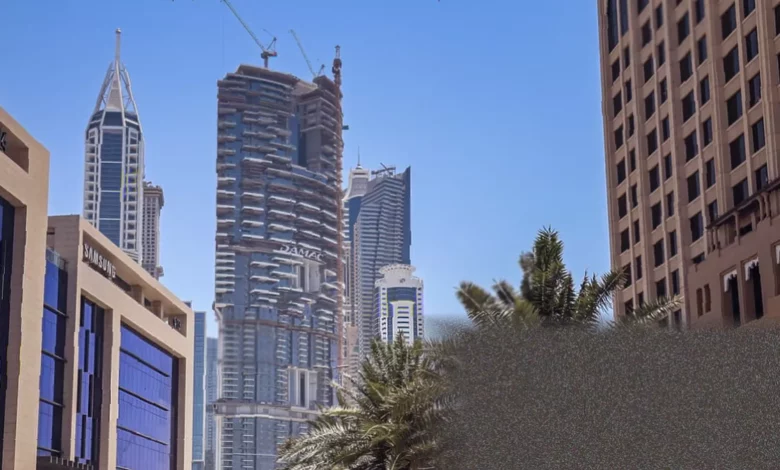
Dubai property sales have plummeted 19% in May, a sharp decline that marks the steepest monthly drop since the pandemic and underscores the fragility of a market once fuelled by a global influx of wealthy investors. The figures, compiled by the Dubai-based consultancy ValuStrat, accelerate a downturn that began in April, when sales fell 4% month-on-month. Transactions in May were less than half the volume recorded in the same month last year, according to the firm, which has tracked the city’s real estate since 2014.
Haider Tuaima, head of real estate research at ValuStrat, said the ready homes market had not recorded an annual decline of this magnitude since the Covid-19 pandemic. A separate analysis from the research firm Reidin, which draws on Dubai Land Department data, found that property worth 22.5bn dirhams (£4.5bn) was sold in May — 42% below the April figure and roughly half the 46.6bn dirhams recorded in February, the month before the conflict escalated. While the headline numbers point to a dramatic slowdown, the underlying cause is a collapse in buyer confidence triggered by war in the Middle East.
War shatters investor confidence
Hostilities erupted in late February, and the shock to Dubai’s property market has been severe. In March, an Iranian missile struck a five-star hotel on the Palm Jumeirah, causing a fire and injuring four people. The incident, combined with broader regional instability, sent a wave of panic through a market that had become accustomed to record-breaking sales. ValuStrat’s home price index fell 5.9% in March from the previous month — the first decline since 2020 — and the selling of luxury homes has been marked by aggressive discounting.
Yasin Valimulla, a buying agent specialising in properties worth at least $10m (£7.5m), said the few sales still going through were being completed at a 20% to 25% discount to pre-conflict values. “Every single one of the super-high-net-worth guys we sold to in the last year and a half has now left Dubai,” he said. “There was a lot of panic in March and there is still not much clarity to this day. Western European buyers are now more reluctant to buy properties here. I think they want to wait out maybe a year, even two years. It depends on how things play out.”
The exodus of wealthy individuals has been notable. Some have paid substantial sums for private jet evacuations, seeking safer havens in Europe — particularly Milan and Geneva, alongside London and Singapore. The shift in buyer demographics is already visible: demand from Middle Eastern countries such as Lebanon and Egypt has become more prominent, while Indian buyers, once a mainstay, have turned cautious. The impact on confidence has been so profound that even the city’s tourism and hospitality sectors have suffered a significant drop in customers and flight cancellations, indirectly weighing on property demand.
Richard Waind, of the real estate group Cencorp, said the war had acted as a “black swan event” that was “huge and swift”. He predicted that many of the smaller brokerages that opened during the frothy market would be forced to close. “There were about 1,000 brokers in the market a decade ago — now it’s about 10,000. That is going to fall,” he said.
Market correction after unsustainable boom
The current downturn is also a correction of a market that had become overheated. Dubai was the busiest city in the world for luxury real estate in 2025, according to Knight Frank. In the $2.5m to $10m bracket, more homes were bought in Dubai than in any other city globally — ahead of London, New York, Los Angeles and Hong Kong. In the $10m-plus segment, the gap was even wider: 9,050 sales in Dubai compared with 6,577 in New York and 3,089 in London. Knight Frank also recorded 500 sales of properties exceeding $10m in 2025, generating over $9bn in ultra-luxury value — up from just 30 such sales in 2020.
That boom was built on Dubai’s zero-income tax policy, its Golden Visa scheme offering residency for property investments of AED 2m or more, and a post-pandemic recovery that saw luxury prices rise 11.62% annually by the end of 2025. The Dubai Land Department reported AED 431bn in total transactions during the first half of 2025, a 25% year-on-year increase. Yet even before the war, there were warnings of oversupply. Ratings agency Fitch had forecast a possible 10% to 15% correction, with an estimated 210,000 new units set to enter the market. “The numbers were so high to begin with, especially in the last two years,” Valimulla said. “The market at that level was not sustainable anyway.”
While the super-rich have retreated, the question of how far prices will fall remains tied to geopolitics. Some reports indicate that prices for completed properties held steady in May, while those under construction fell by less than 9% — suggesting that the primary shock has been to transaction volumes rather than outright values. The Dubai Land Department has expressed confidence in the market’s outlook, citing strong fundamentals and a diversified investor base, but agents on the ground paint a more cautious picture. “There is going to be a correction in pricing,” Valimulla said. “We just do not know the impact of that correction until we have [geopolitical] clarity.”