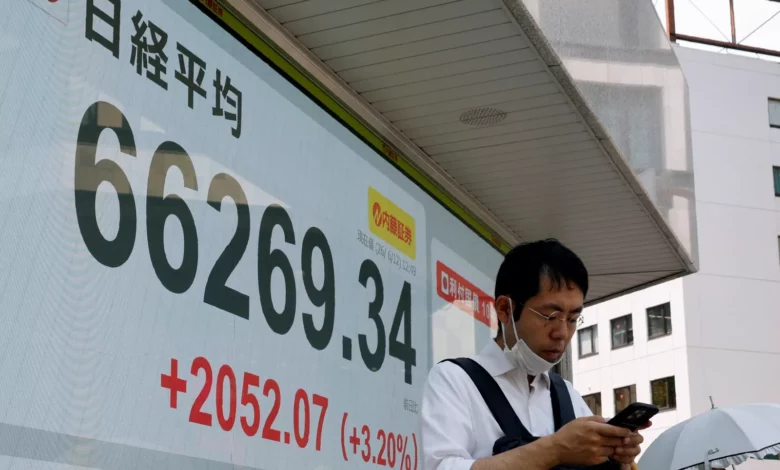
Japan’s Nikkei share average powered to a fresh record high on Thursday, breaching the 71,000-point barrier for the first time, as investors piled into semiconductor and AI-related stocks despite a backdrop of geopolitical uncertainty and shifting monetary policy expectations.
Asian markets mixed as oil retreats on Iran deal
Across the broader Asia-Pacific region, MSCI’s broadest index of shares excluding Japan was flat. South Korean shares rose 0.9 per cent, later extending gains to more than 2 per cent to hit their highest close in two weeks. Taiwan’s Taiex jumped 1 per cent. Hong Kong’s Hang Seng, however, sank to an 11-month low, while Singapore’s Straits Times Index pared earlier gains to sit 0.2 per cent higher.
The rally in Tokyo was fuelled by solid gains in semiconductor and AI-related names, even as other markets took a more cautious view. The benchmark 10-year Japanese government bond yield climbed 2 basis points to 2.620 per cent, its highest close since 16 June, after touching 2.63 per cent during the session.
The positive tone in parts of Asia came as oil prices extended their recent slide following the signing of an interim peace deal between the United States and Iran. The agreement, signed remotely by the two presidents, extends a ceasefire first announced in April by a further 60 days to allow negotiations for a final truce. The full text of the accord was released after it had already circulated widely.
A key element of the deal is the reopening of the Strait of Hormuz to toll-free passage for 60 days, with Iran agreeing to remove technical and commercial obstacles within 30 days to facilitate vessel transit. The US has lifted its naval blockade on Iranian ports and waived sanctions on Iranian oil exports. The interim arrangement is a 14-point memorandum of understanding, with final truce talks set to begin on Friday in Switzerland.
Oil prices dropped sharply as the market priced in the easing of supply constraints. US crude fell 1.25 per cent to $75.83 a barrel, while Brent crude lost 1.4 per cent to $78.41 a barrel. Both benchmarks have now plummeted more than 15 per cent since the previous week, when talks of an agreement first emerged, and are almost back to pre-war levels. The conflict had previously caused the largest disruption to world energy supply since the 1970s energy crisis, with Brent crude surpassing $100 a barrel and peaking at $126.
Despite the apparent progress, US President Donald Trump threatened to resume attacks and kill Iranian officials if Iran failed to honour its commitments. He also said the agreement was not final and that the US could resume bombing Iran if it “doesn’t behave”. Pakistani Prime Minister Shehbaz Sharif played a key role in mediating the negotiations. The deal defers difficult issues such as Iran’s nuclear programme; the US has stated that Iran agreed never to have a nuclear weapon, but Israel fears it will allow Iran to continue enriching uranium at some level. Israel has continued carrying out limited strikes in Lebanon since the deal was announced.
“Major geopolitical risk persists and will also remain a major driver of market action,” said Kyle Rodda, a senior financial market analyst at Capital.com.
Wall Street sell-off deepens on rate hike fears
While Asian trading saw pockets of strength, the mood on Wall Street was markedly different. All three major US indexes fell close to or more than 1 per cent overnight, as traders bet that the Federal Reserve’s next move would be a rate hike. The Dow Jones Industrial Average dropped 507.12 points, or 0.98 per cent, to 51,492.55. The S&P 500 lost 91.25 points, or 1.21 per cent, to 7,420.10. The Nasdaq Composite slid 354.69 points, or 1.34 per cent, to 26,021.66. The sell-off came despite a strong rally earlier in the week, when the Nasdaq climbed 3 per cent and the Dow hit a record-high close on Monday.
The trigger for the latest downturn was hawkish commentary from the Fed’s new chair, Kevin Warsh, who highlighted the need to tame inflation. According to the Fed’s Summary of Economic Projections, inflation expectations for 2026 have been revised up. Nearly half of the Federal Open Market Committee — nine of 19 policymakers — now expect a rate hike later this year, a sharp departure from three months ago, when none supported such a move. The Fed kept its benchmark interest rate unchanged in the range of 3.5 per cent to 3.75 per cent at its most recent meeting, but markets are now pricing in at least one quarter-point increase in the federal funds rate over the next six months.
The impact of the hawkish repricing was visible across bond markets. The yield on the benchmark 10-year US Treasury note rose to 4.471 per cent, compared with its US close of 4.463 per cent on Wednesday. The two-year yield, which is more sensitive to expectations for the Fed funds rate, touched 4.1759 per cent, up from 4.163 per cent. In currencies, the dollar rose 0.01 per cent against the yen to 160.65, touching its highest level since July 2024 overnight. The dollar index, which measures the greenback against a basket of major currencies, edged down 0.03 per cent to 100.32. The euro gained 0.1 per cent to $1.1511.
Central bank decisions and economic backdrop
The Bank of England meets on Thursday and, like the Fed, is expected to hold interest rates unchanged at 3.75 per cent. Policymakers are grappling with heightened uncertainty stemming from the Iran conflict and its inflationary impact. The UK economy shrank in April as the war began to weigh on growth, while inflation has risen to 3.3 per cent, higher than the pre-war forecast of February.
The recent decline in oil prices has begun to ease worries about an economic slowdown, especially in energy-importing Europe. The International Energy Agency said on Wednesday that the oil market would move into a significant supply surplus in 2027 after recovering from the closure of the Strait of Hormuz. The agency projects global oil supply will grow by about 8 million barrels per day in 2027, while demand is expected to advance by only about 2 million barrels per day, creating one of the largest surpluses seen in recent years. The reopening of the strait, through which roughly one-fifth of global oil production passes, is central to that outlook. The US and its partners have also been required to devise a $300 billion plan to finance Iran’s recovery as part of the broader framework.
Analysts have cautioned against expecting a near-term return to pre-war prices, citing factors such as shipping insurance costs, the risk of mines in the strait, potential further closures, and the ever-present threat of renewed hostilities. US stock futures, however, pointed to a rebound at Thursday’s open, with S&P 500 e-minis gaining 0.81 per cent to 7,484.8.