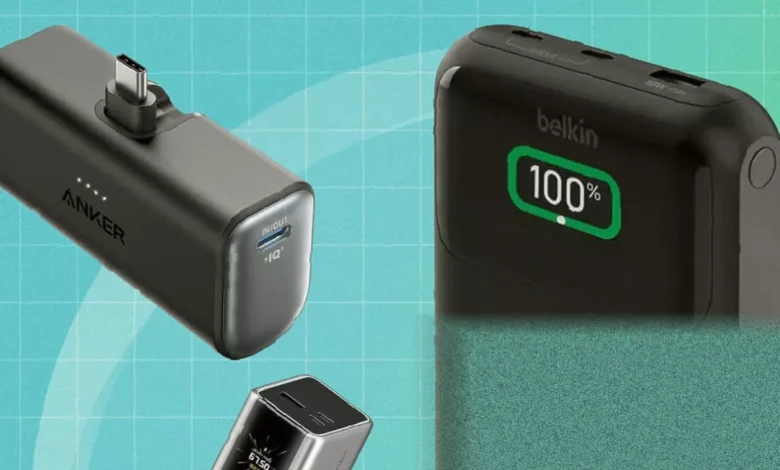
Power banks offer a lifeline against gadget battery death. Few things are more disempowering than the flash of a low-battery graphic or the plaintive bleep that signals your smartphone, laptop or other essential device is about to give up. In that moment you lose a way to entertain yourself, get things done, stay in touch, or even get home safely. There is a time and a place for a digital detox – but rarely when you need directions, a train ticket or to finish a piece of work.
Carrying a power bank is the ticket out of electronic oblivion. These pocket-sized cuboids plug into compatible devices and charge them, often via assorted connections such as USB-C and USB-A. Most power banks are designed for smartphones and smaller gadgets like fitness trackers and earbuds, but some models can also power hungrier laptops and large portable speakers. For those who need even more capability, portable power stations can charge various high-voltage appliances — perfect for camping, garden parties and power cuts.
The problem: a world of draining batteries
The anxiety of a dwindling battery is a modern constant, especially as smartphones pack ever-larger capacities that demand equally capable charging solutions. Advances in battery technology have pushed smartphone batteries well beyond the 2,500mAh to 3,500mAh range of a few years ago. The average smartphone battery capacity reached 5,291mAh in January 2026, driven by the adoption of silicon-carbon batteries. These new cells allow manufacturers to squeeze more capacity into the same physical space compared with traditional lithium-ion cells. Honor was an early adopter of silicon-carbon technology, followed by Xiaomi, OPPO, OnePlus and vivo. The result: devices such as the Honor Magic 8 Lite boast a 7,500mAh battery that some users report lasting up to four days, while the European version of the Honor Magic 8 Pro packs 6,270mAh (its Chinese counterpart has 7,200mAh, a difference driven by transport regulations that restrict the shipment of large batteries into certain regions). Even mid-range models like the Honor Magic 7 Lite, marketed as a “mid-range Battery King”, offer 6,600mAh and up to two days of use. For older or less flashy handsets, a 2,500mAh battery is still common, and the popular Samsung Galaxy S25 sits at 4,000mAh.
Laptops are no less demanding. The Acer Aspire Vero 16 has a 53Wh battery and requires a 65W charger; the Lenovo ThinkPad T16 has a 52.5Wh battery and also needs 65W. Without a power bank that can deliver that kind of wattage, a dead laptop means you are effectively offline.
The solution: choosing the right power bank
To navigate the growing market, tech reviewer Pete Wise put 17 power banks through their paces, testing models from Belkin, Anker, Cuktech, Iniu, Ugreen, Bluetti, Acer and EcoFlow. He charged a range of devices — including the Honor Magic 7 Lite (6,600mAh), Magic 7 Pro (5,270mAh), Magic 8 Lite (7,500mAh) and Magic 8 Pro (6,270mAh), plus the Acer and Lenovo laptops — and timed how long each power bank took to deliver a 30% charge. The best performers earned a place in the list below.
At a glance: the power banks that stood out
Best power bank overall: Belkin BoostCharge Pro 3-port 20k
Best budget power bank: Belkin BoostCharge 10k with integrated cable
Best power bank for portability: Anker Nano
Best power bank for smartphones: Anker Nano A1638
Best power bank for speed and power: Cuktech 15 Ultra
Best high-storage power bank: Ugreen Nexode 25000mAh 200W
Best power bank for multiple users: Belkin UltraCharge Pro laptop power bank 27K
Some power banks also include extras such as digital displays, integrated cables and control buttons. The Cuktech 15 Ultra, for example, features a detailed screen that shows real-time wattage, amperage, voltage, battery level and estimated charging times. It can output up to 210W total and charge itself to 70% in just over 20 minutes using “Beast Mode”, making it a standout for anyone who needs speed and power on the go. For air travellers, models like the Anker 20,000mAh 87W power bank are approved for flights — a useful detail for frequent flyers.
Understanding the specs: wattage, capacity and what really matters
Before you buy a power bank, understanding a few key specifications is crucial. The wattage (W) tells you how much power the device can deliver. If you need to charge a laptop that requires 65W, you must choose a power bank that can supply at least that amount. Higher-wattage models are typically heavier, bulkier and more expensive because they need larger batteries and better cooling. Voltage is equally important — mismatched voltage can prevent charging or damage devices.
Capacity, measured in milliampere-hours (mAh), indicates how much electrical charge the power bank’s lithium-ion battery can hold. A power bank with 20,000mAh can fully charge a 6,000mAh smartphone about three times (accounting for some energy loss). For reference, a typical modern smartphone battery ranges from 2,500mAh to 5,000mAh, though heavy users who game or stream extensively will benefit from a higher capacity power bank. Laptops are rated in watt-hours (Wh), so the rule of thumb is that a power bank’s wattage must match or exceed the laptop’s charging requirement.
Ports and connections are another vital consideration. Most power banks use USB-C or USB-A to connect to devices, and some can also charge smartphones wirelessly. Apple users should look for models with a Lightning cable and port. If you plan to charge multiple gadgets at once, check both the maximum power output per port and the total output when several devices are connected simultaneously — splitting power across ports reduces the speed for each.
Testing revealed that even flagship smartphones now routinely have batteries above 3,500mAh. The Honor Magic 7 Pro, for example, supports 100W wired charging, while the Magic 8 Lite and Magic 7 Lite both support 66W charging. Matching your power bank’s output to these speeds can make a dramatic difference in how quickly you get back to full charge.
How long should a power bank last?
Like all lithium-ion devices, power banks gradually lose capacity over time. A full charge and discharge counts as one cycle, and most power banks are rated for 300 to 1,000 cycles. After that, their capacity can drop to 60-80% of the original. Depending on usage frequency, this translates to anything from one to several years. Heavy daily users might hit 365 cycles per year and see noticeable degradation in 1.5 to 2 years; occasional users can get 3 to 5 years or more. It is no coincidence that power bank warranties typically top out at about two years.
Good habits can preserve the battery’s condition. Very-low or very-high charge levels put the most stress on cells, so try to keep your power bank moderately charged most of the time. Overcharging (maintaining 100% for long periods) and over-discharging (letting it drop to 0%) accelerate degradation. Storage conditions matter too: extreme heat causes electrolyte decomposition and increases internal resistance, while cold and humidity can cause corrosion and gas generation. The optimal operating temperature range is 15°C to 25°C. If you store a power bank for weeks or months, aim for a charge level of 40-60% in a cool, dry place. Even when not in use, power banks self-discharge at a rate of roughly 2-10% per month, so it is wise to recharge them every two to three months to prevent deep discharge.
What to do with your old power bank
Old power banks — and any product containing lithium-ion batteries — should never go into the household rubbish bin because of the fire risk. Instead, take them to a local recycling centre where they can be sorted into a WEEE (Waste Electrical and Electronic Equipment) bin. Valuable materials such as lithium, cobalt and nickel can then be recovered and used to produce other items. For guidance or to find a recycling centre, head to Recycle Your Electricals.
For the record, the power banks that manufacturers did not want returned after testing will be donated to Cat Action Trust 1977, a small national charity dedicated to the welfare of feral cats.