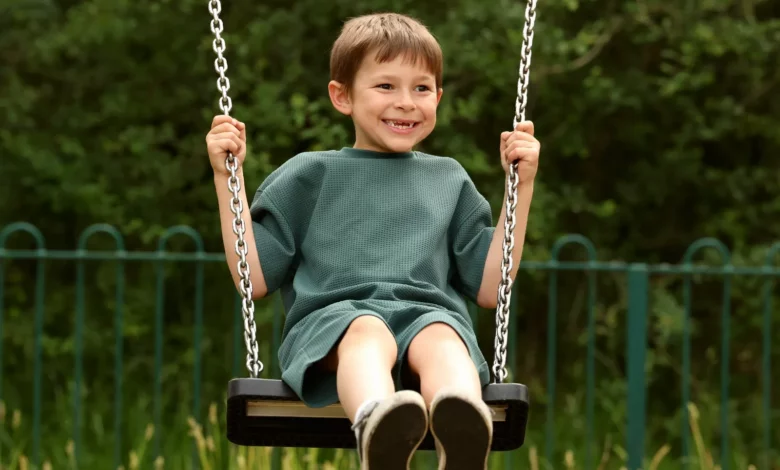
A seven-year-old boy is thriving after becoming the first child in the United Kingdom to receive a life-saving heart procedure typically reserved for adults – a series of angioplasties that reversed his heart failure and cleared the way for major surgery. Elliot Atkins, who now lives with his family in Colchester, Essex, is described by his mother as “running around with his friends and happy” and is training for his school’s sports day, eager to take part in the class race, ball skills and throwing events.
Elliot’s journey began when he was born healthy at Musgrove Park Hospital in Taunton, Somerset. But at 11 months old, after developing a chest infection, he became seriously unwell and struggled to breathe. A scan revealed his heart was enlarged, and he was taken to the Bristol Royal Hospital for Children, where further tests confirmed he was in heart failure with dangerously high blood pressure and a narrowed aorta – the large tube that connects the heart to the rest of the body. Medics were initially puzzled, with his mother Amy Govier recalling that “they couldn’t work out why, because his symptoms weren’t adding up.”
Elliot was then referred to Great Ormond Street Hospital (GOSH), where specialists diagnosed him with a “one in a million” condition called middle aortic syndrome (MAS). This rare disorder involves the narrowing of the abdominal aorta and often the renal and other visceral arteries, significantly reducing blood flow, raising blood pressure, and placing extreme strain on the heart, kidneys, brain and eyes. MAS accounts for only 0.5 to 2 per cent of all aortic narrowing cases and can be associated with specific genetic syndromes.
A groundbreaking intervention
With Elliot’s heart failure so advanced, major surgery was initially considered too risky. Doctors from different specialties across the children’s hospital decided to try an approach never before performed in a child with heart failure: an angioplasty. The procedure, common in adult cardiology, involves guiding a small balloon into narrowed blood vessels and inflating it to widen them, thereby improving blood flow. However, it had not traditionally been considered possible for children in severe heart failure.
Elliot’s father, Thomas Atkins, a military medic, described the anxiety of facing an unprecedented treatment. “There was nothing that we could go and look at and read,” he said. “It meant we couldn’t Google anything to reassure ourselves that this was going to be okay. There was stuff on angioplasty, sure, but the patient pool was much, much older, so we knew that the procedure itself was fairly routine, but the fact that it was on a child in Elliot’s condition… we were at a loss really.” Despite the uncertainty, discussions with the angioplasty surgeons and vascular surgeons put the family’s mind at ease, and the team was reassured by the fact that Elliot’s behaviour didn’t match his clinical picture – he still acted like a normal child. Ms Govier said much of her reaction was “pure horror and shock.”
Between his first angioplasty in 2020 and the age of two, Elliot underwent six such procedures. The interventions widened his blood vessels, improved his blood pressure control, and strengthened his heart, making him fit enough to withstand a long and complex operation that would ultimately save his life.
The life-saving surgery and recovery
Last July, Elliot received an aortic bypass graft with a transplant of a single kidney. Surgeons created a new route for blood flow around the narrowed section of his aorta using a specially designed synthetic graft, while relocating his kidney to improve its blood supply and help control his blood pressure. The operation was the culmination of the series of angioplasties – without them, his mother said, “he wouldn’t have made it.”
Today, Elliot is taking fewer medications and his quality of life has improved significantly. “He just knows he’s got this scar on his tummy, and that’s it,” Ms Govier said. “He’s just a bundle of joy, he always tries to make people laugh.”
GOSH confirmed that Elliot is the first child in the UK to receive an angioplasty for heart failure. There are no other documented cases globally, meaning he could be the first child ever to undergo the intervention for that purpose. Since his initial procedure in 2020, the teams at GOSH have successfully performed angioplasties for heart failure on several other children, both from other UK centres and from abroad.
Dr Jelena Stojanovic, Elliot’s clinician and lead for the kidney transplant and renovascular service, said: “Following Elliot’s intervention, we have successfully performed this intervention over several other children who will refer to us not from other centres in the UK but also from abroad. This is a very rare condition, and the numbers on its own will be small, but what is important is that the children can be offered the chance to survive. When we as a team look at him today, we see a child who has been given an opportunity that simply would have not existed without the treatment and the extraordinary efforts of the teams involved in his care.” She added that GOSH’s multidisciplinary approach means its teams “use our collective expertise to push the boundaries of what is possible and treat the elsewhere untreatable conditions.”