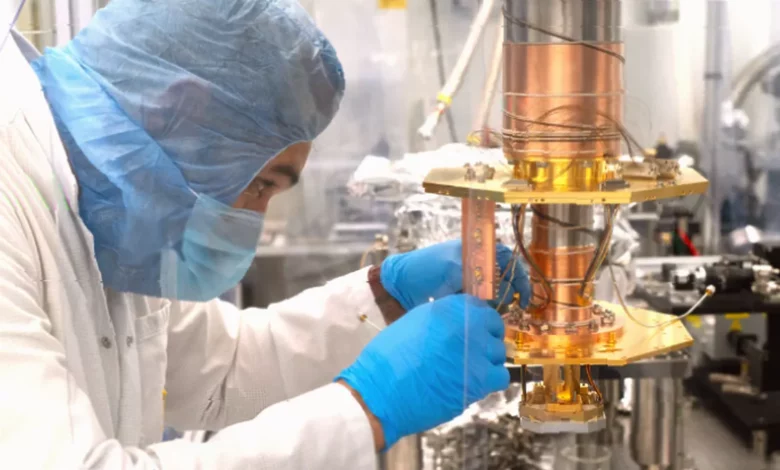
EleQtron, a German company developing trapped-ion quantum processors, has closed a Series A funding round worth €57 million, with the investment led by Schwarz Digits, the technology arm of the Schwarz Group, Europe’s largest retail group. The round marks a significant injection of capital into the deep-tech sector and signals growing corporate appetite for quantum computing capabilities.
Alongside Schwarz Digits, the round drew participation from the European Innovation Council (EIC) Fund, existing investor Earlybird, and new backers including Ankaa Ventures, Precitec, NRW.BANK and IFB Hamburg. The company said the funds will be directed toward three main priorities: scaling up the production of new hardware, expanding cloud-based remote access for research partners, and further developing its proprietary MAGIC hardware platform. This latest funding builds on more than €15 million secured in 2022, primarily through the BMBF-funded “MAGIC App” project.
Company Background and Growth
Founded in 2020 as a spin-off from the University of Siegen, eleQtron traces its roots to the university’s Chair of Quantum Optics, where foundational research for its core technology was conducted. The company was co-founded by Dr Christof Wunderlich, a recognised pioneer in radio-frequency-controlled stored ions, Dr Michael Johanning and Jan Henrik Leisse. The University of Siegen also offers a Master’s degree in Quantum Science, reflecting its broader engagement with the field.
EleQtron now employs more than 100 people drawn from over 25 countries — an unusual degree of international diversity for a deep-tech hardware startup based in Siegen. The company has introduced dedicated hiring programmes aimed at attracting more female candidates, and reports that women make up 13 per cent of its team, a figure it says is above the sector average. On the commercial side, eleQtron has secured contracts with an order volume exceeding €50 million, including agreements to supply quantum computers to the German Aerospace Centre (DLR) and the Jülich Supercomputing Centre.
Inside the Trapped-Ion Technology
At the heart of eleQtron’s work are trapped-ion quantum processors. These machines use individual atoms held in place by electromagnetic fields as the fundamental units of computation, known as qubits. The company’s proprietary approach, called MAGIC (Magnetic Gradient Induced Coupling), uses magnetic fields and microwave signals to control those single atoms. The microwaves involved are similar to those found in everyday devices such as smartphones and satellites, and because those components are already mass-produced for other industries, scaling up to larger machines becomes primarily an engineering challenge rather than a fundamental physics problem.
The trapped-ion design offers several notable advantages over other quantum computing architectures. Because every atom of a given element is identical, trapped-ion qubits possess a natural consistency that leads to a lower inherent error rate before any correction is applied. These systems can also operate at or near room temperature, a significant practical benefit compared with superconducting approaches that require extreme cryogenic cooling. Furthermore, trapped-ion qubits are widely regarded as offering the best coherence times — the length of time a qubit can retain its quantum state — and the highest fidelity entangling gate operations among current quantum computing platforms. This combination of attributes makes the technology especially attractive for researchers aiming to build commercially viable quantum computers that avoid the most challenging scaling problems seen in competing designs.
Strategic Context and Market Position
The investment by Schwarz Digits is part of a broader strategy by the Schwarz Group to secure independence in key technologies and shape forward-looking, secure IT infrastructure in Germany. Christian Müller, co-CEO of Schwarz Digits, described the investment as a “logical building block” following the group’s earlier strategic decisions in cloud and artificial intelligence. Schwarz Digits is already a significant backer of the AI company Aleph Alpha, part of an effort to build a sovereign European AI ecosystem. The group is also transforming itself into what it calls an ecosystem orchestrator, integrating technology, cloud services and circular economy solutions.
EleQtron operates in a fast-growing global market. The overall quantum computing market is projected to reach hundreds of billions of dollars by the mid-2030s, with demand expected from pharmaceuticals, logistics, finance and aerospace. The trapped-ion quantum processor segment alone is forecast to grow to an estimated USD 2.93 billion by 2033. In Europe, eleQtron competes with firms such as IQM, which uses superconducting quantum processors, and Pasqal, which works with neutral atoms. On the global stage, it faces established players including IBM, Google, IonQ, Universal Quantum and ZuriQ.
Europe is actively working to establish itself as a leader in quantum technologies. The EU’s Quantum Strategy and the proposed Quantum Act aim to transform the continent into a “quantum industrial powerhouse” by 2030. Germany is a key contributor to this effort, having designated quantum technology as a strategic priority and earmarked substantial public funds for research and industry consortia such as QUTAC. The European High Performance Computing Joint Undertaking (EuroHPC JU) is also integrating quantum accelerators into supercomputers, further embedding quantum capabilities into the continent’s research infrastructure.