EU would fast‑track UK rejoining as ‘major victory’ for bloc
The European Union would treat a British decision to rejoin the bloc as a landmark triumph for the European project and stands ready to fast‑track the country’s accession, senior EU figures have said. Sandro Gozi, who chairs the European Parliament’s delegation to the EU‑UK Parliamentary Partnership Assembly, told The Independent that a request from London would be seen not as a victory over the UK but “as a victory for Europe as a whole”. He insisted that the process could be accelerated because of the UK’s existing alignment with EU law and the institutional memory that remains from its 47 years as a member. Brussels sources confirmed that the UK’s potential re‑accession could take place much more quickly than for other candidate countries, given that significant portions of its legislation are already compatible with the bloc’s rules.
Gozi drew a direct parallel with Finland, which took just three years to join the EU after leaving the European Economic Area. “The UK is still aligned with EU legislation and where it has diverged it is very clear where it has diverged,” one source explained. “Both sides would need to vet existing Albanian legislation, get it translated and then go through it very carefully. In Britain, that’s very clear.” A separate source with links to Brussels agreed, noting that the UK’s pre‑existing alignment makes it a fundamentally different case from aspiring members such as Albania.
The price of re‑entry: Euro membership and lost carve‑outs
Yet any swift return would come with significant conditions that are likely to prove deeply controversial in British politics. Gozi warned that the UK would have to accept the same terms as any other candidate country and give up its “obsession with carve‑outs”. Chief among those is joining the euro. The UK previously negotiated a permanent opt‑out from the single currency as part of its EU membership, as well as a rebate that reduced its budget contribution by roughly 66 per cent. Both would almost certainly have to be surrendered.
While Brussels sources said joining the euro would be a “key starting point” of talks, multiple officials pushed back against the idea that it would be an absolute red line. “The EU’s starting point will be that we should commit to joining the euro in due course,” one source said. “But look at the fact that there are at least five member states who are not in the euro and show no intention of joining. Denmark, Sweden, Poland and so on. The EU has already had to accept a two‑tier position when it comes to euro membership.” That suggests room for a phased approach, though the same source acknowledged that the UK currently fails to meet the strict economic entry criteria – particularly the benchmark on government debt. A former MEP put it bluntly: “You can’t just join the euro. The entry criteria are very strict with four economic benchmarks, and the UK doesn’t currently meet them, and it’s a very long way from meeting the one on government debt.”
The possibility of wiggle room was echoed by another official, who said the UK could commit to joining “in due course” without an immediate deadline. However, any compromise would still draw fierce criticism from the Conservatives and Reform UK, who have already seized on the prospect of the UK rejoining the single currency. Polling from April 2026 illustrates the scale of the challenge: while 55 per cent of British voters support rejoining the EU overall, that backing is heavily concentrated among Labour (83 per cent), Liberal Democrat (84 per cent) and Green Party (82 per cent) supporters – whereas only 39 per cent of Conservatives and 18 per cent of Reform UK voters are in favour. A separate YouGov survey from the same month found 53 per cent of people favour UK membership, with 32 per cent opposed.
Political jockeying and public mood
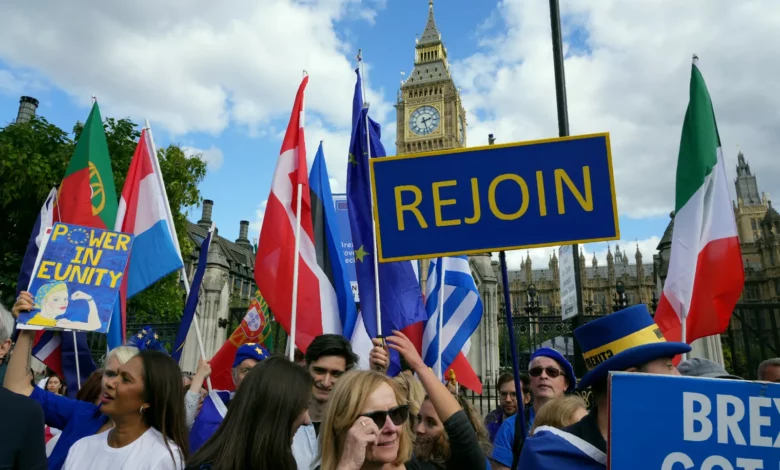
The debate over Britain’s place in Europe has been reignited by Wes Streeting, a former health secretary and contender for the Labour Party leadership. Last week Streeting described Brexit as “a catastrophic mistake” and argued that “Britain’s future lies with Europe, and one day – one day – back in the European Union”. His intervention has provoked internal criticism, with some Labour MPs warning that it misreads public sentiment and risks alienating voters who backed Leave. Gozi, however, suggested that a clear promise to rejoin could be an effective electoral tool for Labour against Reform UK, arguing that it would diminish Nigel Farage’s appeal. The YouGov polls show that 63 per cent of the British public want closer ties with the EU, lending weight to the view that the mood is shifting.
The legal route for any re‑application is set out in Article 49 of the Maastricht Treaty, which requires unanimous support from existing member states and a majority in the European Parliament. Political scientist Anthony Salamone has suggested that sustained public backing of around 60 per cent would be a plausible minimum for member states to approve a UK bid. New negotiated terms would also likely require participation in the Schengen Area, further testing the political appetite in London.
Brussels focused on existing deals, not hypotheticals
Despite the speculation, a source close to the EU’s ambassador to the UK was quick to temper hopes of a fast‑track. They insisted that the bloc is currently focused on delivering existing agreements with Britain, in particular the Sanitary and Phytosanitary (SPS) deal that aims to ease trade in plants, animals and food products. That agreement, expected to come into effect in mid‑2027, involves dynamic alignment with EU SPS legislation and the creation of a shared SPS zone. Businesses trading with the EU are being urged to prepare for changes that will reduce paperwork and border checks.
The same source dismissed talk of UK re‑accession as “an internal issue”, pointing out that “we have nearly 10 countries that want to join the EU that are candidate accession countries. This is the biggest amount of countries we’ve seen. And there has so far been no request from the UK to rejoin, so there is currently no discussion.” That blunt assessment echoes the position of European Commission President Ursula von der Leyen, who said in November 2023 that Britain was on a clear “direction of travel” toward rejoining and that her generation had “goofed it up”, leaving it to the next generation to “fix” the mistake of Brexit. The main political parties in the UK remain divided: the Conservatives and Reform UK oppose rejoining; the Green Party, Liberal Democrats, Plaid Cymru and Scottish National Party support it; and the Labour Party’s official position is to stay out – a stance that Wes Streeting’s leadership challenge now directly calls into question.