The distressing saga of a stranded humpback whale in the Baltic Sea has escalated far beyond an ecological drama, spiralling into a national crisis marked by death threats against experts and exploited as a rallying cry for political extremism.
A Nation Divided
For weeks, the plight of the 10-metre male whale has captivated Germany, morphing from a rescue mission into a feverish public spectacle. Dubbed “Timmy” by some locals—a name experts pointedly avoid for fear of unhelpful anthropomorphism—the animal’s suffering has been documented in relentless Instagram stories and media liveblogs. This intense focus has, however, curdled into something darker. The news magazine Spiegel described the scene as a “failed theatre production,” starring “offended animal rights protectors, angry police, helpless authorities and a whale which doesn’t follow stage instructions”.
Behind that spectacle lies a wave of vitriol. Experts from the German Oceanographic Museum in Stralsund and other involved scientists have faced serious death threats for their role in the operation, to the extent that one leading humpback whale specialist has stopped allowing her name to be used in media reports, stating “it has become dangerous to talk about humpback whales in Germany”. Social media influencers have levied harsh criticism against the scientists, leading to personal attacks that German police are now investigating. The situation has sparked protests, with some participants ignoring safety barriers to approach the whale.
The emotional public response has also been channelled into the political sphere. Critics accusing politicians and environmentalists of worsening the whale’s condition, even of animal cruelty, have framed the entire episode as an argument for bringing the far right into power. This political weaponisation of the whale’s suffering underscores the profound divisions the stranding has exposed.
A Rescue Effort Overwhelmed
The whale was first sighted in early March near Wismar and Timmendorfer Strand, far from its natural habitat. The Baltic Sea’s low salinity was causing significant skin problems, and its shallow waters are entirely unsuitable for a creature of its size. Experts believe it may have been lured in by shoals of herring, a common prey for humpbacks, which use sophisticated feeding techniques like bubble-net fishing.
Initial rescue attempts, coordinated with advice from the International Whaling Commission (IWC), involved using excavators to dig channels and creating waves with boats to guide the whale back to deeper water. All failed, with the animal repeatedly stranding itself. A key factor in its decline was a fishing net entangled in its jaw, which likely caused disorientation and severe weakness; though most of the net was removed, traces may remain.
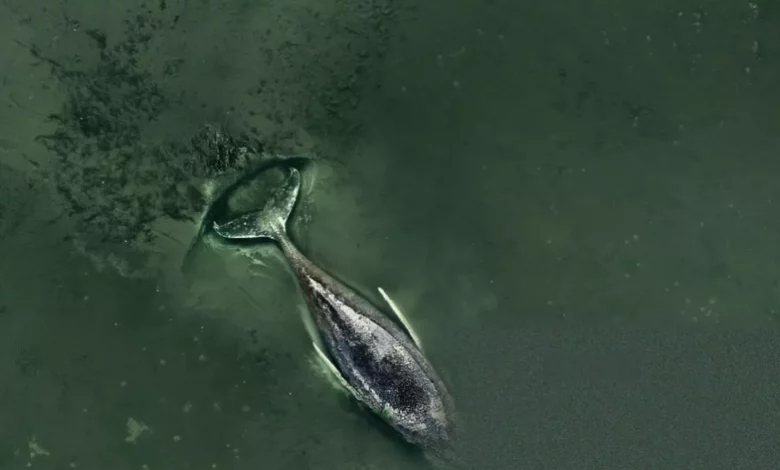
The whale’s condition, now in the shallow Kirchsee bay on the island of Poel, has deteriorated catastrophically. Marine biologists and veterinarians have documented wounds on its back, skin infections, and signs of severe organ damage, potentially including fluid in its lungs. Its immense body weight pressing on the seabed risks organ failure. Seagulls have been observed pecking at its injuries, and it shows minimal activity, breathing only every four to five minutes—a sign of profound exhaustion.
Faced with this, the environment minister for Mecklenburg-Vorpommern, Till Backhaus, alongside rescue workers and scientists, held an emotional press conference almost two weeks ago to declare active rescue efforts over. “The patient is very sick,” Backhaus said, calling it one of the most demanding situations of his 27-year career. The authorities pleaded with the public to let the animal die in peace.
That plea was ignored. A torrent of well-meaning but often impractical suggestions flooded in, including using cranes, inflatable pontoons, playing whale song, or hiring a giant catamaran from Denmark. An Austrian inventor proposed building a swimming pool around the whale, while a self-styled “whale ambassador” composed a ritual healing song. A German millionaire, the MediaMarkt founder Walter Gunz, campaigned vigorously and even filed a lawsuit to force action, though it failed as he could not legally represent the whale.
Some proposals turned to euthanasia. One method considered, and reportedly used in Australia for whales larger than seven metres in emergency situations, involved attaching explosive devices to the head—a method the IWC acknowledges for dire cases. German authorities, however, ruled this out due to the risk of failure and danger to local infrastructure. Administering a lethal injection was also deemed virtually impossible, as it would require inserting a needle directly into the whale’s heart.
Political Fallout and Systemic Failure
The inability to resolve the situation has left authorities floundering. The local mayor admitted, “We have all been totally out of our depth.” Minister Backhaus has stated authorities will accompany the whale “to the last,” though he conceded that a hoped-for “Easter miracle” had not materialised.
The case has highlighted a stark contradiction in marine protection. The organisation OceanCare points out that despite strict marine mammal protection laws in Germany and the EU, these often fail in practice due to threats from fishing gear, pollution, underwater noise, and shipping traffic. They advocate for stricter implementation, including reduced shipping speeds.
Ultimately, the stranded humpback presents a unique and tragic challenge, as the IWC notes live large whales rarely strand in the Baltic. The plan is now set for its disposal after death, involving ships and lifting equipment. As the fire brigade continues to spray the dying animal with seawater in a final act of comfort, the episode stands as a grim testament to how a wild creature’s misfortune can ignite human passions, exposing societal fractures and the limits of both compassion and bureaucracy.