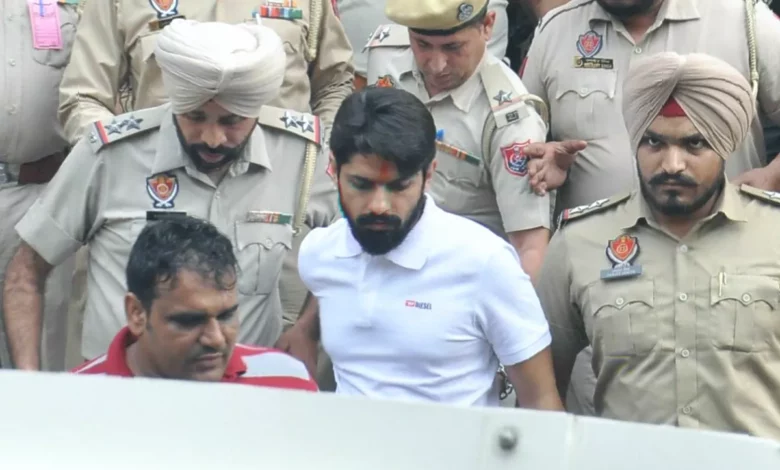
Gangster Lawrence Bishnoi orchestrates a sprawling criminal empire from a high-security prison cell, directing murders, extortion and international violence despite more than a decade behind bars awaiting trial on multiple counts of murder and extortion, according to Indian authorities and international intelligence agencies.
From his jail cell, Bishnoi allegedly commands a network of around 700 to 800 members operating across five Indian states and internationally, India’s National Investigation Agency has said. His most serious crimes have taken place while he has been in custody. In October 2024, members of his gang gunned down Baba Siddique, a senior Indian politician and former Maharashtra cabinet minister, in Mumbai. The assassination of Punjabi rapper Sidhu Moose Wala in May 2022 was also claimed by the gang. A well-publicised hit list includes Bollywood stars and stand-up comedians, with actor Salman Khan a longstanding target over the 1998 blackbuck poaching case — an animal considered sacred by the Bishnoi community.
Bishnoi’s ability to operate from prison raises serious questions about security within India’s penal system. He is alleged to use contraband devices and illegal communications to maintain control over his gang, the Bishnoi Gang, which now operates in North America, Europe, the Middle East, and countries including Italy, Armenia, Pakistan, Azerbaijan and Turkey. A classified Royal Canadian Mounted Police report has alleged that Bishnoi is operating a transnational criminal network from prison and “acting on behalf of the Indian government” — a claim India has vehemently rejected as “preposterous” and “absurd”.
The making of a modern don
Born Balkaran Brar on 12 February 1993 in the village of Dutarawali, in Punjab’s Fazilka district, Bishnoi grew up in a relatively wealthy landowning family. His father was a former police constable who later became a farmer. His mother, who harboured ambitions for him, renamed him after Henry Lawrence, a 19th-century British administrator who established a string of military-style schools. The family home, a spacious whitewashed building protected by a seven-foot boundary wall topped with barbed wire and CCTV cameras, sits just on the Indian side of the border with Pakistan.
Bishnoi enrolled at university in 2010 to study law, attending DAV College in Chandigarh, where he became president of the college’s student body and drifted into the underbelly of student politics. Early cases were registered against him for attempted murder, trespassing, assault and robbery in Chandigarh between 2010 and 2012. He was acquitted in four of seven first information reports filed against him there, with three still pending. His descent was swift. A shoot-out with police in 2014 marked the start of the decade-long jail stretch he is still serving. He was transferred to Tihar Jail in Delhi in 2021 under the Maharashtra Control of Organised Crime Act and is currently lodged in Sabarmati Jail in Gujarat. Despite his incarceration, he has been convicted only of minor offences such as extortion and illegal possession of arms.
Image, influence and international reach
During his years behind bars, Bishnoi has perfected managing his image as a revolutionary and made a virtue of his vegetarian diet and celibacy. He is celebrated in parts of the mainstream press as a “Hindu don” and reportedly considers himself a warrior for the cause. The Guardian has described him as “a model” for India’s great masses of unemployed youth, exemplifying a nihilistic ideology: grab what you can, by any means necessary, and punish anyone insulting the creed. A streaming platform, Zee5, has announced a documentary series titled “Lawrence of Punjab”, aiming to explore the formation of his criminal identity through culture, systems and digital visibility. The series has faced legal challenges in India, with the Punjab Police urging the centre to halt its release over concerns it might glorify gangster culture and incite youth towards criminal activities. Zee5 is reportedly challenging the government’s advisory.
The gang’s international network extends across Canada, the United States, Australia, Pakistan, Dubai, Thailand and Europe. The Federal Bureau of Investigation has arrested a Bishnoi member in California. Funds generated through extortion have reportedly been sent to Canada, the US, Dubai, Thailand and Australia to support associates and family members abroad, and to fund activities of pro-Khalistan extremists. In October 2024, Canada designated the Bishnoi Gang as a terrorist entity, following the Trudeau government’s accusation that the Modi government used the gang to carry out crimes against Sikh dissidents on Canadian soil. The designation allows for the freezing of gang assets in Canada and makes it illegal to provide material support to the group. A key suspect in the Baba Siddique murder, Zeeshan Akhtar, was arrested in Canada in June 2025 in connection with a fake passport case. Anmol Bishnoi, Lawrence’s brother and a prime accused in the same murder, was deported from the United States to India in November 2025.
The question of allies
Bishnoi shares many of the ruling administration’s strong Hindu nationalist convictions. His gang has allegedly targeted Muslims and Sikhs viewed with suspicion in the Hindu nationalist imagination. As the BBC has noted, “separating the man from the myth is becoming ever more difficult.” The control he exerts, however, would be impossible without powerful allies. India has dismissed Canada’s allegations of state links as baseless, stating that it had shared security-related information with Canada regarding gang members and requested action — requests India says were ignored. India has also asked Canada not to issue visas to individuals with links to gangs in India. The question remains exactly how far up India’s chain of command Bishnoi’s allies go.