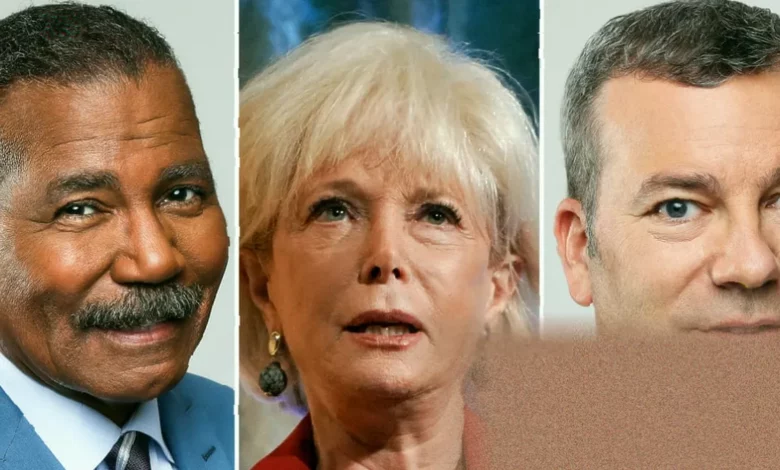
Three veteran 60 Minutes correspondents — Lesley Stahl, Bill Whitaker and Jon Wertheim — have announced they will remain with the programme, despite a wave of high-profile firings that has thrown the broadcast into turmoil. In a joint statement issued on Friday, the trio acknowledged they had “had a hard time deciding whether to stay”, adding that they did not want to see the show “die”. They said they had been “grieving because this whole mess has wounded and damaged the broadcast”. Their declaration: “We want to stay and fight.”
Stahl, 84, and Whitaker, 74, had been considered wild cards in the crisis, having stayed silent during weeks of upheaval that began when the new leadership of CBS News ousted several senior figures. The pair now join Wertheim, who had been expected to remain, in committing to the programme even as they condemn the management decisions that prompted the departures.
The firings that shook the broadcast
The trouble began in late May 2026 when CBS News, under a restructured editorial team, fired correspondents Sharyn Alfonsi and Cecilia Vega, along with senior producers Tanya Simon, Draggan Mihailovich and Matthew Polevoy. The network described the moves as part of a “total restructuring” of 60 Minutes. The new executive producer, Nick Bilton — appointed on 28 May to replace Simon — had no prior experience in broadcast television management, having built his career in technology reporting and documentary production. Bilton’s appointment was spearheaded by CBS News editor-in-chief Bari Weiss and CBS News president Tom Cibrowski; Weiss called Bilton “one of the most entrepreneurial journalists of our time”.
Days later, on the evening of Tuesday 3 June, the network terminated veteran correspondent Scott Pelley, informing him by email that he was being fired for “cause” because of his conduct in an explosive staff meeting the previous day with Bilton and managing editor Charles Forelle. In that meeting, Pelley reportedly accused Weiss of “murdering the show” and Bilton of having “slender qualifications”. Pelley later claimed in a statement that new management had instructed him to “inject falsehoods and bias into a politically sensitive story”. CBS News, for its part, said Pelley’s behaviour in the meeting constituted grounds for dismissal.
Alfonsi, whose contract was not renewed, said her dismissal was “a deliberate choice to penalize a journalist for refusing to sanitize factually accurate reporting” after she clashed with Weiss over a planned segment on El Salvador’s CECOT prison. Vega alleged she faced “censorship, both imposed and self-driven” and “efforts to insert political bias into our stories”. Anderson Cooper, a longtime contributor, had already departed in mid-May to focus on his CNN role and family.
The shake-up also claimed executive editor Draggan Mihailovich, managing producer Guy Campanile, and senior producer Matthew Polevoy. Tanya Simon, the daughter of the late 60 Minutes correspondent Bob Simon, was dismissed from her role as executive producer.
Why the veterans are staying — and what they say they are fighting for
In their joint statement, Stahl, Whitaker and Wertheim gave their most detailed explanation yet for remaining at a programme they described as wounded. They stressed that their decision should not be interpreted as “an endorsement of the existing power structure”. “That is simply, categorically not the case,” they wrote.
Instead, they said, their motivation is to “try and repair and preserve our reputation by continuing the Mike Wallace tradition of holding their feet to the fire”. The trio invoked the legacy of the programme’s original tough interviewer, vowing to fight for the values that made 60 Minutes an institution. “We want to stay and fight,” they added.
They expressed particular anger over the treatment of Simon and Mihailovich, whom they called “strong leaders who everyone respected”. The correspondents said they remained “deeply upset by the firings” of the two producers. “As far as we can tell — because no explanation has ever been offered — they were expelled because they fought for our 60 Minutes values and stood up to protect our independence and integrity. Newsrooms are not supposed to run like dictatorships,” the statement read.
The trio also voiced solidarity with Alfonsi, Vega, Pelley, Polevoy and Campanile. “We want to express how sorry we are that these principled, fair and honest journalists were treated so shabbily, with such indecency. It’s been heartbreaking,” they said.
The correspondents’ decision to stay comes despite their own misgivings about the direction of the network. Stahl, who joined CBS News in 1971 and has been on 60 Minutes since 1991, had previously voiced deep pessimism about press freedom. In May 2025, in an interview with New Yorker editor David Remnick, she expressed frustration with Paramount’s controlling shareholder, Shari Redstone, after it became clear the company planned to settle a lawsuit filed by Donald Trump. Stahl said she was “praying” that David Ellison, the chief executive of the company that had agreed to buy Paramount, would respect editorial independence. Asked if she was optimistic, she replied: “No, but there’s also not a lot of dark thinking, either. … I’m pessimistic about the future for all press today.”
Whitaker, who joined CBS News in 1984 and became a 60 Minutes correspondent in 2014, conducted the October 2024 interview with Kamala Harris that formed the basis of Trump’s $10bn lawsuit against the network. Trump alleged the interview had been deceptively edited to benefit Harris. After a complaint from the Center for American Rights, the Federal Communications Commission became involved, and in February 2025 CBS acceded to pressure to release full transcripts and all video footage. The suit was ultimately settled in July 2025 for $16m, with the funds designated for Trump’s future presidential library. The settlement occurred as Paramount was seeking FCC approval for its merger with Skydance Media, a deal led by David Ellison. Shari Redstone was reportedly keen to settle the lawsuit to clear the way for the merger.
The new executive producer, Nick Bilton, has said he held conversations with Stahl, Whitaker and Wertheim and emphasised his commitment to “journalistic independence”. But the trio’s statement makes clear they remain deeply sceptical. “We feared that our returning might be construed as an endorsement of the existing power structure,” they wrote. “That is simply, categorically not the case.”
Bari Weiss, who became editor-in-chief of CBS News in October 2025 with no prior background in television news, has stated her ambition to transform 60 Minutes so it can “thrive in the 21st century”. Alfonsi accused Weiss of “choosing access journalism over accountability and protecting power rather than scrutinizing it”. Managing editor Charles Forelle, for his part, has maintained that owners are independent of the news operation at CBS.
The three correspondents’ commitment to stay will be seen as a bid to prevent the complete collapse of a programme that has defined American broadcast journalism for decades. In their own words, they are choosing to fight from inside — even as they mourn the colleagues they believe were sacrificed to that fight.