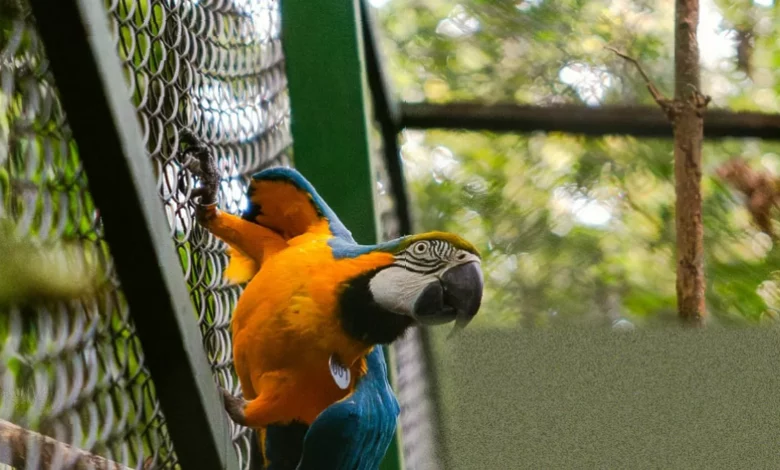
Flashes of blue and gold are once again darting through the canopy of Rio de Janeiro’s Tijuca forest, a sight unseen in the city for two centuries. The blue-and-yellow macaw, a bird so iconic its image adorns artwork across Rio but whose real presence was erased by history, is officially back.
The species was first described in the region by the French explorer Jean de Léry in the 16th century and last recorded by the Austrian naturalist Johann Natterer in 1818. After that, the record falls silent. Experts from the Refauna project state the macaw was almost certainly wiped out by deforestation for coffee and charcoal, and targeted by the wildlife trade for its vivid plumage.
The Reforestation of an Urban Rainforest
The lush expanse of Tijuca National Park, one of the world’s largest urban forests, is itself a product of monumental human effort. In the 1860s, facing severe water shortages, Emperor Dom Pedro II ordered the replanting of the denuded hills. This pioneering tropical reforestation, carried out by enslaved people under Major Manuel Gomes Archer, saw over 100,000 trees planted. While it restored the green cloak, the forest remained quiet. Marcelo Rheingantz, executive director of Refauna, estimates two-thirds of its large and medium-sized mammals had been lost.
This silence sparked the “refaunation” movement. Starting in 2010, Refauna began reintroducing species that were extinct in the park but survived elsewhere in Brazil. The long-legged red-rumped agouti rodent came first, followed by the yellow-footed tortoise and the brown howler monkey—last recorded in Rio in 1832 in Charles Darwin’s Beagle diary. “It’s really beautiful to be putting the forest’s orchestra back together again,” Rheingantz says.
Rebuilding the Web of Life
The return of the blue-and-yellow macaw, however, is the most striking movement in this symphony. Four birds, rescued from captivity and named Fernanda, Selton, Fatima and Sueli, have been meticulously prepared. The team spent months training them to avoid humans, recognise native fruits, and rebuild flight muscles. After an initial release earlier this year, they are back in their enclosure for monitoring, with a further release planned for September. Refauna’s scientific director, Luisa Genes, notes their powerful beaks can crack tough seeds and, crucially, their ability to travel tens of kilometres a day means they can “help regenerate other forests by taking seeds from Tijuca outside the park.”
This is the core of the project: rebuilding ecological relationships, not just adding animals. Vanessa Kanaan, director of Instituto Fauna Brasil, emphasises that reintroduction is “about ensuring that these species can once again perform their ecological roles.” The impact is already visible. Rheingantz points to the fruit of the Joannesia princeps tree, known as the agouti—or macaw—nut. Without the agouti to disperse it, the forest floor was once carpeted with rotting fruit, a symptom of “empty forest syndrome.” Now, the agouti’s sharp teeth crack the nuts, while howler monkey droppings create moist nurseries for seeds, which dung beetles then roll away. About 90% of the Atlantic Forest’s flora relies on animals to reproduce.
The macaws face challenges, primarily their own beauty and curiosity shaped by captivity. With the park receiving 5 million visitors a year, the team actively discourages human contact, waving red sticks and covering enclosures with foliage. They are also educating the public on the dangers of feeding the birds. The ultimate dream, shared by Rheingantz and park director Viviane Lasmar, is to see these symbols of restoration flying across the city’s skyline, actively stitching the fragmented forest back to health with every seed they drop.