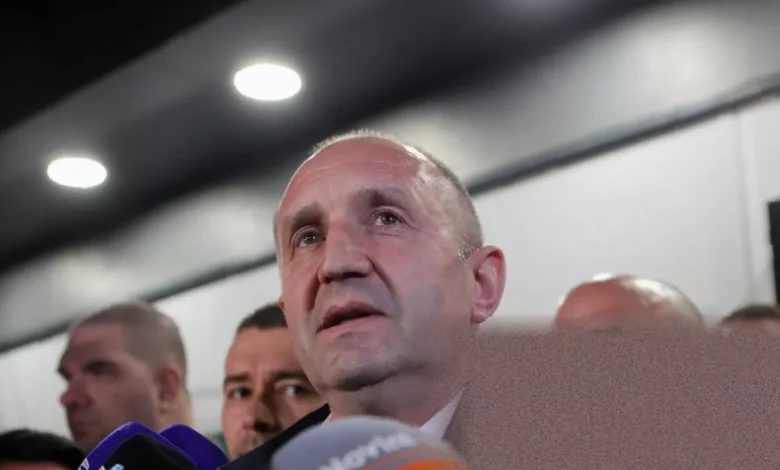
Rumen Radev’s Progressive Bulgaria party has secured a commanding victory in the country’s parliamentary elections, a result strong enough to potentially end the cycle of weak coalition governments that has plagued Bulgarian politics for years.
With 44.6% of the vote after 60% of ballots were counted, the party is projected to win about 44% overall, aiming for an outright majority in the 240-seat parliament. This performance, surpassing opinion polls, is one of the strongest by a single party in a generation and places Radev far ahead of his rivals. The pro-European We Continue the Change-Democratic Bulgaria (PP-DB) coalition trails on 14.2%, while the long-dominant GERB party, led by former prime minister Boyko Borissov, sits on 13%.
“This is a victory of hope over distrust, a victory of freedom over fear, and finally, if you will, a victory of morality,” Radev told a press conference. Borissov has conceded defeat.
A mandate born from frustration
The scale of the win reflects a profound public exhaustion. Bulgaria, a Balkan nation of 6.5 million, has endured eight elections in five years. The previous government collapsed in December 2025 following mass protests against a budget proposing tax and social security hikes, a symptom of broader anger over corruption and the veteran parties that have dominated for decades.
Radev, a former air force general and president who resigned in January to run, positioned himself as an anti-corruption figure. He rode a wave of frustration, with his recently formed party leveraging his standing and connection to the protests. “There is now an opportunity for the things people have been hoping to see change to actually become visible,” said Evelina Koleva, a manager in Sofia.
His campaign rhetoric drew direct comparisons with Hungary’s Viktor Orbán, focusing on a desire to improve ties with Moscow and resume the free flow of Russian oil and gas into Europe. A Eurosceptic, he has criticised the EU’s reliance on renewable energy and, during his presidency, vetoed legislative proposals and criticised the provision of lethal aid to Ukraine.
Policy ambiguity and profound challenges
Despite the clear mandate, Radev has been notably vague on detailed policy. He has stated Bulgaria would “make efforts to continue on its European path” and expressed a willingness to work on judicial reform with the pro-European PP-DB coalition, focusing on dismantling the “oligarchic corruption model”.
However, the government will face deep-seated crises. As Tihomir Bezlov, a senior fellow at the Centre for the Study of Democracy in Sofia, noted: “The country’s main challenge is the economic crisis and the demographic crisis. There do not seem to be many ideas in the winning camp on either of these issues.”
Bulgaria is described as the fastest-shrinking country on Earth, suffering a staggering brain drain. This is acutely felt in healthcare, where a significant portion of the population delays medical care due to costs. The system faces a staffing collapse: the average age of a Bulgarian doctor is 51, with an estimated 75% expected to retire by 2040, amid a critical shortage of nurses. Crumbling infrastructure in some regions adds to the domestic pressure.
Economically, the cost of living remains a fierce issue, particularly since Bulgaria adopted the euro in January 2026—a move Radev previously criticised. While euro adoption is expected to bring long-term benefits like lower transaction costs and greater investment, it has sparked public anxiety about inflation.
On the international stage, Radev’s positions suggest significant friction ahead. He opposes the security agreement Bulgaria’s interim government signed with Ukraine and has been a consistent voice against military support for Kyiv. Some analysts suggest he could become the EU’s strongest anti-Ukrainian voice and defender of Russian interests. His stance is amplified by a domestic media landscape where Russia has deeply entrenched channels, and by networks of social media accounts that promoted his party online.
Yet, as a NATO member and EU state, Bulgaria’s institutional anchors remain. Radev has also stated he wants to strengthen the EU and NATO, emphasising national interest and independence. How he navigates between these statements and his pro-Moscow leanings will define Bulgaria’s role in a divided Europe.