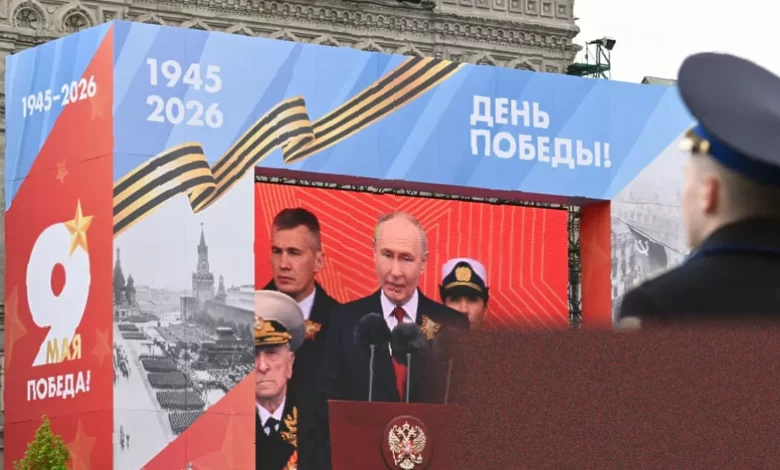
This year’s Victory Day parade was significantly scaled back due to security fears, with Moscow placed under a security blanket that included city-wide internet shutdowns and soldiers equipped with drone jammers. The absence of the customary column of missiles and armoured vehicles, a fixture since 2017, marked the most visible sign of a Kremlin on the defensive as the war in Ukraine grinds into its fourth year.
A Parade Stripped of Pageantry
Instead of the usual military hardware, guests were shown a video presentation of Russia’s drone capabilities and nuclear arsenal. The Ministry of Defence cited the “current operational situation” as the reason for omitting the vehicle column. The parade itself lasted roughly 45 minutes, about half the length of previous years, and for the first time in three years an aerial component was included, with the Russian Knights aerobatic team flying Su-30 and MiG-29 fighters followed by Su-25 jets trailing smoke in the colours of the national flag.
Heavy security blanketed the capital. Russian authorities openly acknowledged the measures were designed specifically to protect President Vladimir Putin, an admission that underscored how dramatically the calculus of a war Moscow once expected to win in weeks has shifted. Internet services were switched off across the city, and flight restrictions were imposed at Moscow airports after Ukraine launched significant drone attacks in the days before the parade. On 8 May alone, Russia reported shooting down 264 drones across more than a dozen regions, including strikes that damaged an oil refinery in Yaroslavl.
The audience was small, comprising delegations from Belarus, Kazakhstan and Uzbekistan. A column of North Korean soldiers also marched across Red Square, highlighting the deepening military alliance between Moscow and Pyongyang. The parade was the last for Sergei Shoigu as Minister of Defence; he was not reappointed to the post shortly afterwards. A pro-Kremlin commentator, Sergei Markov, wrote on Telegram that it was “a modest parade” and added, “There are still enormous challenges ahead.”
Putin’s Defiant Message
Speaking to the crowd, Putin invoked the sacrifices of the Second World War to rally support for his soldiers fighting in Ukraine. “The great feat of the generation of victors inspires the warriors carrying out the tasks of the special military operation today,” he said, using the Kremlin’s preferred euphemism for the invasion. “They stand against an aggressive force armed and supported by the entire Nato bloc. And despite this, our heroes move forward. Victory has always been and will always be ours.”
Yet this year Putin was seated not beside veterans of the Second World War, as in previous years, but flanked by soldiers who had fought in Ukraine. The war has now outlasted the Soviet Union’s entire campaign against Nazi Germany — a point Putin has repeatedly tried to blur by falsely casting his invasion as a continuation of the struggle against Nazism. Ukraine marked its own commemoration a day earlier, on 8 May, as the Day of Remembrance and Victory over Nazism, with President Volodymyr Zelenskyy using the occasion to address Russian war crimes.
The War’s Mounting Toll
It was not until the final hours before the parade that it became clear Ukraine would not disrupt the proceedings. On the eve of the event, US President Donald Trump announced that Russia and Ukraine had agreed to a three-day ceasefire and a prisoner exchange involving 1,000 individuals from each side. The ceasefire, which suspends all “kinetic activity”, is set to hold until 11 May. Ukraine had initially dismissed an earlier Russian proposal for a unilateral two-day ceasefire as a cynical ploy to shield the celebrations from drone attacks. Zelenskyy’s response came in the form of a decree laced with sardonic wit: Ukraine would “permit” Russia to hold the parade by choosing not to attack it, out of deference to a request from the US president.
Behind the rhetoric, the strain on Russia is becoming harder to conceal. After years of war-fuelled growth driven largely by mass military spending, the economy is showing signs of strain. Defence spending has surpassed social expenditures for the first time in modern Russian history. Growth has slowed sharply, with rising inflation squeezing ordinary Russians and businesses alike, while the budget deficit climbs to record highs. A tight labour market, driven by military orders and conscription, is adding to the pressures. State-linked pollsters have reported Putin’s approval rating as low as 66.7% in recent months, with trust in the president also declining, partly attributed to the internet restrictions and growing public frustration.
On the battlefield, the picture is similarly grinding. Advances have slowed, both armies showing signs of exhaustion and sustaining heavy casualties while continuing to strike each other’s energy infrastructure. Russian troops are near a standstill, with neither side appearing close to a breakthrough. Yet there is little sign that any of this is pushing Putin toward compromise. The Kremlin aide Yuri Ushakov told Russian media that Moscow sees no basis for a new round of trilateral talks with Ukraine and the US until Ukrainian forces withdraw from the Donetsk region in eastern Ukraine — a condition Kyiv has flatly rejected. Ukraine continues to hold several key cities and fortified positions in Donetsk, defended at the cost of tens of thousands of lives.
North Korea’s role has added a further dimension. Russia and North Korea signed a “Comprehensive Strategic Partnership Treaty” in June last year, which includes a mutual defence provision obligating both states to provide military assistance without delay in the event of an attack on the other. South Korea’s intelligence agency estimates that around 6,000 North Korean soldiers have been killed or wounded fighting alongside Russian forces in Ukraine. Moscow and Pyongyang are now moving towards formalising a five-year military cooperation plan for 2027-2031, which could involve technology transfers, joint production and regularised military exercises. Analysts suggest North Korea receives financial aid, military technology, food and energy in return for its support, helping it circumvent international sanctions.