Renewable energy projects are driving deep divisions across regional Victoria, pitting neighbour against neighbour and leaving communities caught between the state’s ambitious climate targets and their own sense of fairness.
For every farmer who has welcomed the transition, there is another who feels bulldozed by a process that offers little room for genuine consultation. The fault lines are most visible in the state’s west, where the steady hum of turbines and the march of transmission towers have become the defining local flashpoints ahead of November’s election.
One farmer’s story of trust and turbines
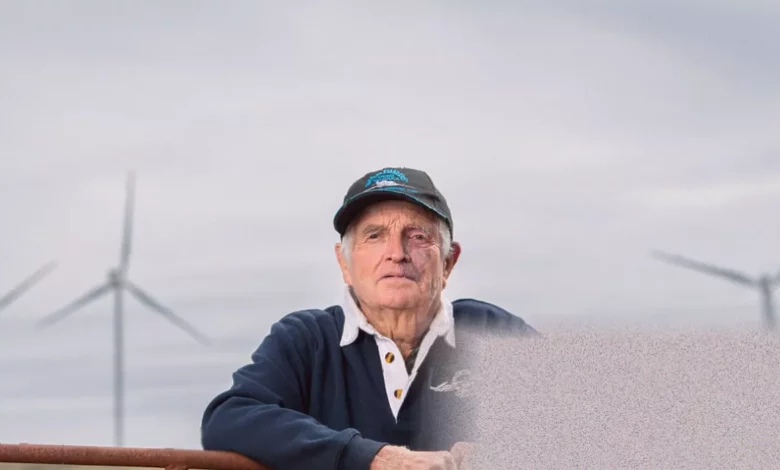
On a grazing property 90 kilometres north-west of Bendigo, Peter Watts lives with the wind. “It might be completely still down here but it’s always windy up there,” he says. For five generations that hill was just part of the landscape. Then, in 2002, scientists told him it was the perfect spot for a windfarm.
Developers came knocking a decade later with a proposal for six 95-metre turbines. After a stretch of drought, the offer of steady income was appealing. Watts signed a 33-year lease, but says it wasn’t the money that sealed it. “They were such a good group of people to deal with,” he explains. “Nothing was ever a problem. If something came up, they’d come sit down with you and work through it.”
When connection to existing Powercor lines required a substation, one was built. When access became an issue, a road was constructed on the edge of his property. Even neighbours who were, as Watts puts it, “grizzly” about the view were brought into the fold – offered about $2,500 a year for the life of the project, plus $25,000 in annual community grants. “They did the work, they got the backing of the community, and that’s what helped get it over the line,” he says.
Watts’s windfarm was among the first in the region. As Victoria pushes towards a legally binding target of 95% renewable electricity generation by 2035, and prepares for the closure of major coal-fired power stations, dozens of similar projects are now spreading across the state’s west.
A very different experience: opposition and anger
Andrew Peverill, who owns a farm in Glenloth in north-west Victoria, tells a story that is the opposite of Watts’s. His property sits in the path of VNI West, a proposed 240-kilometre transmission line that will link Victoria to New South Wales. About 2.3 kilometres of the line will cut across his land, used for broad-acre cropping and running merino sheep.
“There’s a lot of land in Australia it could go on that it wouldn’t affect much,” he says. “But it’s really good ground [here] and the further south you go, the better it gets.” Peverill supports renewable energy – like most farmers he has solar panels on his roof – but not this development. “It’s the way it’s being done,” he says.
The VNI West line will eventually connect into the Western Renewables Link, another major transmission project managed by AusNet, which links Bulgana in western Victoria to Sydenham in Melbourne’s north-west. Opposition to that project has been on display for five years near Daylesford, where a farmer has sprayed “piss off AusNet” onto a hillside.
The backlash is not limited to words. The outgoing president of the Victorian Farmers Federation, Brett Hosking, who lives in the path of VNI, says community engagement has been “woeful”. Some volunteer fire brigades have said they will not attend fires at properties hosting renewable infrastructure. Farmers have protested outside parliament and heckled Premier Jacinta Allan at a Ballarat address in 2025. Anger over a new emergency services levy added fuel to the fire, forcing the government to freeze the rate hike for farmers for two years.
Peverill was among a group of farmers who last year blocked VicGrid – the new state body created to oversee planning across six renewable energy zones – from entering their properties to carry out ecological surveys. More farmers are blocking surveys this year. VicGrid says the surveys are part of preparing an environmental effects statement, and that more than 170 landholders have allowed access since 2023, receiving payments of between $10,000 and $50,000. It has issued 26 notices of proposed entry for properties where access was refused. Under the new laws, a property owner who bars entry could face fines of up to $12,210 for obstructing access.
For Peverill, key questions about VNI West remain unanswered: how the line will affect GPS-guided farm machinery; why government payments are capped at 25 years when towers will “be here forever”; the potential fire risk; and effects on waterways. He also argues there has been little effort to follow property boundaries instead of cutting through the middle of farms. VicGrid says there are 6,500 kilometres of transmission across Victoria, most of it on farms that remain productive, and that there are no records of any turbine starting a bushfire in the state.
Even Peter Watts, whose own experience was positive, is critical of VNI. He describes it as the “opposite” of everything that made his windfarm work. “Families that have been friends for years and years have gotten to the stage where they can’t even look at each other,” he says. “That’s just not right.”
The clash between targets and landholder rights
The conflict at the heart of this story is between the government’s determination to transform Victoria’s energy system and the rights of landholders who feel their property and livelihoods are being treated as a bargaining chip.
The Allan government set its renewable energy target in 2022: 65% by 2030 and 95% by 2035, enshrined in legislation. It has also set storage targets of at least 2.6 gigawatts by 2030 and 6.3 gigawatts by 2035. The government estimates these targets will drive about $9.5 billion in economic activity and support around 59,000 jobs by 2035. The revival of the State Electricity Commission, with an initial $1 billion investment, is intended to deliver 4.5 gigawatts of publicly owned renewable power to replace the capacity of retiring coal-fired stations such as Loy Yang A.
To speed up the transition, the government created the Development Facilitation Program, which fast-tracks planning approvals for renewable projects and limits third-party appeals. Since its expansion, the program has facilitated over $7.8 billion in investment across 22 projects, creating more than 3,000 jobs. Recent approvals include a 332-megawatt solar farm in Meadow Creek, a battery storage facility in Hazelwood, and a 500-megawatt battery in the Kiewa Valley backed by Trina Solar.
But the same urgency has led to the most controversial element: legislation that allows VicGrid and its contractors to access private land without a landholder’s consent. This power, drawn from section 93 of the Electricity Industry Act 2000, has been expanded to give VicGrid broad authority to enter properties for surveys and planning. The government argues it provides certainty and aligns with other major public infrastructure projects. Critics call it a “land grab” and a “massive overreach”.
The group Farmers Fightback has characterised the transition as a plan to “make foreign billionaires much wealthier”, noting that VNI West will be built and operated by a Spanish multinational. It accused VicGrid of “the most egregious overreach” in Victoria’s history and described its attempts to access land as a “coordinated campaign of intimidation”. Another group, the Across Victoria Alliance, has staged protests including burning government information packs.
Only a few, including Tragowel farmer Craig McIntosh, have broken ranks to publicly support the project.
Recent polling commissioned by Renew Australia for All in the western Victoria renewable energy zone found 66% of those surveyed supported the transition, while 13% opposed. Many farmers are in the latter camp.
Political consequences loom
The renewable energy divide is shaping up as a defining election issue, particularly in regional seats. Labor insiders privately concede the projects could cost the party the seat of Ripon in western Victoria, which takes in most of the path of the Western Renewables Link and is held on a margin of less than 3%. Other regional seats along the two transmission routes have traditionally been Nationals heartland, but One Nation is gaining ground. Barnaby Joyce, the former Nationals MP who defected to One Nation in December, visited Horsham in February and criticised VicGrid’s expanded powers.
Coalition Shadow Energy Spokesperson David Davis says the Coalition will repeal the VicGrid bill if elected in November, describing its “draconian powers” as a “massive overreach”. He is also critical of cost overruns on VNI West but will not say whether the Coalition will continue with that project or the Western Renewables Link if it wins government.
The Allan government says it is pushing ahead. It says since 2024, 25 renewable energy projects have been fast-tracked, with decisions made in an average of four months after an application is submitted. “Only Labor will build the critical renewable energy infrastructure, including VNI West, needed to deliver cheap power and keep the lights on,” a spokesperson said.
Industry rethinks the social licence
The largest renewable development in the state is the Golden Plains windfarm, with 215 turbines across about 16,700 hectares near Rokewood. Stage one, with 123 turbines already built, generates about 4.5% of Victoria’s energy supply, or roughly 2.6 gigawatts a year. The project is a $3 billion-plus investment by TagEnergy, and is Australia’s largest wind farm to date, expected to power over 765,000 homes. A 300-megawatt battery storage facility is also part of the project.
Managing partner Andrew Riggs says host landholders were “super excited” about the guaranteed income stream, “but sometimes the neighbours aren’t happy”. That tension has forced a rethink. Over the past five years, landholder payments have risen more slowly, with money instead directed to neighbouring properties to “spread the benefits wider”. About 200 households within three kilometres of stage one receive electricity bill credits and annual payments based on proximity and impact. Within five kilometres, neighbours were offered landscaping support to screen views of turbines, or one-off payments to do it themselves. Community grants have also funded local projects in Rokewood.
Mayor of Golden Plains Shire, Owen Sharkey, says the approach helped avoid division. “That’s not to say there wasn’t opposition – there were still a few people who didn’t want it,” he says. “But broadly there was support. This was a low socioeconomic community, where the farmers were absolutely struggling. So I think it was really embraced by community for those reasons.” That helped head off the “tinfoil hats” and “uneducated debate”, he says. But the region is now in the Central Highlands renewable energy zone, and as the number of projects grows, the capacity for careful consultation wanes. “Ninety per cent of people aren’t anti renewables,” Sharkey says. “They want a say. They want input.”
Wayne Weaire, a board member at VicGrid, applied to join after his property at Bolwarrah was caught in limbo over the Western Renewables Link development envelope. “They said it would be somewhere between my property and 20km south,” he says. “I’d been around government long enough to know what was coming – so we sold. In the end, I was right.” He is now urging landholders to allow VicGrid onto their properties for surveys, because he says it is their opportunity to have their say. “The pressure is on to make sure there is energy there when the last coal power station is shut down,” he says. “And we’ve got so much to do.”
But for many in regional Victoria, the pressure feels one-sided. The government’s timeline leaves little room for the kind of patient, neighbourly negotiation that made Peter Watts’s hill a success story, and the division shows no sign of healing.