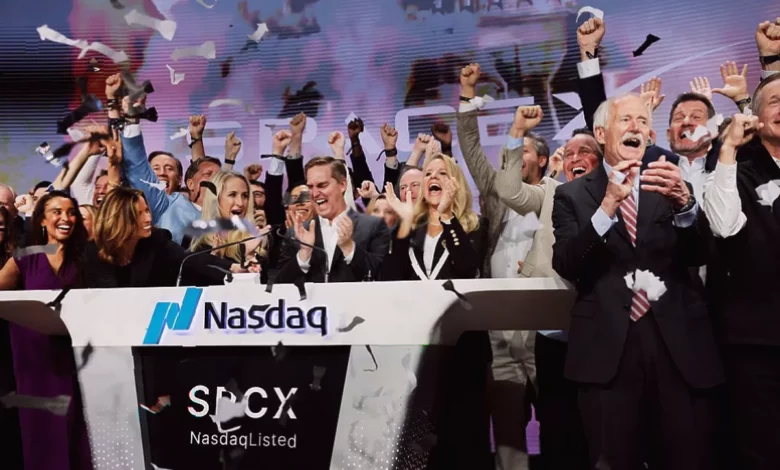
SpaceX’s initial public offering was four times oversubscribed, triggering a scramble for shares that left the vast majority of would-be investors empty-handed or with far smaller allocations than they had hoped for. The landmark listing, which raised approximately $75 billion and valued the company at $1.77 trillion, saw demand surge past $250 billion — yet only 20 per cent of the shares were set aside for retail investors globally, and the portions that reached Europe were minuscule.
In the UK, retail investors bought roughly £271.4 million worth of stock through the so-called POP operator route, with Marex Financial facilitating access. Those who applied for up to £2,013 ($2,700) received their full allocation; larger applications were scaled back. European retail investors as a whole received less than 1 per cent of the shares sold, despite strong demand. The huge mismatch between appetite and supply has left many nursing disappointment.
Jeremy Fawcett, head of the retail investment consultancy Platforum, likened the experience to the Royal Mail float in October 2013, which was seven times oversubscribed. “Royal Mail was the last big one in the UK, comparable to the government sell-offs during the move to privatisation in the 1980s,” he said. “If the amount you actually buy is significantly lower than what you’d hoped for, by the time you come to sell, taking into account trading fees and foreign exchange, you have to really think about how much you end up with. There’s a huge amount of uncertainty… if you remember the 2012 Olympics, we all applied for hundreds of tickets. And most people got nothing. So you get excited because you think, ‘I put my money on the line’, and then you get very little out of it.”
Lynn Hutchinson, head of ETF and index solutions at Charles Stanley, noted that SpaceX is “one of the most talked about stocks of the last few months” and that retail investors “quite like a new stock becoming available. Plus it’s got the ‘Elon Musk factor’ – who has a huge retail fanbase as well, albeit not across the board. Many investors have wanted access to this company for years.”
Index inclusion rules set to fuel price swings
The limited supply of freely tradable shares — a free float estimated at just 4.3 per cent to 5 per cent — is combining with fast-track inclusion into major indices to create conditions for intense volatility. “There will be an initial dash for the shares because of the limited availability,” Hutchinson said. “But after that, the next release will likely be after Q2 earnings, so more shares will likely come on between July and September, if indeed the holders (employees and early investors) decide to sell them.”
The first index funds to include SpaceX will be those tracking the Nasdaq-100. Nasdaq has amended its rules to allow fast-tracked entry 15 days after an IPO instead of the previous three-month window, and has removed minimum float requirements. Crucially, a three-times multiplier will be applied: rather than weighting the stock based on its current free-float market capitalisation of roughly $75 billion, index funds will treat it as though it had a market cap of $225 billion. This could force passive investors to chase the stock aggressively, further amplifying volatility across the entire index.
Index providers MSCI and FTSE Russell are also moving quickly. FTSE Russell will include SpaceX after five trading days, with the change effective after the market close on June 26, 2026. MSCI is expected to add the stock approximately ten trading days after the IPO, effective June 29. S&P Dow Jones Indices, by contrast, has declined to fast-track SpaceX into the S&P 500, maintaining its standard requirements for profitability and a 12-month seasoning period. That means S&P 500 tracker funds will have to wait until at least mid-2027.
Analysts at Oppenheimer have warned of “extreme stock and operational volatility” given the combination of immense retail demand and the forced buying from index funds. The scarcity of available shares means that even modest inflows from passive managers could produce outsized price moves. “It looks like it will be staged, with some released earlier, and the full lockup expiration after 180 days,” Hutchinson said. “We expect it will be staggered and therefore volatile for several months yet.”
She also cautioned clients not to get carried away by the hype, reminding them that the allocations within many tracker funds will be tiny because of the limited free float. “Perhaps as it gets further along and if the stock’s still really volatile, it might make more of a difference. But at the moment we’re looking at, in some cases, 0.2% to 1% depending on which index it’s going into because there’s not enough free-float available.”
Specialist thematic exchange-traded funds face even higher thresholds. The VanEck Space Innovators ETF (LON: JEDG), the largest space ETF by assets under management, would be a natural home for SpaceX, but it requires a minimum 10 per cent free float. Moritz Henkel, product manager at VanEck EU, confirmed the company will wait until its September review before deciding whether to add the stock. “There will be no pre-IPO or super fast-track inclusion, nor rule change,” he said. “For us, it’s more important to stick to defined rules and have a consistent rules-based exposure than to chase this early onboarding of SpaceX.”
Lock-ups, selling pressure and future catalysts
The stock’s volatility is unlikely to subside quickly, thanks to a carefully orchestrated lock-up schedule. Rather than a traditional single 180-day lock-up, SpaceX has introduced a tiered, staggered system. Regular shareholders — including employees and early investors — can begin selling in small tranches: for example, 7 per cent after 70, 90, 105, 120 and 135 days, with an additional 28 per cent permitted after Q3 earnings. The remainder unlocks at 180 days. Elon Musk and other significant investors have agreed to a far longer lock-up of 366 days, with Musk’s stake subject to performance milestones. Approximately 5.45 billion of his shares could become sellable after that period. The staggered approach is designed to meter the flow of shares onto the market and prevent a single, destabilising deluge.
The sheer scale of the listing is already forcing large institutional investors to reshuffle their portfolios. JPMorgan has estimated that roughly $95 billion worth of holdings — likely in big technology names — will be sold to accommodate new positions in SpaceX. Holly Mackay, writing on the Boring Money blog, noted: “If large investors want to buy in, they will need to free up cash by selling other holdings. They might take some profits from high-performing shares like Nvidia, so I’d expect some knock-on volatility in other shares which have had strong gains so far this year.”
SpaceX’s debut has also prompted a temporary pullback in other publicly traded space companies, as some investors switch capital to capture gains from the IPO. Analysts expect this correction to be short-lived, with the listing potentially shedding more light on the industry and attracting fresh capital.
Henkel pointed out that Elon Musk and his team have “blazed the trail, bringing a government industry into the private sphere as a commercially viable ecosystem”. The reusable Falcon boosters marked a turning point, dramatically lowering launch costs and enabling a wave of new space companies, including many that have come to market via IPOs and special purpose acquisition companies. “Much still depends on launch execution, R&D and mission reliability,” he said. “As SpaceX transitions to public markets it will essentially rerate the whole sector, bringing greater transparency, investor scrutiny and pressure to meet deadlines, amplifying its successes and failures.”
The company’s IPO prospectus placed a heavy emphasis on risk. “A couple of failed missions may only have a small impact to the balance sheet – even though they are very costly – but they’re potentially having a much larger effect on the actual stock price,” Henkel said. “Failed missions lead to decreased investor confidence in the technical abilities, which can cause you to lose trust. When we’re looking at SpaceX in the coming months and years, and capabilities of meeting deadlines, and commitments they’ve communicated to the open market, these are now more pressured because they are in the public market.”