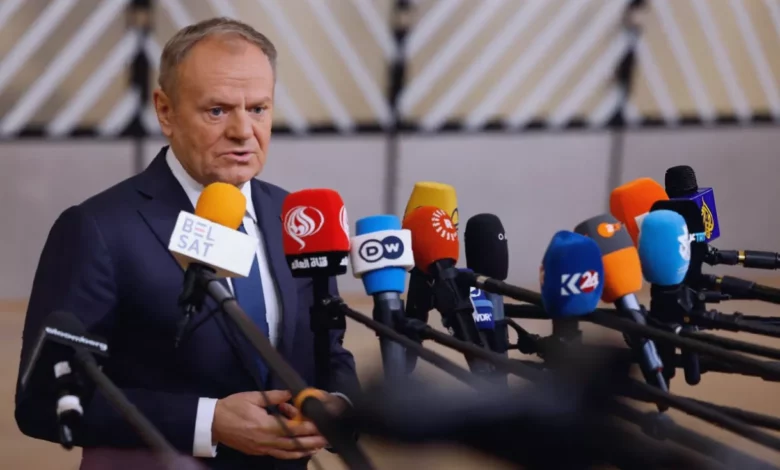
Polish Prime Minister Donald Tusk has levelled explosive allegations in parliament, claiming that a cryptocurrency company financed with “Russian money” linked to organised crime and intelligence services has been bankrolling opposition politicians and events to sway the country’s political direction.
Speaking ahead of a vote to override President Karol Nawrocki’s veto of crypto-asset market regulations, Mr Tusk asserted that the blocking of these rules was no accident. He claimed it served the interests of the firm Zondacrypto, which he said had provided financial support to politicians from the formerly governing Law and Justice (PiS) party and the far-right Confederation grouping. “The source of this company’s financial success is not only Russian money linked to the so-called Bratva, one of the most important mafia groups in Russia, but also to Russian secret services,” the Prime Minister told lawmakers.
Alleged Russian Ties and Political Payments
The “Bratva” is a collective term for Russian organised crime syndicates, with groups like the Solntsevskaya Bratva known for activities ranging from money laundering and drug trafficking to racketeering. Mr Tusk’s claim connects these criminal elements directly to a company operating within Poland’s financial sphere. Adding granular detail to the allegation, data from Poland’s Internal Security Agency (ABW) reportedly indicates that Zondacrypto’s chief executive, Przemysław Kral, made substantial payments to political foundations last autumn. According to this information, a foundation linked to former Justice Minister Zbigniew Ziobro of PiS received 450,000 PLN, while a foundation associated with Confederation MP Przemysław Wipler received 70,000 EUR around October-November 2025.
These alleged transfers occurred shortly before parliamentary manoeuvres to override President Nawrocki’s vetoes, suggesting, in the government’s view, a direct link between financial support and political action. Mr Tusk stated that when deciding to veto the new regulations, President Nawrocki was “fully aware” of the details concerning Zondacrypto.
CPAC, Foreign Endorsement, and Election Timing
The firm’s alleged political reach extended to a major international event. Mr Tusk said Zondacrypto acted as a strategic sponsor for the Conservative Political Action Conference (CPAC) held in Rzeszow, eastern Poland, in March 2025. That gathering took place just five days before a tightly contested presidential election runoff between Karol Nawrocki and the liberal candidate Rafał Trzaskowski. At the event, Kristi Noem, then the US Secretary of Homeland Security and a prominent ally of Donald Trump, openly backed Mr Nawrocki, describing his opponent as “an absolute train wreck of a leader” and urging the election of a Trumpian-style leader for Poland.
President Nawrocki, a historian and former boxer affiliated with PiS, narrowly won that election and was inaugurated in August 2025. His presidency has been marked by confrontation with Mr Tusk’s government, with a platform emphasising conservative nationalism, Christian values, and a pro-NATO but EU-sceptic stance.
Regulatory Deadlock and a Firm in Crisis
The legislative battle at the heart of the allegations concerns Poland’s implementation of the EU’s Markets in Crypto-Assets (MiCA) Regulation. MiCA, which became fully applicable in December 2024, establishes a harmonised EU framework for crypto assets. Poland’s parliament adopted the Act on the Crypto-Assets Market in September 2025 to enact these rules, which would bring the sector under the supervision of the Polish Financial Supervision Authority (KNF). However, President Nawrocki has vetoed this legislation twice in the past six months, most recently in February 2026, creating a regulatory limbo.
The government argues the new rules are essential for investor protection and EU compliance. In response to Mr Tusk’s accusations, Zbigniew Bogucki, the head of the president’s office, stated that Mr Nawrocki was not opposed to regulation in principle, but to the “flawed regulatory model” proposed by the government. Slawomir Menzen, leader of the Confederation, argued the legislation would have “destroyed the Polish cryptocurrency market.”
Meanwhile, Zondacrypto itself appears to be facing severe internal difficulties. Reports indicate the exchange is experiencing a liquidity crisis, with its bitcoin reserves having plummeted by over 99% between August 2024 and March 2026, leading to significant delays for users attempting to withdraw funds.