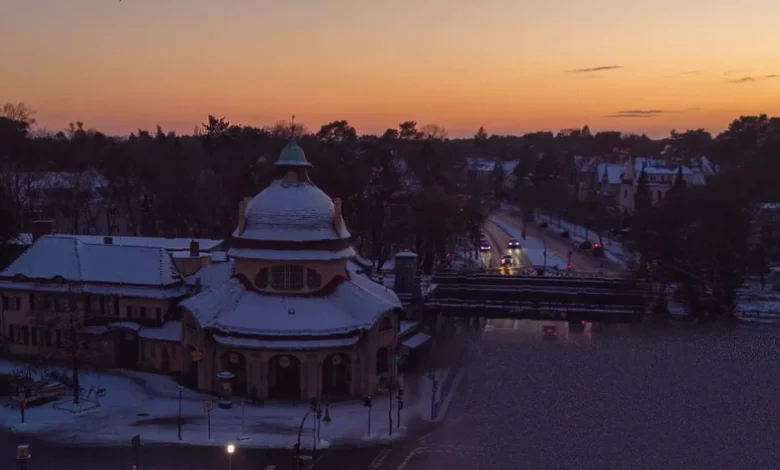
A deliberate arson attack on five high-voltage cables beneath a bridge in southern Berlin caused the German capital’s longest power cut since the Second World War, plunging tens of thousands of homes, businesses and hospitals into darkness for five days in early January.
The first to feel the consequences were the city’s hospitals. At the Immanuel hospital in the affluent Wannsee district, chief technician Sebastian Brandt woke to the smell of diesel on the morning of 3 January. The emergency generator – a deafening, decades-old machine – had kicked in, meaning the hospital had lost grid power. With around 3,000 litres of diesel on site, Brandt calculated a burn rate of roughly 550 litres per day. When the grid operator warned the outage might last until the end of the following week, he was dispatched to fetch more fuel from a petrol station still on the grid. A neighbouring hospice was preparing to move its patients to the hospital.
At the larger Hubertus hospital, director Michael Schmidt faced a graver problem. Several operations had been planned for that morning. “It was good that it happened before 8am, so no one was actually lying on the table,” he later said. Although the generator had kicked in, the heating system failed because the gas pumps supplying it were outside the hospital grounds and not connected to the emergency power. With outside temperatures around -1C, Schmidt began drawing up plans to evacuate 150 patients. The hospital’s technicians eventually rerouted power to the gas pumps, and Stromnetz Berlin, the city’s state-owned grid operator, restored electricity to all four affected hospitals by the next morning using emergency power lines. But the surrounding residential homes remained dark for five more days. Elderly residents were moved to emergency accommodation, and local news showed people angry at the lack of information.
The cause of the blackout became clear within hours. At about 6am on 3 January, someone had set fire to five 10cm-thick high-voltage cables fixed to the underside of a bridge over the Teltow canal, a waterway cutting through southern Berlin. Almost all of Berlin’s 22,400 miles of electricity cables are buried underground, but crossing water creates vulnerable points. These particular cables led from a natural gas power station and supplied about 45,000 homes, 2,200 businesses and four hospitals. A picture released by Stromnetz Berlin showed them burning brightly above a pile of debris. Power was restored to 10,000 homes by the next day, but another 35,000 waited five days – the longest continuous blackout in Berlin since the Second World War.
About 24 hours after the lights went out, a confession appeared on left-wing platforms such as Indymedia.org, which allow anonymous, untraceable uploads. The 4,500-word statement, titled “Shutting down fossil fuel power stations is handiwork. Take courage. Militant new year’s greetings”, was attributed to “Volcano Group: Turn off the juice of the rulers”. Berlin police described the statement as “authentic”. German authorities launched a terrorism investigation, and federal interior minister Alexander Dobrindt posted a reward of €1 million for information leading to arrests – ten times larger than the reward for the Islamist who killed 13 people in the 2016 Berlin Christmas market attack.
A 15-year shadow of sabotage
The blackout placed the attack in the context of a series of intermittent strikes on Berlin’s critical infrastructure over the past 15 years. At least seven “Volcano Group” attacks have been recorded in and around Berlin since 2011, the first apparently inspired by the 2010 eruption of Iceland’s Eyjafjallajökull volcano, which grounded air traffic across Europe for days. The group’s early confessions namechecked different Icelandic volcanoes: “The Roar of Eyjafjallajökull”, “The Hekla Reception Committee”, and “Anonymous/Volcano Katla”. The name “Vulkangruppe” – Volcano Group – appears to have been adopted around 2018.
Between 2011 and 2013, attacks targeted railway power lines and cable boxes. After an apparent hiatus, the group resumed in 2018, destroying power lines in Berlin’s Charlottenburg district, causing a blackout affecting about 6,500 homes and 400 businesses. In 2020, they claimed an arson attack at the Heinrich Hertz Institute, a research centre for digital infrastructure. In 2021, they damaged power cables at a transmitter tower in Grünheide, the construction site of Tesla’s first European Gigafactory. In March 2024, they burned an electricity pylon at that same factory, causing a production halt lasting several days and financial losses for Tesla “in the high nine-figure range”, according to a Tesla official. That attack was claimed by “Volcano Group shut down Tesla”. In September 2025, an arson attack on two pylons in Berlin’s Adlershof district knocked out power to a technology park housing several IT security companies; the confession resembled earlier ones in style and ideology but was not explicitly attributed to the Volcano Group.
All investigations have been taken over by Germany’s federal state prosecutor’s office, meaning they are treated as crimes endangering the functioning of the state – terrorism. According to responses given to Green party MPs in February, there are four separate federal Volcano Group investigations still in progress, the oldest dating back to 2011.
The investigation: a trail with no arrests
Not a single arrest has been made in connection with any Volcano Group attack. In 2023, two people active in the left-wing scene were arrested with flammable materials near railway lines in the Adlershof district, but the trial ended when a judge ruled there was no hard evidence against them. On 24 March, about 500 police officers raided 14 properties associated with Berlin’s far-left scene in connection with the September 2025 arson attack; no arrest warrants were issued.
Professor Hendrik Hansen, an expert in political extremism at Germany’s Federal University of Applied Administrative Sciences, said there are simply no physical clues as to who the perpetrators are. “It’s not that easy to carry out a crime without leaving DNA traces at the scene,” he noted, suggesting a high level of skill. Felix Neumann, an extremism and terrorism prevention researcher at the Konrad Adenauer Foundation, a thinktank affiliated with the conservative Christian Democratic Union, agreed: “They knew from the start what they were doing, and that’s the big difference to far-right extremists or Islamists, where we often have perpetrators who do things for the first time.”
Much of that knowhow is available on the internet. Manuals explain how to build rudimentary incendiary devices with cheap components from electronics and hardware stores, how to avoid CCTV, how to pass on tools without being noticed, and even how to remove plastic gloves without leaving DNA. They also offer guidance on recruiting people with the right psychological profile and organising cells of two or three people into highly autonomous, minimally hierarchical structures.
Given how public this information is, Hansen said it is impossible to tell whether members of such groups even know each other personally. “It could just be that they took the label and decided: we’ll do something similar.” In other words, the Volcano Group may be a franchise – an open-source label anyone can adopt if they have a can of flammable liquid and the determination to find a vulnerable spot on the power grid.
Ideology: rambling, contradictory and professional
The claim of responsibility for the January blackout was less a manifesto than a rambling blog post, full of spleen and non sequiturs. “We can no longer afford the rich,” it began. “We can trigger the end of the imperial lifestyle. We can stop the plunder of the Earth.” It declared the attack an “act of self-defence and international solidarity with all those who defend the Earth and life itself”. Unlike the earlier attacks, which focused on Germany’s participation in overseas wars, this Volcano Group had a distinctly environmentalist bent, cataloguing ecological violence inflicted by capitalism while digressing into poetic observations about digital technology: “We serve our own surveillance and it is total … We feed on the colourful pictures that machines filter and put in front of us.” The statement lacked a coherent set of principles but served as a call to arms, urging followers to sabotage fossil fuel infrastructure, power grids, server centres, chip industry, automobile and arms industries, and “the police headquarters, which are the guarantors of patriarchal property relations”.
German authorities describe the Volcano Group as a far-left, anti-fascist, anarchist organisation – a “violence-oriented anarchist” structure. Experts such as Tadzio Müller, a veteran of Berlin’s leftist climate movement, locate them within a particular strand of radical leftism called anarcho-primitivism, which has long advocated destabilising the economy through physical sabotage and has recently taken on an eco-activist tone. Müller, who co-founded the environmentalist action group Ende Gelände, said he was horrified when he heard the blackout was the work of the Volcano Group. He believes the action was a leftist one that “went horribly wrong”. The group’s statement admitted as much: “The scope of the effect on around 40,000 private homes was neither intended nor factored in. With today’s knowledge about the consequences for sections of the population, we would have moved the action to a warmer season.”
Despite this apparent remorse, the group has caused no injuries or directly attributable deaths, and public opinion has been largely hostile. Berlin’s leftist scene was virtually united in disowning them. “Historically, you never see an underground leftwing group without some kind of above-ground periphery. But here, absolutely no one on the left is defending them. That’s unusual,” said Nathaniel Flakin, a Berlin journalist and historian.
Conflicting theories and possible Russian involvement
Internet sleuths flagged oddities in the group’s German, including incorrect spellings of names such as “Vans” for JD Vance. Reddit threads reverse-engineered the text through AI translation programmes and claimed it had originally been written in Russian. A month later, the federal interior ministry admitted investigators had not ruled anything out, stating that “the federal security forces generally pursue all evidence … including that pointing to potential other groups of perpetrators as well the possible Russian authorship of the letter of confession.” Green party MP Irene Mihalic called the lack of progress “outrageous”, saying: “The investigative authorities should have enough powers to throw some light on to it. It’s interesting that they know so little.”
Some speculated about a false flag attack carried out by Russian agents with the help of Germany’s far-right Alternative for Germany (AfD), which has been officially designated as an extremist entity by Germany’s domestic intelligence agency. The theory was fuelled by questions submitted by AfD representative Frank-Christian Hansel about the safety of Berlin’s power grid. Hansel dismissed the notion as “ridiculous”, saying it was his duty as a parliamentarian to ask about resilience. The Volcano Group itself responded to the Russian rumours with a second statement on 8 January, calling such speculation “irrelevant rubbish” but acknowledging that “fake news, AI-generated reports and hybrid attacks have caused uncertainty”.
Further confusion arose on 7 January, when a statement claiming to be from the original 2011 Volcano Group appeared on Indymedia, distancing itself from the January blackout. “We wanted interruption, not escalation. Disruption of normality, not its destruction,” it said, noting their quarrel had been with Germany’s involvement in foreign conflicts and the arms industry. The 3 January Volcano Group sniped back, calling this a fake possibly planted by “intelligence agencies and/or fascists” to sow confusion and division.
No credible evidence of Russian state involvement has been produced, and Hendrik Hansen cautioned that comparing the group to the historical Red Army Faction (RAF) – an armed communist militia that carried out more than 30 killings – is far-fetched. “Just ideologically, the RAF was Marxist-Leninist-Maoist, and so stood for an idea that the revolution would bring a dictatorship of the proletariat,” he said. “That’s a completely different ideological current. Second, the RAF carried out targeted murders with guns and bomb attacks. We haven’t had that in recent attacks.” Nonetheless, interior minister Dobrindt has drawn parallels, having said in 2022 that “the emergence of a climate RAF must be prevented.”