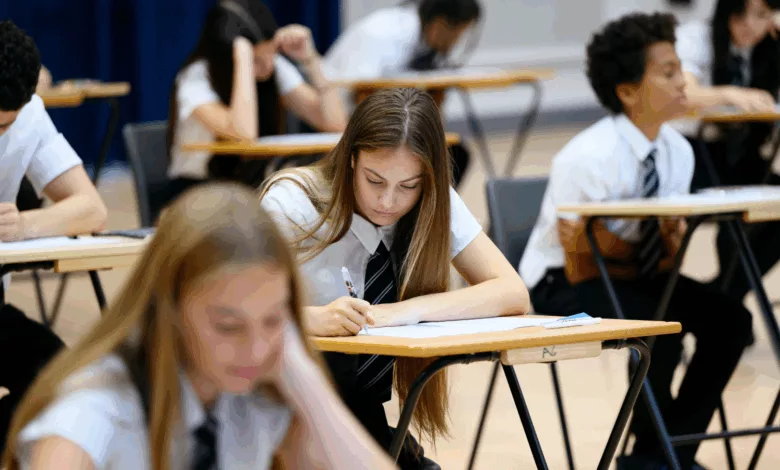
A GCSE French listening paper has ignited fresh accusations of “woke social engineering” after students were asked to translate a passage in which a speaker described their younger sister as “bisexual”. Thousands of teenagers sat the Pearson Edexcel exam this week as part of their French qualification, and the content of the audio recording – which also referred to divorced parents and an unemployed brother – has prompted a fierce debate about whether language assessments are being used to advance social and political messaging.
The listening component accounts for a quarter of a student’s final GCSE grade. Several pupils reported mishearing the word “bisexual” as “sexual” during the recording, leading to confusion and discussion after the test. One mother said her son was left “mortified” after he initially believed the recording stated “my little sister is sexual” before later concluding it likely said “bisexual”. She stressed that her son had no issue with discussions around sexuality in general. “He was mortified not at the idea that the concept of bisexuality came up, he’s Gen Z and a 16-year-old, he’s completely at home with everybody, you do you – what he was mortified by was that it was shoehorned into a French exam,” she said.
The mother questioned whether themes surrounding sexuality and family breakdown belonged in GCSE language exams at all. “At GCSE level, it should just be a functional thing that will enable you to have a nice weekend in Paris or to buy yourself something at a restaurant or not get lost. It just doesn’t feel appropriate,” she told the news website. She argued that efforts to modernise exam content risked discouraging students from taking languages altogether.
A broader row over modern themes in exam content
The controversy is the latest flashpoint in a long-running debate about the inclusion of sexuality and contemporary social issues in school assessments. Critics argue that exam boards are injecting political and social messaging into tests that have traditionally been designed to measure practical communication skills. The mother echoed this view, saying the question “comes as this massive collapse in the number of kids taking modern foreign languages, this madness is just not helping”.
Official data shows GCSE language uptake has fallen significantly since modern foreign languages stopped being compulsory. More than half as many pupils now take GCSE French compared with 2005. Around 128,000 students sat the subject in England last summer, down from 147,000 in 2015. Provisional figures for summer 2025 show French entries at 128,155, a further decrease from 130,650 the previous year. Spanish has now overtaken French as the most popular foreign language at GCSE level, and German entries have also declined.
The incident follows previous criticism of Pearson Edexcel over guidance that permits gender-neutral language in French GCSE exams despite the language’s grammatical gender structure. The board’s specifications for French, Spanish and German GCSEs for 2026 include a section on “gendered language” that allows students to use non-binary or gender-neutral pronouns and new adjectival endings according to their preferred way of identifying. The guidance is reportedly supported by the LGBT charity Stonewall.
The approach has drawn international criticism. Former French education minister Jean-Michel Blanquer called the proposals “absurd”, noting that terms such as “iel” – a gender-neutral pronoun – are not widely used in France and that the French language’s grammatical structure has not changed. L’Académie Française, the body responsible for the purity of the French language, decreed in 2017 that gender-neutral pronouns were “harmful to the practice and comprehension of the French language”.
Pearson Edexcel has confirmed that gender-neutral pronouns are not required in French, German or Spanish GCSE assessments, and that students are only assessed on standard masculine and feminine forms. A spokeswoman said the use of gendered language can present challenges for trans and non-binary students, but stressed that assessments are marked anonymously.
The row also intersects with a broader government-backed curriculum review led by Professor Becky Francis, which recommended greater diversity and representation in educational materials. The review suggested updating programmes of study to better reflect the diversity of modern society and ensuring that curricula are inclusive. It acknowledged a tension between introducing diverse content and retaining core knowledge, stating that the curriculum principle must ensure mutual access to core knowledge. Implementation can depend on the capacity and choices of individual schools and teachers, leading to potential inconsistencies.
Exam board’s defence
Pearson Edexcel defended the assessment, insisting that its exams are “developed by experienced subject matter experts and that language exams in particular are designed to represent and reflect a range of student experiences so that learners can understand and communicate effectively”. The board added: “We regularly review our content, and we will continue to do so with the French listening exam.”
Ofqual, the exams regulator, has provided guidance on exam accessibility, advising against the use of complex language and stereotypes that could disadvantage certain groups of learners. The regulator’s guidance aims to ensure assessments are fair and do not introduce unnecessary barriers for students demonstrating their knowledge and skills. The Pearson Edexcel GCSE French specification (Issue 2, May 2025) notes that listening texts will be taken from various thematic contexts and will sample vocabulary across the qualification content. Each extract is played three times with pauses to allow students time to process information and write responses.